

Reputation management is the systematic control of how information about an organisation is created, indexed, and interpreted across digital and search ecosystems. Online reputation refers to how a brand or entity is perceived through the combination of search results, reviews, social content, and media coverage that appear when its name is queried. In the context of restaurants, this reputation is not shaped by offline experience alone: it is defined by how the entity is represented and ranked on Google and other search platforms.
How does restaurant reputation begin on Google?
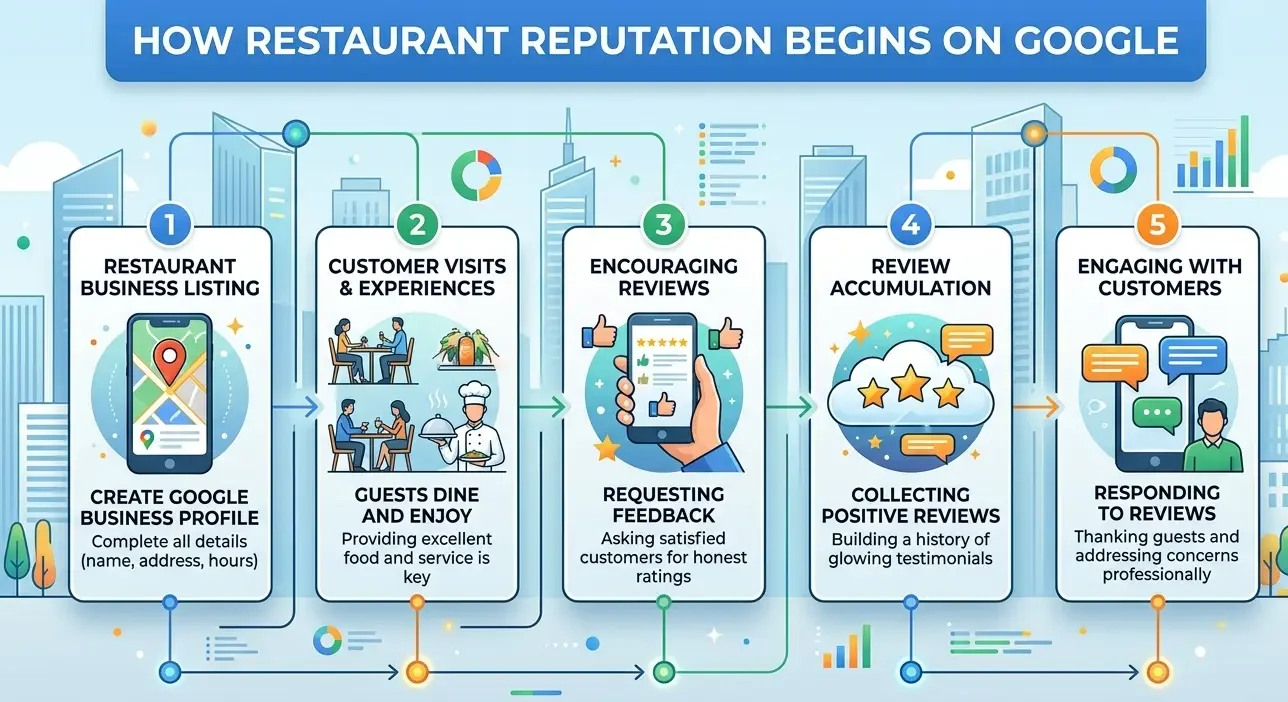
Restaurant reputation begins on Google because the search engine is the first place most consumers evaluate trust, credibility, and service quality before deciding to visit. Search visibility is not neutral; it is a reputation signal. When a diner searches for a restaurant name, the resulting SERP (search engine results page) demonstrates what information is indexed, ranked, and prioritised, and that configuration directly shapes belief.
Dive Deeper With Our Expert Guides and Related Blog Posts:
Why Hospitality Reputation Management Is the Most Review-Sensitive Sector
How TripAdvisor Review Management Affects Your Property Ranking and Revenue
Restaurant reputation on Google is formed by the combination of reviews, business information, and third‑party content that appears in search results. Each indexed signal contributes to entity perception, and search visibility determines how often and how positively that reputation is encountered.
Within search ecosystems, reputation starts with entity indexing. Google defines a restaurant as a local entity by associating its name, address, category, and contact details with structured data and citations. When consistent signals appear across multiple platforms, the search engine treats the entity as stable and credible, which increases its likelihood of appearing in relevant queries. Discrepancies in name spelling, address, or category reduce the strength of this identity signal and weaken reputation consistency.
Search also evaluates unstructured content. Independent articles, local news pieces, and blog posts about a restaurant are interpreted as reputation‑related narratives. When these items are frequently cited and linked, they reinforce the entity’s perceived relevance and authority. By contrast, sparse or conflicting coverage signals informational ambiguity, which can make the restaurant appear less established or less trustworthy to both users and algorithms.
Finally, reputation starts with user behaviour. How often people search for a restaurant, click on its listing, and apply filters (such as “open now” or “high rating”) feeds behavioural signals back into the system. Search engines interpret high engagement with detailed information—such as photos, menus, and reviews—as evidence of relevance. Over time, this pattern consolidates the restaurant’s reputation as a known, active entity within the searcher’s geography and intent cluster.
Why are online reviews part of a restaurant’s Google reputation?
Online reviews are part of a restaurant’s Google reputation because they are directly embedded into the SERP as structured, user‑generated signals that search engines evaluate when assessing entity perception. Ratings and review text are not only information for users; they are inputs that help the system rank and interpret credibility.
Online reviews contribute to a restaurant’s Google reputation by providing quantifiable ratings and contextual sentiment that appear directly on the listing. Search engines treat these signals as indicators of user satisfaction and service quality, which influence how prominently the restaurant is shown in local and branded searches.
Within search ecosystems, reviews are reputation signals. Each star rating and written review is a discrete data point that describes user experience. When aggregated, these data points form a numerical score and a corpus of sentiment that algorithms can interpret at scale. A higher average rating and a consistent volume of positive comments raise the perceived reliability of the restaurant compared with similar entities.
Search engines also analyse review text. Natural language processing techniques allow the system to evaluate recurring themes—such as cleanliness, service speed, or food quality—as indicators of performance. Negative patterns that appear repeatedly across multiple reviews are treated as systemic risk signals, while frequent positive phrases are interpreted as evidence of strength. This textual analysis complements the numeric score, providing a richer basis for reputation evaluation.
Additionally, review velocity and recency matter. A steady stream of recent reviews demonstrates that the restaurant is active and continuously engaging guests. Search systems favour entities that maintain current, up‑to‑date feedback, because stale or missing reviews create informational gaps. In this sense, the absence of reviews can be as damaging to reputation as low ratings, since both reduce perceived credibility.
How does Google interpret social media content as a reputation signal?
Google interprets social media content as a reputation signal by indexing public posts, shares, and engagement metrics that relate to the restaurant’s name or brand and using them to infer relevance, authority, and public perception. Social signals are not ranking factors in isolation, but they contribute to the broader context in which an entity is evaluated.
Social media content affects a restaurant’s Google reputation when public posts, images, and mentions are indexed and associated with its brand. Engaged, credible activity—such as user‑shared experiences and media coverage—strengthens perception, while erratic or low‑quality activity can dilute or destabilise that image.
Within search ecosystems, social media is treated as part of the digital footprint. When users share photos, tag locations, or write status updates about a visit, this content becomes searchable and linkable. If other platforms reference these social posts through backlinks or citations, Google interprets them as evidence that the restaurant is discussed in broader public discourse. This amplifies the entity’s visibility beyond the immediacy of the social platform itself.
Algorithms also analyse engagement patterns. High interaction rates—such as likes, comments, and shares—signal that the audience treats the content as meaningful. When such activity is associated with positive sentiment, it reinforces the perception that the restaurant is popular and well‑regarded. Conversely, low engagement or negative commentary can indicate diminished relevance or declining interest, even if the raw volume of posts is high.
Finally, social media contributes to SERP narratives. Articles that reference trending social conversations about a restaurant may be indexed and shown alongside the restaurant’s listing. In this way, social activity becomes a secondary layer of reputation content that search systems can evaluate when constructing entity perception. A consistent pattern of positive, publicly accessible social signals strengthens the coherence of that reputation.
What role does press and media coverage play in restaurant reputation on Google?
Press and media coverage play a role in restaurant reputation on Google by generating authoritative, third‑party content that search engines treat as high‑credibility signals when evaluating entity perception. News articles, features, and local reporting are not direct endorsements, but they are treated as strong indicators of notability and relevance.
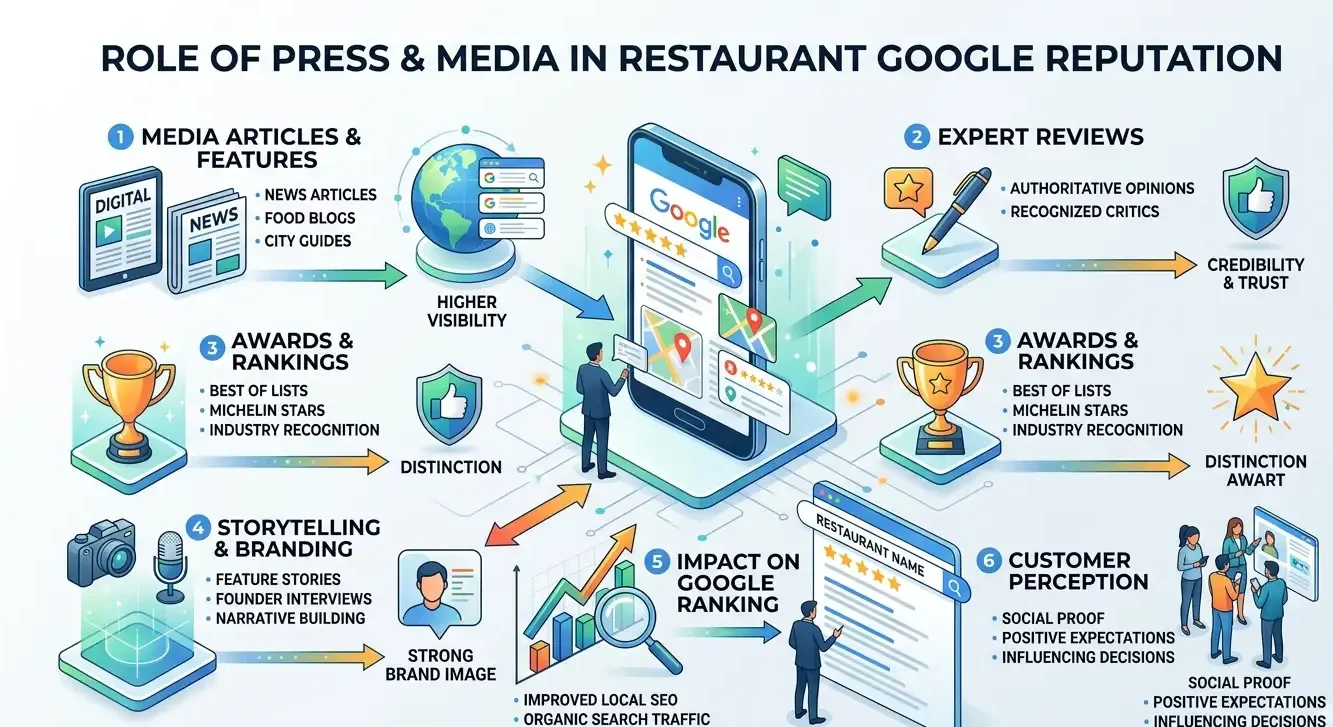
Media coverage shapes a restaurant’s Google reputation by creating externally validated content that Search indexes and ranks. Articles that mention the restaurant’s name, location, and offering increase its perceived authority and help search engines position it as a credible, established entity within the local landscape.
Within search ecosystems, press coverage is source‑credibility content. Reputable outlets are given higher trust weight in content indexing, so mentions or features in well‑known publications are interpreted as signals of external recognition. When these references include consistent, accurate information about the restaurant, they reinforce the entity’s factual profile and reduce informational ambiguity.
Search engines also track how often a restaurant is mentioned across different domains. A pattern of repeated coverage in multiple outlets signals sustained relevance and sectoral importance. This coverage can be amplified when other websites link back to these articles, creating a web of interlinked references that further strengthens the restaurant’s perceived authority.
Finally, media narratives influence SERP perception. Headlines and article summaries that accompany search results convey a narrative about the restaurant’s position in the market—whether it is a new arrival, a long‑standing favourite, or a controversial venue. These narratives do not alter the business’s factual data, but they shape how users interpret the entity’s reputation when they scan the SERP.
How does a restaurant’s digital footprint shape its reputation across search?
A restaurant’s digital footprint shapes its reputation across search by consolidating all indexed information—listings, reviews, social content, and media coverage—into a distributed perception of the entity. The footprint is not a single profile; it is the collective set of signals that appear whenever the restaurant is searched on Social Media and Press.
A restaurant’s digital footprint encompasses every indexed page, review, and mention associated with its name. Search engines use this footprint to construct a coherent view of trust, authority, and relevance, which determines how the restaurant appears and is interpreted in SERPs.
Within search ecosystems, the digital footprint is reputation evidence. Each website, directory listing, or social profile that references the restaurant contributes one piece to the overall puzzle. When these pieces are consistent—same name spelling, address, and category—they reinforce the entity’s identity. Inconsistencies introduce informational noise, which algorithms may interpret as instability or low credibility.
Content indexing also distinguishes between primary and secondary sources. The restaurant’s own site, Google Business Profile, and booking platforms are treated as core information sources. Third‑party content, such as review sites and local guides, is treated as interpretive commentary. Search systems combine these layers to form a composite reputation, weighting primary sources more heavily but still incorporating the sentiment and context of secondary references.
Over time, the digital footprint evolves as new content is published and older content is updated or removed. Search engines monitor this evolution through crawling and indexing cycles, adjusting entity perception based on what is current and what is no longer available. A well‑maintained digital footprint, with up‑to‑date information and active engagement channels, signals ongoing relevance and operational stability, which positively influences reputation in search.
What conceptual insights does this reveal about search‑based reputation?
Search‑based reputation is not a direct reflection of reality; it is a representation reconstructed from the indexed signals that surround an entity. Reputation management, therefore, is the practice of aligning how information is created, structured, and interpreted across search ecosystems. Online reputation refers to the sum of those signals as they appear in SERPs, reviews, social media, and media content.
Search engines evaluate reputation through mechanisms that combine structured data (such as ratings and business information), unstructured content (such as reviews and articles), and behavioural inputs (such as clicks and searches). Each of these layers contributes to entity perception, and together they determine search visibility and informational prominence. A restaurant’s digital footprint—the aggregate of listings, posts, and coverage—acts as the raw material from which this perception is constructed.
Finally, reputation in search is systemic, not static. It shifts as new content is indexed, existing content is updated, and user behaviour changes. Understanding these dynamics allows entities to see reputation less as a marketing problem and more as an information‑architecture problem: one that concerns how data is organised, indexed, and interpreted in the broader search ecosystem.
FAQs
What is restaurant reputation management on Google?
Restaurant reputation management on Google refers to how a venue’s listings, reviews, and related content appear and are interpreted in search results. It involves monitoring and influencing how search engines rank and present reputation signals such as ratings, descriptions, and review sentiment.
Why does how a restaurant appears on Google matter for reputation?
How a restaurant appears on Google shapes search visibility, perceived credibility, and entity perception before a guest ever visits. Strong, consistent information across Google Business Profile, reviews, and local content helps position the venue as trustworthy and relevant in branded and category-based queries.
How does Google use reviews in restaurant reputation management?
Google treats reviews as structured reputation signals that affect how prominently a restaurant shows up in local search and maps. Review volume, average rating, and sentiment patterns all contribute to how search engines evaluate the restaurant’s trustworthiness and relevance.
Do social media and press coverage affect restaurant reputation on Google?
Social media activity and press coverage can influence restaurant reputation on Google when public posts and news articles are indexed and linked in search results. Mentions across credible outlets and engaged social content help reinforce the restaurant’s authority and perceived presence in the local market.
How can a UK‑based reputation agency help with restaurant reputation management?
A UK‑based reputation‑focused agency can help align a restaurant’s digital footprint so listings, reviews, and off‑site content present a coherent and credible image. Support typically includes guidance on how to manage online reputation signals across Google, social platforms, and media to strengthen how the restaurant appears in search.