

Trustpilot review management differs from Google review strategy because each platform uses different reputation signals, moderation rules, and search visibility effects. Online reputation control methods are evaluated through how they shape sentiment distribution, entity credibility, and SERP composition across distinct trust environments.
How do Trustpilot and Google shape reputation differently?
Review management service shape local search visibility, while Trustpilot shapes third-party credibility and comparison behaviour.
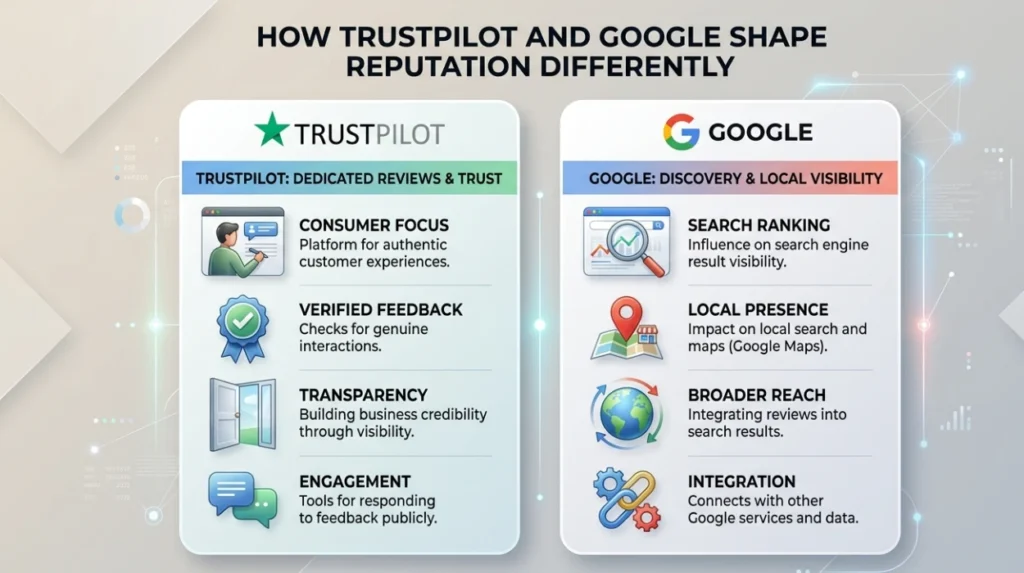
Google reviews are embedded inside Google Business Profiles and influence local pack rankings, map visibility, and click-through behaviour. Trustpilot operates as an independent review domain that often ranks for branded searches and comparison queries.
Dive Deeper With Our Expert Guides and Related Blog Posts:
What the Fake Google Review Removal Process Involves Step by Step in the UK
What Evidence You Need to Report Fake Google Reviews Successfully
That difference matters because Google review signals feed directly into local search performance, while Trustpilot reviews contribute more strongly to external trust signals. Search engines interpret both through relevance and authority, but the context differs. Google reviews affect platform-native visibility. Trustpilot affects cross-platform perception and branded SERPs. This distinction defines why the two strategies do not use the same management logic.
The reputation impact also differs by user journey. Google reviews often shape immediate local action such as calls, directions, and bookings. Trustpilot reviews more often shape research-stage judgement, especially where users compare providers before purchase. That means Google review strategy focuses on operational responsiveness and local credibility. Trustpilot review management focuses on narrative control, complaint handling, and profile quality across a broader trust environment. Both influence entity credibility, but they do so at different stages of decision-making. The platform architecture determines the management approach.
What are the key platform differences?
- Optimise Google review responses to influence local search signals and recent sentiment distribution.
- Manage Trustpilot replies to shape profile trust, complaint interpretation, and comparative reputation.
- Track Google Business Profile visibility because star ratings affect map and local pack performance.
- Analyse Trustpilot ranking influence because review volume and score affect branded search perception.
- Differentiate response strategy by platform because each system rewards different reputation signals.
Which platform has stronger search visibility influence?
Google has stronger direct search visibility influence because its reviews sit inside the search ecosystem and affect local result presentation immediately.
Google review strategy affects ranking through proximity, relevance, and prominence signals tied to the business profile. That means review volume, recency, and response quality can influence local pack placement and user engagement. Trustpilot, by contrast, usually exerts influence through organic ranking on branded and comparison terms. It often appears as an external authority layer rather than a native local ranking factor. This makes Google review signals more immediate for local intent and Trustpilot more important for broader trust perception. The difference is structural rather than cosmetic.
Google also benefits from platform integration. Reviews appear alongside maps, opening hours, directions, and business data. That creates a direct action path. Trustpilot does not operate inside that same local conversion framework. It influences evaluation, but not the same type of search result interaction. As a result, Google review management tends to deliver more measurable local visibility effects. Trustpilot review management tends to deliver stronger third-party credibility effects. The decision depends on whether the business needs local search control or external trust reinforcement.
How do moderation and removal rules differ?
Trustpilot moderation is stricter around content policy, while Google review removal depends heavily on policy breach, account authenticity, and platform enforcement thresholds.
Trustpilot is built around an independent review framework that includes fraud detection, guideline enforcement, and visible public replies. Its moderation model concentrates on review authenticity, abusive language, conflict of interest, and platform rules. Google review removal works through policy violations such as spam, off-topic content, hate speech, harassment, or fake engagement. Both platforms allow reporting, but the criteria and enforcement speed differ. Trustpilot often focuses on marketplace trust and review legitimacy. Google focuses on local listing integrity and user-generated content quality. That creates different tactical options for reputation managers.
The practical difference is that Trustpilot often functions as a reputation ledger with high visibility around complaint patterns. Google often functions as a local ranking and conversion asset with fast consumer impact. A false review on Google can affect local intent quickly. A negative Trustpilot profile can affect broader pre-purchase research and comparison behaviour. Moderation therefore changes not only content status but also search perception influence. The same complaint behaves differently depending on where it appears. That is why removal strategy cannot be copied across platforms without adjustment.
Which strategy is more reactive and which is more proactive?
Google review strategy is usually more reactive, while Trustpilot management is often more proactive.
Reactive strategy responds to individual reviews, rating drops, and visible service complaints. That makes sense because Google reviews are tightly connected to live customer behaviour and location-based discovery. Teams monitor responses, flag policy breaches, and repair recent sentiment quickly. Trustpilot management is often more proactive because profile structure, review acquisition patterns, and complaint handling shape long-term credibility. It rewards consistent review flow, response discipline, and visible resolution patterns. Proactive management therefore builds reputation signals before a crisis becomes visible. The difference lies in timing and platform behaviour.
Reactive work has speed but limited durability. It addresses the immediate review event and the visible response around it. Proactive work has stronger sustainability because it changes the review environment before negative sentiment dominates. Trustpilot especially rewards this because profile quality and response history influence perception over time. Google also benefits from proactivity, but its local search context places greater weight on recent experience. That means Google needs faster correction cycles. Trustpilot needs steadier reputation architecture. The two systems overlap but do not behave the same way.
Which platform is better for long-term reputation control?
Trustpilot is usually better for long-term third-party credibility control, while Google is better for immediate local perception management.
Trustpilot operates as an external review platform that persists in branded search results and comparison research. That gives it strong value for long-term narrative influence. Users often treat Trustpilot as a summary source for reliability and complaint handling. Google, in contrast, moves faster with recency and proximity signals. Its reputation impact is stronger for current local behaviour and near-term conversions. Long-term control therefore depends on whether the goal is broad trust architecture or local search conversion. The two outcomes are related but not identical.
Trustpilot’s advantage is durability in the research phase. It often ranks well for company-name searches and review-led comparisons. That means a poor profile can shape perception across the entire evaluation cycle. Google’s advantage is immediacy. It can influence what users do right now through maps, calls, and directions. For sustained reputation control, Trustpilot often requires more narrative management because it acts as a public trust archive. Google requires more operational responsiveness because it reflects recent consumer experience. Each platform therefore serves a different stage of the reputation lifecycle.
How do content suppression and content enhancement differ across platforms?
Content suppression reduces the visibility of damaging material, while content enhancement strengthens positive or neutral material to shift the balance of reputation signals.
Suppression is effective when harmful pages or review summaries already rank in visible positions. It operates by reducing the prominence of negative content through deindexing, removal, or ranking competition. Enhancement works by increasing the visibility of credible content, strong profiles, and authoritative mentions. On Google, suppression often involves managing review replies, profile completeness, and local prominence. On Trustpilot, enhancement relies on more active profile management, review acquisition, and public response quality. The mechanism is similar but the execution changes by platform. Both are designed to influence SERP composition and trust interpretation.
Suppression is strongest when a visible negative result has disproportionate search ranking influence. Enhancement is stronger when the goal is to rebuild entity credibility over time. In practice, Google review strategy benefits from both because local search is highly sensitive to recent signals. Trustpilot benefits from enhancement because users read it as a reputation summary. That means content strategy must follow platform intent. A generic response plan loses effectiveness. A platform-specific approach aligns better with search behaviour and user judgement.
How do the two approaches compare?
- Suppress damaging Google reviews where policy breaches exist, because removal changes local visibility directly.
- Enhance Google review volume and response quality, because recent sentiment supports local perception.
- Suppress policy-violating Trustpilot reviews, because removing false or abusive content improves profile trust.
- Enhance Trustpilot credibility with consistent replies, because visible engagement improves perceived accountability.
- Measure both platforms separately, because each produces different trust signals and search outcomes.
Which response patterns improve credibility most?
Clear, timely, and specific responses improve credibility most because they demonstrate accountability and reduce uncertainty around negative sentiment.
Google responses often influence local consumer judgement by showing whether a business resolves problems quickly. Trustpilot responses influence broader brand trust by showing whether the organisation handles criticism in a public, transparent way. The mechanism is similar but not identical. In Google, the reply can support local conversion and mitigate a low rating’s impact. In Trustpilot, the reply can shape the overall narrative around service quality and complaint handling. Response content therefore acts as a reputation signal in both systems. The difference is the context in which users read it.
The strongest responses avoid generic language and address the specific issue. That reduces perception of defensiveness and increases credibility. It also signals that the organisation understands the complaint rather than simply monitoring the rating. On Trustpilot, this matters because users often compare response quality across competitors. On Google, it matters because the reply sits next to the review in local search. A strong response can partially offset negative sentiment distribution. It rarely removes the original review effect, but it changes how the audience interprets it.
Which platform carries greater risk exposure?
Trustpilot carries greater brand-wide research risk, while Google carries greater local conversion risk.

Trustpilot risk comes from its role as a third-party summary source. A negative profile can influence purchase comparisons, branded searches, and word-of-mouth verification. That creates broad reputation exposure because users encounter the platform before they commit. Google risk is more immediate in local search and map-based discovery. A poor Google review profile can reduce clicks, calls, and visits. The exposure is narrower in scope but faster in effect. That makes Google a critical operational risk surface for location-based businesses.
The difference also affects prioritisation. If the objective is to protect local traffic and footfall, Google review management takes priority. If the objective is to protect brand credibility during evaluation, Trustpilot management takes priority. Both contribute to reputation signals, but not equally. The better strategy depends on where the business loses trust first. That is why comparison matters. Without platform-specific analysis, review management becomes reactive and inefficient.
What is the most effective combined approach?
The most effective combined approach is to manage both platforms separately while aligning their response structures, sentiment monitoring, and escalation thresholds.
Combined management works because Trustpilot and Google influence different parts of the search and trust ecosystem. Google shapes local discovery, while Trustpilot shapes external validation. A combined approach tracks rating trends, review content, and response quality on both platforms. It also aligns issue resolution across channels so that user experience stays consistent. That improves entity credibility because the same organisation is not telling two different stories in two different trust environments. The approach is stronger than platform-only management because it recognises how users actually evaluate businesses.
The limitation is operational complexity. Different moderation rules, reply patterns, and ranking effects require different tactics. A single workflow fails to capture those distinctions. That is why the strongest review strategy combines measurement, response discipline, and reputation signal analysis. It evaluates each platform on its own terms while keeping the broader narrative aligned. For hospitality and travel businesses, that distinction matters even more because customer experience, public reviews, and search visibility interact closely.