

Reputation management is the systematic practice of influencing how an entity is perceived across search ecosystems. Online reputation refers to the aggregate set of indexed signals, content, reviews and entity associations that determine what searchers find about an individual or organisation.
Search visibility is the measurable presence of specific pages, snippets and entities on search engine results pages (SERPs) for relevant queries. Within search ecosystems, search visibility refers to the probability that a user will encounter particular content when querying a name, brand or topic.
Search engines crawl and index web pages, then rank them by relevance and authority using algorithms that combine content relevance, backlink profiles, structured data, and behavioural engagement. Ranking components convert raw content into visibility signals; for example, a high-frequency, top-ranked page creates repeated exposure and becomes a primary reputation signal associated with an entity. SERP features—knowledge panels, featured snippets, reviews—surface condensed reputation information independent of page rank.
When high-authority pages present consistent, credible information, they suppress alternative narratives by occupying prime SERP real estate. Conversely, highly visible negative content elevates adverse entity perception. Search visibility therefore functions as the gatekeeper of reputation information, controlling which signals are accessible and salient to searchers.
How do search engines interpret credibility and trust for reputation signals?
Credibility is a quantifiable attribute that search ecosystems assign to pages and entities based on signals that correlate with trustworthiness. Within search ecosystems, credibility refers to combined algorithmic judgments derived from links, citations, content quality and contextual entity associations.
Mechanism (how it works): Algorithms evaluate source authority (backlink profile quality, domain history), content signals (expertise, topical depth, structured markup), and behavioural data (click-through rates, dwell time). Additionally, entity recognition systems map content to canonical entities using knowledge graphs and schema. Signals labelled as trust indicators include verified structured data, consistent NAP (name, address, phone) information, and corroborating citations across independent authoritative domains. Negative signals—spam patterns, sudden backlink spikes, contradictory citations—reduce perceived credibility.
Build stronger online credibility with professional Corporate Reputation Management that enhances trust signals, authoritative entity associations, and positive search visibility. Strategic reputation management helps businesses improve SERP perception by strengthening credible content, verified citations, and high-authority digital presence.
What define reputation signals and how are they interpreted?
Reputation signals are indexed objects—pages, reviews, citations, metadata and links—that collectively inform entity perception. Within search ecosystems, reputation signals refer to any retrievable datum that algorithms and users interpret as evidence about an entity’s behaviour, competence or reliability.
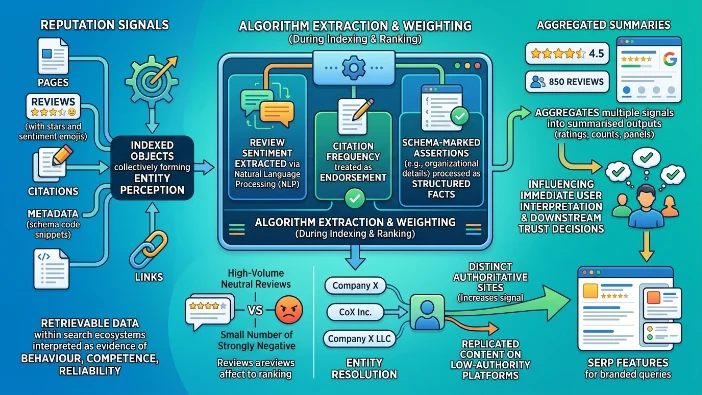
Algorithms extract and weight signals during indexing and ranking. Examples include review sentiment extracted via natural language processing, citation frequency treated as endorsement, and schema-marked assertions (e.g., organisational details) processed as structured facts. Signals interact: high-volume neutral reviews produce a different ranking outcome from a small number of strongly negative reviews. Search systems normalise and disambiguate signals using entity resolution; identical mentions on distinct authoritative sites increase signal strength more than replicated content on low-authority platforms.
Prominent reputation signals shape the snippets and SERP features that appear for branded queries. Search engines aggregate multiple signals into summarised outputs (ratings, review counts, knowledge panels), thus influencing immediate user interpretation and downstream trust decisions.
How does content indexing influence what people find about an entity?
Answer: Content indexing determines which representations of an entity are included in the searchable corpus and therefore available to shape entity perception.
Definition: Content indexing is the process by which search engines discover, parse and store web content for retrieval in SERPs. Within search ecosystems, content indexing refers to the conversion of live web content into structured entries accessible to ranking algorithms.
Mechanism (how it works): Crawlers fetch content and follow links to map the web graph. Parsers extract textual content, metadata and structured markup; indexing pipelines tokenise and associate content with entities in a knowledge graph. Index freshness, canonical tags, and robots directives alter inclusion and weighting. Content subject to removal protocols or limited by access controls will not contribute to index-based reputation signals.
Impact on search visibility or perception: Indexed content determines the set of candidate items that can occupy prominent SERP slots. If problematic content remains indexed and ranks, it continues to act as a reputation amplifier. Conversely, de-indexing or re-categorisation (e.g., archiving behind paywalls) reduces visibility and the content’s ability to influence entity perception.
How do review signals and sentiment analysis shape online reputation?
Answer: Review signals and sentiment analysis quantify public evaluation and feed directly into reputation scoring within search ecosystems.
Definition: Review signals refer to ratings, review text and reviewer metadata indexed by search engines and platforms. Sentiment analysis is the automated extraction of positive, neutral or negative orientation from text. Within search ecosystems, these elements refer to the collective evaluative evidence that algorithms use to characterise reputation.
Mechanism (how it works): Algorithms parse review data, extract sentiment scores using natural language processing, and aggregate scores into visible metrics such as average ratings. Reviewer authenticity signals (account age, behaviour, cross-platform presence) modulate the weight assigned to individual reviews. Platforms expose review aggregates via structured data (schema.org ratings) which search engines index and use to generate SERP features.
Impact on search visibility or perception: Positive aggregates and rich review snippets increase perceived credibility and click-through potential in SERPs. Negative sentiment, particularly on high-authority platforms, creates conspicuous signals that lower trust metrics in search evaluations. Consequently, review landscapes act as immediate reputation indicators that affect both ranking decisions and user evaluations.
How does entity perception emerge from the digital footprint?
Answer: Entity perception emerges from the sum of indexed content, interlinking relationships and structured entity data across the web.
Definition: Digital footprint is the collection of all online traces—pages, mentions, social profiles, reviews and backlinks—associated with an entity. Within search ecosystems, digital footprint refers to the dataset that entity-resolution systems use to construct a canonical representation.
Mechanism (how it works): Entity resolution algorithms correlate mentions, disambiguate identities and construct knowledge graph entries. Signals such as co-occurrence with defined attributes (locations, job titles), consistent schema markup, and cross-platform corroboration strengthen an entity’s canonical profile. Link graphs reveal endorsement patterns that tie disparate content to the entity, while temporal signals indicate whether information is current or outdated.
Impact on search visibility or perception: A coherent, extensive digital footprint consolidates entity perception into fewer, higher-authority SERP assets. Fragmented or contradictory footprints lead to ambiguous SERP presentations, increasing the chance that undesirable content surfaces. Search ecosystems prioritise connected, corroborated entity representations when presenting summarised reputation outputs.
Dive Deeper With Our Expert Guides and Related Blog Posts:
What Is Reputation Management and Why Does It Matter Online
How Your Business Reputation Affects Customer Trust and Revenue Growth
How do authority and trust signals interact to influence SERP evaluation?
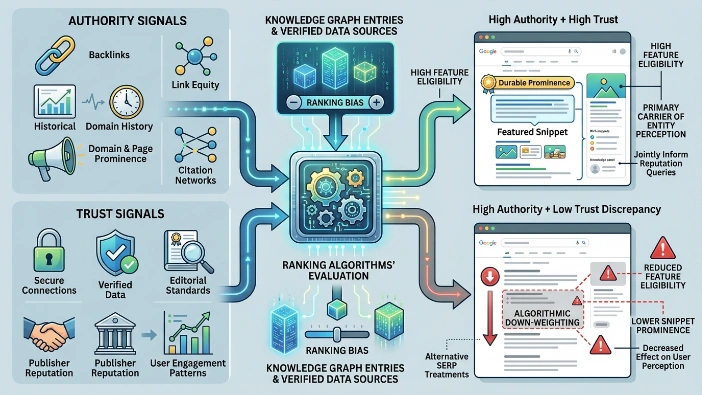
Authority signals are measures of domain and page prominence (backlinks, domain history). Trust signals are indicators of reliability (secure connections, verified data, editorial standards). Within search ecosystems, authority and trust jointly inform ranking algorithms’ evaluation of content suitability for reputation queries.
Ranking models incorporate authority metrics (link equity, citation networks) and overlay trust heuristics (content accuracy, publisher reputation, user engagement patterns). Knowledge graph entries and verified data sources supply high-trust anchors that alter ranking bias. The presence of both high authority and high trust creates durable prominence in SERPs, while discrepancies—high authority with low trust—trigger algorithmic down-weighting or result in alternative SERP treatments.
Impact on search visibility or perception: Content that unites authority and trust becomes the primary carrier of entity perception in SERPs. Content lacking trust signals—despite authority—faces reduced feature eligibility and lower snippet prominence, decreasing its effect on user perception.
For more information explore:
Comparing Online Reputation Management Approaches for UK Businesses
How do different types of content (static, dynamic, user-generated) affect reputation signals?
Static content is relatively unchanging (official pages, archived reports), dynamic content updates frequently (news, blog posts), and user-generated content includes reviews and forum posts. Within search ecosystems, these types refer to distinct classes of indexed material that supply reputation evidence.
Crawlers prioritise dynamic content for freshness signals, indexers assign higher temporal relevance, and algorithms weigh user-generated content by platform authority and reviewer credibility. Static pages supply stable entity facts that anchor knowledge graph entries, while dynamic and user-generated content provide sentiment and context that modify perception over time.
Impact on search visibility or perception: Static authoritative pages create long-term reputation anchors in SERPs. Dynamic content can rapidly shift entity perception through news cycles and trending queries. User-generated content aggregates as social proof and influences short-to-medium-term reputation metrics. The combined mix dictates both the stability and responsiveness of an entity’s online reputation
What is corporate reputation management and why does it matter?
Corporate reputation management defines the set of activities that monitor, evaluate and shape an organisation’s public standing across search ecosystems. It matters because indexed reputation signals, review aggregates and SERP visibility directly affect stakeholder trust, investor evaluation and customer decision-making.
How do review signals affect corporate reputation in search results?
Review signals refer to ratings, review text and reviewer metadata indexed by platforms and search engines. Search systems aggregate sentiment and reviewer provenance to generate visible metrics (average ratings, review snippets) that influence click behaviour and perceived credibility.
How does content indexing determine what people find about a company?
Content indexing converts web pages, metadata and structured data into retrievable entries within search indexes. Indexed items become candidate assets for SERP features and knowledge panels, so indexed negative content retains reputational influence until re-indexed or de-prioritised.
Which authority and trust signals most influence SERP evaluation for corporate queries?
Authority and trust signals include high-quality backlinks, domain history, verified structured data and consistent entity information across authoritative sources. Search algorithms combine these signals to adjust ranking weight and feature eligibility, thus determining which content anchors corporate perception.