

Reputation management is the practice of analysing and influencing how an organisation or individual is represented within search ecosystems. Online reputation refers to the collection of indexed content, review signals, and algorithmic inferences that define an entity’s public standing on search engine results pages (SERPs).
A reputation management agency evaluates and influences the set of reputation signals that search engines use to form entity perception. The agency maps an entity’s digital footprint, audits indexed content and review signals, creates a remediation plan for negative reputation signals, implements content and technical interventions, and monitors ongoing SERP evaluation to measure changes in search visibility.
The agency conducts an entity audit (content inventory, backlink profile, review aggregation, social signals), defines priority reputation signals, implements content creation, suppression strategies, metadata and schema adjustments, and coordinates review management to influence indexing and ranking behaviours.
Interventions change what search engines index and surface, alter SERP composition, adjust snippet content through metadata and structured data, and shift entity perception by creating high-quality, authoritative signals that search algorithms weight more heavily.
How is reputation formed in search engines?
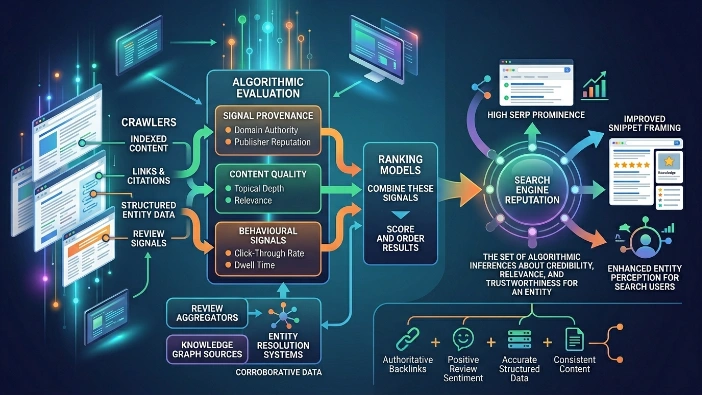
Reputation in search engines is an emergent property derived from indexed content, link and citation patterns, review signals, and structured entity data. Reputation is the set of algorithmic inferences search engines make about credibility, relevance, and trustworthiness for an entity.
Crawlers index pages and extract content, metadata, structured data, and links. Algorithms evaluate signal provenance (domain authority, publisher reputation), content quality (topical depth, relevance), and behavioural signals (click-through rate, dwell time). Review aggregators and knowledge graph sources provide corroborative data that feed entity resolution systems. Ranking models combine these signals to score and order results.
The combination of authoritative backlinks, positive review sentiment, accurate structured data, and consistent content increases SERP prominence and improves snippet framing, thereby enhancing entity perception for search users.
How do search algorithms interpret trust and credibility?
Search algorithms interpret trust and credibility through signal provenance, content authority markers, and corroboration across independent sources. Algorithms evaluate the source history, cross-referencing entity attributes and third‑party endorsements to determine trustworthiness.
Algorithms assess provenance through domain history, editorial signals, inbound citation quality, and publisher-level reputation. Structured data (for example, organization schema and verified profiles) reduces entity ambiguity. Cross-source agreement—consistent facts across high-authority platforms—triggers higher trust weights. Machine-learned models extract semantic patterns and penalise content with contradicting signals or low provenance.
Higher trust scores increase the probability of top-ranking placements and favourable SERP features (knowledge panels, featured snippets). Lower trust scores depress visibility and increase the chance that corrective or third‑party content outranks the entity.
How does content influence entity perception in search results?
Content defines the narrative available to algorithms and users; high-quality, semantically aligned content defines the entity’s topical footprint and influences entity perception. Content is the primary medium through which reputation signals are expressed and measured.
Search engines parse content to extract named entities, topical relationships, and sentiment signals. Semantic frameworks and latent topical models determine topical relevance and depth. Content with clear citations, expert signals, and structured markup registers as higher-quality material. Negative content concentrated on high-authority domains generates durable adverse reputation signals due to strong provenance.
Authoritative, comprehensive content increases topical coverage and displaces negative snippets in SERPs. Conversely, thin or contradictory content fragments entity perception and enables negative or third‑party narratives to dominate ranking positions.
What role do review signals and sentiment play?
Review signals and sentiment provide explicit user-generated indicators that algorithms incorporate into reputation scoring and SERP features. Reviews act as direct reputation inputs with measurable sentiment polarity and source weight.
Aggregators collect review data from multiple platforms and normalise scores. Algorithms evaluate score distributions, review velocity, and reviewer provenance to detect manipulation. Textual sentiment analysis extracts polarity and topic-level complaints or praise, which inform entity-level sentiment profiles. Consistent negative sentiment from authoritative review sources increases adverse weighting in ranking models.
Strong, corroborated positive review signals enhance prominence in local packs and review-rich SERP features. Negative sentiment across trusted platforms reduces click-through rates and informs snippet selection, shaping user perception before click.
Enhance brand trust and customer perception with professional Corporate Reputation Management focused on improving review signals, sentiment balance, and search visibility. Strategic reputation management strengthens positive feedback, reduces the impact of negative sentiment, and helps businesses maintain stronger credibility across SERPs and review platforms.
How do structured data and entity graphs affect SERP evaluation?
Structured data and entity graphs reduce ambiguity and supply explicit attributes that feed knowledge graph construction and SERP features. They accelerate entity resolution and enhance the precision of how search engines display information.
Markup (JSON-LD, schema.org types) tags key entity attributes—legal name, location, contact details, official profiles—and signals canonical ownership. Crawlers and parsers ingest markup to populate knowledge panels and influence rich snippets. Entity graphs link attributes across domains and sources, enabling algorithms to corroborate facts and suppress conflicting content.
Accurate structured data increases the likelihood of owning knowledge panels and featured snippets, improving the clarity of entity representation in SERPs. Incomplete or inconsistent structured data increases ambiguity and allows third‑party sources to define the entity.
Which reputation signals do search ranking models prioritise?
Search ranking models prioritise provenance, topical authority, corroboration, and user engagement metrics as primary reputation signals. The relative weight depends on query intent and vertical (news, local, commercial).
Models rank signals by signal-to-noise ratio: high-provenance backlinks and authoritative publisher coverage receive greater weight; corroborated facts across independent sources increase confidence; recent, high-engagement content provides recency signals for time-sensitive queries. Algorithms apply penalties for signals indicative of manipulation (spammy links, review anomalies).
Entities with high-quality provenance and corroborative evidence occupy top SERP positions and receive richer SERP features. Entities lacking these signals experience reduced organic visibility and are more susceptible to adverse content prominence.
Dive Deeper With Our Expert Guides and Related Blog Posts:
How Online Reputation Management Shapes What People Find About You
What Is Reputation Management and Why Does It Matter Online
How does indexing and content lifecycle affect reputation?
Indexing determines which reputation signals are visible to algorithms; the content lifecycle—creation, indexing, update, removal—controls persistence and evolution of reputation signals. Timely updates and remediation alter long-term SERP outcomes.
Newly published content enters crawl queues and is evaluated for freshness and relevance. Crawl frequency correlates with domain authority; authoritative sites receive faster indexing and greater update propagation. Content removal or de-indexing reduces visible negative signals, but residual links and cached copies sustain partial effects.
Efficient indexing of corrective content accelerates improvements in SERP composition. Delayed indexing or slow content updates prolong negative signal visibility and deterioration of entity perception.
For more detail explore:
Key Questions to Ask Before Hiring a Reputation Management Agency
How does a digital footprint shape brand and entity reputation?
A digital footprint aggregates all public signals that create the entity’s searchable presence; its composition determines both the breadth and depth of reputation visibility. The footprint shapes the semantic context within which search engines evaluate the entity.

Search systems map entities by crawling domains, social profiles, media mentions, and structured data. The footprint’s diversity and provenance determine redundancy and corroboration. High-quality, consistent footprints reduce ambiguity and strengthen entity signals; fragmented footprints increase noise and permit contradictory narratives to surface.
A robust, coherent footprint enhances SERP dominance and reduces the share of voice occupied by negative or unrelated content. Sparse or inconsistent footprints amplify the influence of isolated adverse signals.
What does corporate reputation management mean?
Corporate reputation management refers to how a business shapes, monitors, and protects its public image across search results, reviews, news, and social mentions. It focuses on reputation signals, entity perception, and search visibility rather than promotion.
What does a reputation management agency do for a business?
A reputation management agency analyses branded search results, review sentiment, and online mentions to understand how the business appears in search ecosystems. It then tracks negative content, strengthens positive signals, and improves the consistency of corporate reputation across channels.
Why is corporate reputation important for search visibility?
Corporate reputation affects how search engines evaluate trust, credibility, and authority around a brand. Strong reputation signals can improve rankings for branded queries, while negative content can dominate SERPs and reduce click-through rates.
How are online reviews used in reputation management?
Online reviews are direct reputation signals that influence perception, trust, and local search visibility. Search systems use review volume, rating patterns, recency, and sentiment to assess how credible a business appears.