

Reputation management is the practice of monitoring, influencing and preserving an entity’s perceived credibility across digital channels. Online reputation refers to the aggregated signals and indexed content that define an organisation’s public standing within search ecosystems.
Price variability is the range of fees charged for activities that affect an entity’s search visibility and entity perception. Within search ecosystems, price variability refers to how different bundles of reputation signals, labour and technology are monetised.
Agencies decompose reputation work into modular tasks: audit, keyword and SERP evaluation, content creation, backlink engineering, review management, and ongoing monitoring. Each module requires distinct resources: data licences, natural-language content production, developer time for indexing tactics, and human analysts for sentiment interpretation. Agencies apply different cost models—hourly rates, retainer fees, project-based pricing or performance-linked fees—based on expected deliverables and measurable reputation outcomes. Higher prices reflect either higher input intensity (more content, deeper technical fixes) or lower measurable risk tolerance (faster remediation windows, legal oversight).
Impact on search visibility or perception: Pricing correlates with the depth of interventions that change content indexing and SERP evaluation. Extensive technical work improves indexation and metadata signalling; high-volume, semantically rich content shifts entity perception over a broader set of queries; active review and citation management adjusts review signals and local search ranking. Therefore, disparate budgets produce divergent rates of change in search visibility and long-term credibility metrics.
What components define agency pricing for corporate reputation work?
Audit and discovery is the initial diagnostic that maps indexed content, review signals and entity knowledge panels. Content engineering refers to structured content creation and optimisation within search ecosystems. Technical SEO is the set of changes affecting crawlability and indexing. Review and citation management is active control of customer feedback channels and third‑party references. Monitoring systems are continuous data pipelines for SERP evaluation and sentiment metrics. Expert analysis is human interpretation and strategic decision-making.
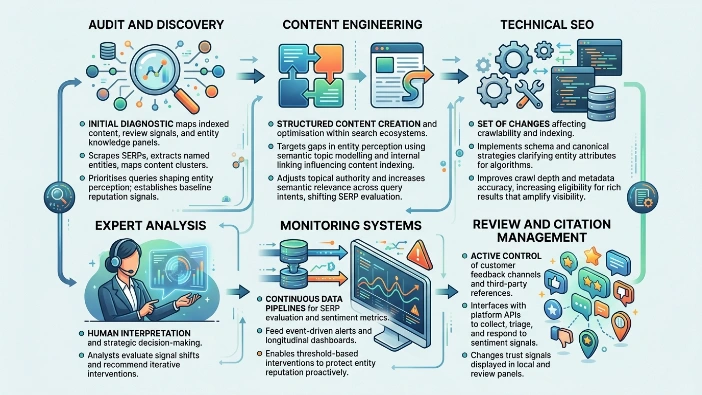
The audit establishes baseline reputation signals by scraping SERPs, extracting named entities, and mapping content clusters. Content engineering then targets gaps in entity perception using semantic topic modelling and internal linking that influences content indexing. Technical SEO implements schema and canonical strategies that clarify entity attributes for algorithms. Review management interfaces with platform APIs to collect, triage and respond to sentiment signals. Monitoring systems feed event-driven alerts and longitudinal dashboards; analysts evaluate signal shifts and recommend iterative interventions.
Each component affects different ranking axes. Audits prioritise queries that shape entity perception. Content engineering adjusts topical authority and increases semantic relevance across query intents, which shifts SERP evaluation. Technical SEO improves crawl depth and metadata accuracy, increasing eligibility for rich results that amplify visibility. Review management changes trust signals displayed in local and review panels. Monitoring enables threshold-based interventions to protect entity reputation proactively.
Why do methodological differences between agencies change cost significantly?
Methodology is the operational approach that defines task sequencing, tooling and metrics. Within search ecosystems, methodology refers to the chosen combination of algorithmic analysis, human review and technical remediation used to alter reputation signals.
Agencies take either an automated, semi-automated or manual approach. Automated approaches leverage data licences, crawling frameworks and rule-based content generation to scale interventions; they reduce per-unit labour but require licence fees and engineering overhead. Semi-automated approaches combine templates with human editing to balance scale and quality. Manual, analyst-led approaches invest heavily in original research, bespoke content and legal oversight. Time-to-effect differs: automated scaling can produce faster output but requires careful SERP evaluation to avoid algorithmic penalties; manual approaches advance entity perception slowly but reduce reputational risk.
Methodology determines the predictability and durability of changes in content indexing and entity perception. Automated scaling increases topical footprint rapidly, influencing short-tail queries and content volume metrics. Manual approaches produce high-trust content and carefully managed signals that integrate more effectively with authority and trust signals, improving long-term SERP positioning for sensitive queries.
How do agencies price the risk and uncertainty inherent in reputation work?
Risk pricing is the premium added to baseline fees to account for potential reversals in SERP evaluation, platform policy changes, or adverse public attention. Within search ecosystems, risk pricing refers to allocation of budget to defensive monitoring, escalation pathways and compliance checks.
Quantifying likely adverse events, estimating remediation workload and assigning escalation resources. Risk controls include legal review pipelines, safer content treatments, and controlled publishing schedules to reduce indexing volatility. Pricing often includes retainer-based on-call hours to activate emergency measures for sudden reputation incidents.
Risk management reduces volatility in entity perception by shortening remediation windows and preventing penalties that could harm indexation. Budgeted risk controls maintain steady trust signals and stabilise SERP evaluation against sudden adverse content spikes.
How does content type and volume affect pricing and outcomes?
Content type is the classification of material (long-form analysis, structured data pages, microcontent, FAQs, multimedia) that contributes to entity reputation. Volume refers to the quantity and cadence of published assets that influence content indexing.
Long-form, research-based content requires analyst effort to construct entity attributes and interlink topical clusters, increasing topical authority. Structured pages with schema markup demand technical implementation to modify knowledge graph signals. Microcontent and frequency affect indexing velocity and query coverage. Multimedia requires additional hosting and optimisation steps for indexability. Agencies price by estimating production hours, editorial review and technical deployment across content types.
High semantic-depth content elevates authority for high-intent queries and strengthens entity perception through richer knowledge graph signals. High publication volume increases query coverage and signals freshness, but risks diluting authority if quality control is insufficient. A correct mix of content type and cadence optimises both topical authority and long-tail visibility in SERP evaluation.
How do measurement, reporting and KPIs influence cost structures?
Measurement and reporting are the processes that capture reputation signals rank tracking, sentiment analysis, citation health and translate them into KPIs. Within search ecosystems, these processes define the feedback loop that informs future interventions.
Agencies set KPIs such as changes in branded negative result count, shifts in sentiment-weighted impression share, and improvements in knowledge panel accuracy. Implementing these KPIs requires rank-tracking across query sets, sentiment models trained on review corpora, and platform API integrations that maintain historical baselines. Analysts produce regular reports and diagnostics that require human interpretation.
Maximise reputation performance with professional Corporate Reputation Management that uses advanced KPI tracking, sentiment analysis, and SERP monitoring to guide strategic decisions. Transparent reporting and data-driven optimisation help businesses improve search visibility, strengthen entity credibility, and achieve measurable long-term reputation growth.
How do review platforms and third‑party citations factor into price differences?
Review signals are user-generated evaluations that contribute to an entity’s trust metrics; citations are third-party references that shape link equity and content discovery within search ecosystems.
Agencies allocate resources to monitor review platforms, triage responses, and engage with citation networks to correct inaccurate listings. Some platforms require paid APIs for complete datasets; some require manual scraping. Legal filtering examines defamatory or non-compliant content for removal requests. Pricing accounts for platform fees, manual engagement time, and escalation costs for disputed content.
Active management of reviews and citations directly changes trust signals visible in local pack results and rich snippets, improving or restoring SERP credibility. The required investment varies with the number and complexity of platforms to monitor, driving price variance across agencies.
Dive Deeper With Our Expert Guides and Related Blog Posts:
What Factors Determine the True Cost of Managing Your Reputation Online
How Does Reputation Management Work Step by Step in Practice
How should in-house teams compare agency pricing without getting misled?
Comparison is the structured evaluation of price proposals across equivalent scope and outcomes. Within search ecosystems, comparison refers to normalising proposals by query set, reporting frequency and remediation SLAs to allow apples-to-apples evaluation.
Create a standard comparison framework: define a fixed set of brand-sensitive queries, request baseline audit outputs, require a defined list of deliverables (content units, technical fixes, monitoring hours), and demand clear KPIs and SLAs for remediation. Request line-item breakdowns for third-party licences, content production hours and incident response retainers. Evaluate proposals for methodological transparency: ask for indexing strategies, schema usage and review platform coverage.
Standardised comparison identifies differences in expected impact on SERP evaluation and entity perception rather than superficial cost differences. Clear deliverable definitions allow in-house teams to attribute price to expected changes in indexed content, review signal adjustments and authority metrics.
What red flags indicate misleading pricing or value claims?
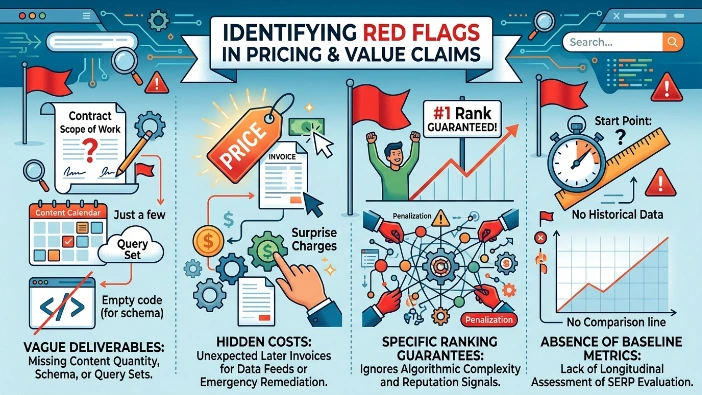
A red flag is a contractual or methodological signal that indicates incomplete scope or inflated expectations. Within search ecosystems, a red flag refers to claims that ignore indexing mechanics or algorithmic complexity.
Vague deliverables omit the number of content pieces, lack schema or fail to specify query sets for measurement. Hidden costs surface as later invoices for data feeds or emergency remediation. Guarantees of specific ranking positions ignore that algorithms evaluate many reputation signals and penalise manipulative tactics. Absence of baseline metrics prevents longitudinal assessment of SERP evaluation shifts.
Engagements driven by opaque pricing or unrealistic claims increase risk of short-term index gains followed by algorithmic penalties or limited long-term authority improvements. Identifying red flags protects the entity’s long-term credibility and prevents wasted expenditure.
Explore More Expert Insights:
How to Compare Reputation Management Pricing Without Getting Misled
This analysis defines the macro topic reputation management and explains why UK agency pricing varies through precise cost components, methodological choices and risk allocation. Pricing differences reflect concrete trade-offs in content engineering, technical SEO, review management, monitoring and reporting that directly alter search visibility, entity perception and SERP evaluation. Comparing offers requires a standardised query set, transparent line-item costing and explicit KPIs to separate superficial price differences from genuine differences in expected impact on indexed content and authority signals.
Common questions about corporate reputation management
What is corporate reputation management and why does it matter?
Corporate reputation management is the practice of monitoring and shaping an organisation’s entity perception across digital channels. It affects search visibility, customer trust and stakeholder decisions by influencing indexed content, review signals and knowledge graph entries.
How do agencies measure success in corporate reputation management?
Agencies measure success using reputation signals such as changes in branded SERP sentiment, reductions in negative result count, improvements in knowledge panel accuracy and citation health. These KPIs use rank-tracking, sentiment-weighted metrics and historical baselines for attribution.
How long does it take to see results from corporate reputation management?
Timeframes vary by intervention: technical fixes and schema can affect indexing within days to weeks, while content-driven authority and sentiment shifts require months to establish durable search visibility. Measurement relies on longitudinal SERP evaluation and trend analysis to confirm sustained impact.
What role do reviews and third‑party citations play in corporate reputation management?
Reviews and citations act as trust signals that search engines use to evaluate credibility and local relevance. Active review management, citation correction and API monitoring improve trust metrics visible in local packs and rich snippets, which directly affect entity perception.
How should an organisation compare proposals from a reputation management PR agency?
Compare on standardised scope: request a fixed query set, line-item costs for third‑party data, defined deliverables (content units, technical fixes), KPIs and remediation SLAs. This normalises proposals so differences reflect methodological approach and expected impact on SERP evaluation.