

Reputation management is the systematic process that defines and shapes how an entity is represented within search ecosystems. Online reputation refers to the aggregate of indexed signals, content, and interactions that together form an entity’s perceived credibility and visibility on search engine results pages (SERPs).
The primary determinant is relevance combined with assessed credibility. Relevance is the degree to which content matches the query intent and associated entity attributes; credibility is the degree to which algorithms evaluate content as authoritative and trustworthy. Together these factors produce the ranking order seen on SERPs.
Search engines parse queries into entity signals and intent patterns, then retrieve documents whose metadata, on-page semantics, and backlink profile match those signals. Algorithms score documents on topical relevance, content quality, link authority, user interaction metrics, and known trust signals (e.g., secure domains, structured data). Ranking functions combine these scores to prioritise results.
Entities that control high-relevance, high-credibility content occupy prominent positions on SERPs, shifting entity perception. Low-scoring content appears lower, reducing its weight in public perception even if it contains negative information. Therefore, understanding which signals drive ranking is essential to manage search-result reputation.
How is reputation formed within search engines?
Reputation forms as an emergent property of indexed content, linked relationships, and engagement metrics aggregated around an entity. Search ecosystems convert content features into reputation signals that feed entity perception models.
Crawlers index content and extract named entities, contextual keywords, and structured data. Algorithms map content to an entity graph where co-occurrence, citation patterns, and link topology create reputation pathways. Reputation signals include backlink quality, content freshness, sentiment indicators extracted from text, and user interaction metrics such as click-through rates and dwell time. These signals alter an entity node’s weight within the graph.
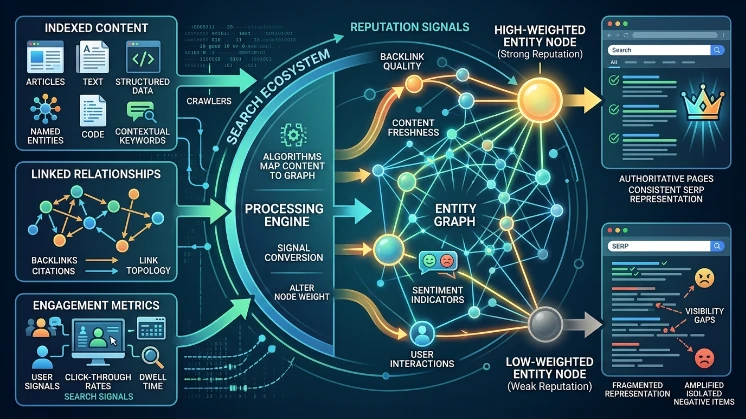
Higher-weighted entity nodes surface authoritative pages across query types, producing consistent SERP representation. Lower-weighted nodes yield fragmented or inconsistent representation, creating visibility gaps that amplify isolated negative items.
How do algorithms interpret trust and credibility for reputation signals?
Algorithms evaluate trust and credibility through measurable proxies that infer authority and verifiability. These proxies translate qualitative elements into quantitative features used in ranking.
Algorithms examine provenance (domain history and ownership), corroboration (cross-references from independent high-authority sources), structural markers (schema markup, HTTPS), and behavioural responses (CTR, bounce, time on page). Natural language processing models analyse linguistic cues for factual framing, attribution, and hedging. Algorithms also factor in entity consistency across knowledge panels and trusted databases.
Content with clear provenance, corroboration, structured metadata, and positive behavioural metrics gains higher credibility scores and improved SERP positions. Content lacking these features receives lower credibility scores and may be relegated to secondary SERP placements, reducing its influence on entity perception.
What role does content indexing play in shaping online reputation?
Content indexing is the technical process that makes content discoverable and analysable by ranking systems. Indexing quality and coverage directly influence which reputation signals exist for an entity.
Crawlers retrieve content, which indexing pipelines normalise, tokenise, and annotate with semantic tags (entities, topics, sentiment markers). Index entries link documents to entity records in knowledge graphs. Indexed timestamps and canonical signals determine which version of a content item contributes to reputation signals.
If content is properly indexed with rich semantic annotations, it integrates into entity graphs and contributes to reputation. Unindexed or poorly indexed content remains invisible to ranking models, thereby not affecting perceived reputation. Indexing latency also matters: rapid indexing of corrective content improves response speed for reputation mitigation.
How does content influence entity perception on SERPs?
Content defines the narrative available to users and algorithms; its framing, structure, and linkage create the perception constructs that users infer directly from the SERP.
Algorithms generate snippets, knowledge panels, and result types (news, images, reviews) from content. Snippet selection uses on-page headings, meta descriptions, and schema; rich results depend on structured data. The visible mix of result types and the top-ranked snippets form immediate perception cues. Additionally, sentiment extracted from review signals and article language informs summarisation features and may affect featured snippets or knowledge card phrasing.
Well-structured, authoritative content increases the probability of favourable snippet representation and rich result inclusion, boosting perceived credibility. Fragmented or negative content that ranks prominently shapes a negative entity perception even if deeper assets exist elsewhere on the index.
How do review signals and sentiment analysis affect reputation rankings?
Review signals and sentiment analysis function as direct reputation indicators within ranking algorithms and ranking features. They convert public opinion into measurable features that modify entity weights.
Search engines ingest review data from structured review markup, third-party review platforms, and review-like user behaviour (comments, social citations). Sentiment models score textual signals for positivity, negativity, and subjectivity. Aggregation functions produce composite reputation metrics that feed into entity-level ranking scores and can influence local packs, review snippets, and mobile SERP features.
Strengthen brand credibility with professional Corporate Reputation Management that improves review signals, sentiment perception, and overall search visibility. By enhancing positive reputation indicators and managing customer feedback strategically, businesses can build trust, improve SERP performance, and reinforce long-term entity authority.
What is the relationship between authority signals and entity perception?
Authority signals are relational and structural indicators that confirm an entity’s expertise or legitimacy within a topical domain. Entity perception emerges from the density and quality of authority linkages.
Link analysis tools and algorithms evaluate link provenance, topical relevance, and anchor text semantics. Citations and references from trusted sources increase an entity’s authority score within the index. Entity validation (e.g., verified profiles, authoritative directories) also raises perceived legitimacy. These signals propagate through the entity graph, affecting the ranking of associated pages.
A concentrated set of authoritative signals elevates content in competitive queries and reduces the SERP impact of marginal negative items. Weak authority linkages allow isolated negative content to persist in higher positions, amplifying reputational risk.
Dive Deeper With Our Expert Guides and Related Blog Posts:
How SEO Is Used to Push Down Negative Search Results for Names and Brands
Why Positive Content Promotion Is the Most Sustainable Reputation Management Tactic
How does a digital footprint contribute to search-result reputation management?
A digital footprint is the sum of all indexed traces an entity leaves online; it forms the substrate from which reputation signals are derived and evaluated.
Each indexed touchpoint webpages, social profiles, press releases, forum entries adds nodes to the entity graph. Algorithms correlate these nodes via entity recognition and linkage patterns. The footprint’s composition (authoritative content versus user-generated content) and structure (clustered official nodes versus dispersed third-party nodes) determine the resilience of reputation signals.
A cohesive, authoritative footprint produces consistent SERP representation and reduces volatility. A fragmented footprint with high-volume user-generated negatives increases SERP variability and elevates the prominence of damaging items. Effective management requires mapping the footprint to identify which nodes exert the most ranking influence.
How do content ranking dynamics interact with entity-level reputation strategies?
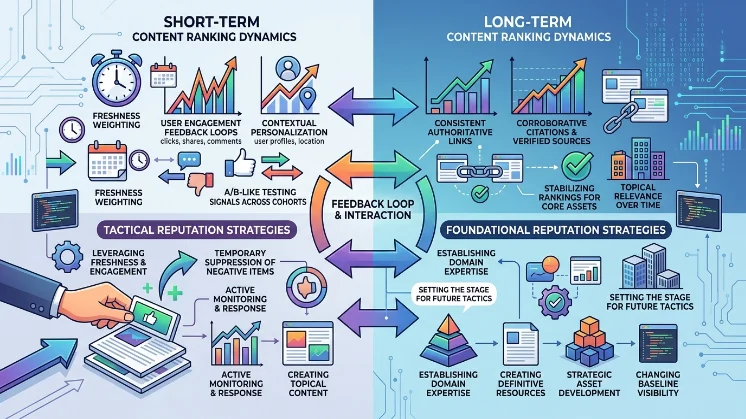
Content ranking dynamics refer to the algorithmic behaviours that promote, demote, or surface items based on short-term signals and long-term patterns. These dynamics shape the strategic prioritisation of reputation assets.
Ranking dynamics incorporate freshness weighting, user engagement feedback loops, and contextual personalisation. Algorithms test content variants via A/B-like signals across cohorts, promoting items with superior engagement and topical relevance. Long-term patterns like consistent authoritative links and corroborative citation stabilise rankings for core assets. Short-term dynamics can amplify news cycles and vocal reviews, temporarily altering entity perception.
Reputation strategies must account for both short-term ranking volatility and long-term stabilisation. Tactical content that leverages freshness and engagement can temporarily suppress negative items, while foundational authority work changes baseline visibility over time.
Understanding what ranks is the foundational step in search-result reputation management. Reputation management is a systems-level practice that defines how entities are constructed within search ecosystems through indexed content, credibility proxies, review and sentiment signals, authority linkages, and digital footprint architecture. Online reputation refers to the composite of these signals as they appear on SERPs and within knowledge graphs. Effective analysis requires precise mapping of which content contributes to entity perception, how algorithms convert qualitative indicators into reputation signals, and how ranking dynamics modulate visibility over time. Addressing reputation at the systems level indexing, semantic annotation, trust signal optimisation, and authority-building creates durable influence over SERP evaluation and entity perception.
Discover More Insights:
How Search Result Reputation Management Combines SEO Content and Digital PR
Frequently asked questions about Corporate Reputation Management
What is corporate reputation management and how does it affect search visibility?
Corporate reputation management is the practice that monitors and shapes an organisation’s online presence to influence entity perception in search ecosystems. It improves search visibility by aligning indexed content, credibility signals, and authority links so authoritative pages rank higher on SERPs.
How does Reputation Management PR Agency evaluate reputation signals?
Reputation Management PR Agency evaluates reputation signals by analysing backlink provenance, review aggregates, content indexing quality, and user engagement metrics like CTR and dwell time. This evaluation produces an actionable map of high-impact pages that drive entity perception and SERP evaluation.
Which content types most influence corporate reputation on SERPs?
Authoritative webpages, structured company profiles, verified press releases, and third-party citations most influence corporate reputation because they provide clear provenance and corroboration. Optimised metadata and schema markup increase the likelihood of rich snippets and knowledge-panel inclusion.
How do review sentiment and ratings impact corporate search rankings?
Review sentiment and ratings feed composite reputation metrics used by search algorithms and local search features; negative aggregates lower perceived credibility while positive aggregates elevate entity authority. Managing structured review data and responding to factual errors improves the score used in SERP features.