
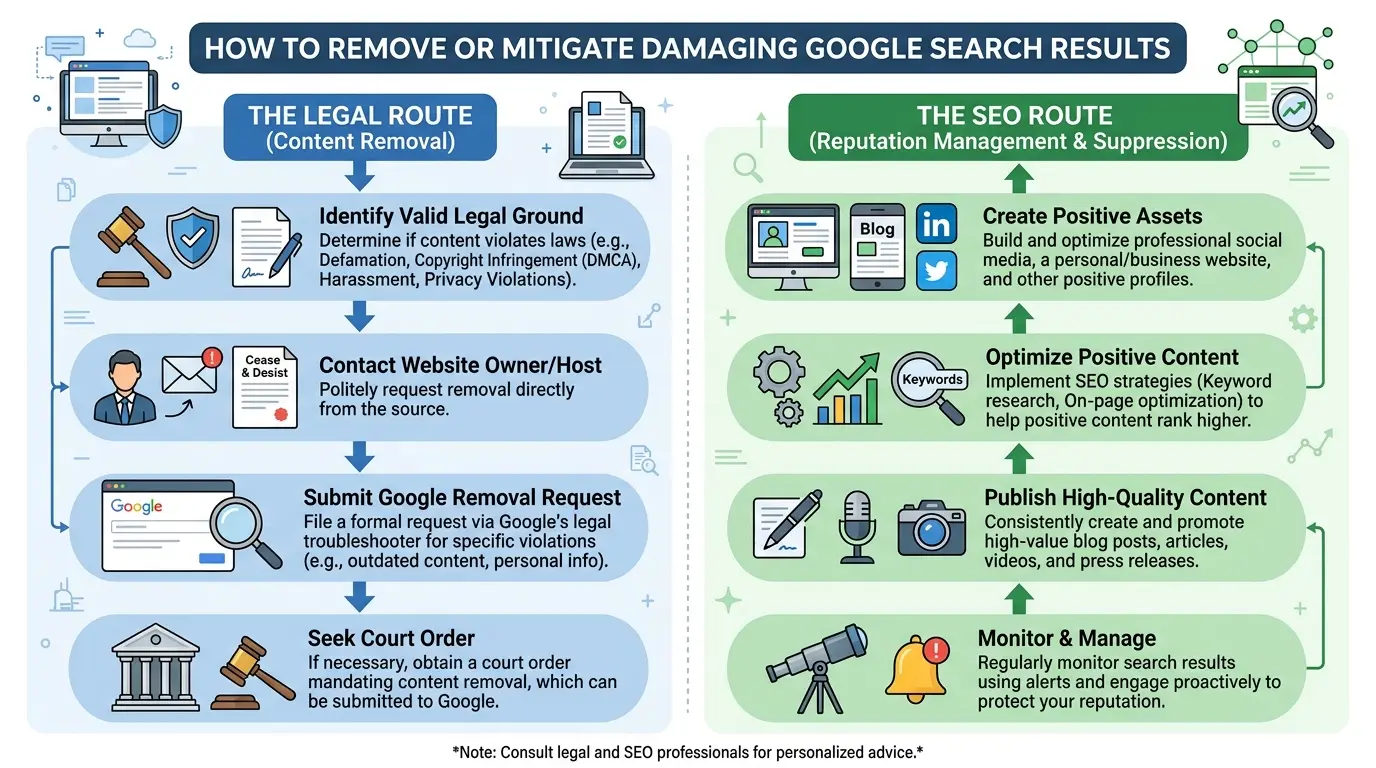
Damaging Google search results can be addressed through legal removal mechanisms, content suppression strategies, and digital footprint optimisation techniques. The most effective route depends on the nature of the content, its legality, its search visibility, and the reputation signals associated with the affected entity.
Reputation management strategies differ based on the source of the negative content, the authority of the publishing domain, and the search ecosystem factors influencing visibility. Online reputation control methods are evaluated through their impact on search ranking influence, entity credibility, sentiment distribution, and long-term SERP composition.
Which Reputation Management Approaches Are Used to Remove Damaging Google Search Results?
Legal removal routes and SEO-based suppression strategies represent two distinct approaches to reputation management. Legal methods focus on eliminating content from search indexes or source websites, while SEO methods focus on changing SERP composition through content enhancement and reputation signal development.
Legal removal operates by challenging the presence of information through privacy laws, defamation regulations, copyright claims, or data protection frameworks. The objective is direct content elimination. When successful, the content no longer appears in search results or becomes inaccessible through the originating source.
SEO-based approaches operate by influencing search ranking systems. Instead of removing content, they increase the visibility of positive or neutral assets that compete for search positions. This process changes search perception by altering the balance of information available to users.
The comparison between these approaches centres on control mechanisms. Legal removal targets content existence, whereas SEO suppression targets content visibility. Both methods influence reputation signals differently and generate distinct outcomes within search ecosystems.
How Do Legal Removal Routes Compare With SEO Suppression Strategies?
Legal removal provides direct intervention against specific content. SEO suppression provides indirect influence over search visibility. The distinction lies in whether the strategy addresses publication rights or ranking mechanisms.
How Does Legal Removal Operate?
Legal removal is a reputation management process based on regulatory and legal frameworks. It operates by establishing that content breaches a recognised legal standard.
Common legal mechanisms include:
- Assess privacy violations through data protection regulations.
- Evaluate defamatory statements against legal thresholds.
- Examine copyright ownership and unauthorised content usage.
- Review inaccurate personal information against removal criteria.
The effectiveness of legal removal depends on evidential strength and jurisdictional applicability. Content that satisfies legal removal standards can disappear entirely from search environments, creating immediate changes in SERP composition.
The limitation is that not all negative content breaches legal standards. Accurate information, lawful opinions, and legitimate public interest material often remain searchable despite reputational concerns.
How Does SEO Suppression Operate?
SEO suppression is a visibility management process. It operates by increasing the authority and relevance of alternative content assets.
Search engines evaluate entities through content quality, topical relevance, engagement signals, and authority indicators. When stronger assets emerge, they can displace less favourable results from prominent search positions.
SEO suppression analyses search ranking influence rather than content legality. The objective is content enhancement instead of content elimination. Positive assets strengthen entity credibility and reshape sentiment distribution across search results.
The limitation is that suppression requires sustained content development and authority building. Results depend on search competition, domain strength, and ranking volatility.
Which Method Produces Faster Reputation Outcomes?
Legal removal generates faster visibility changes when eligibility requirements are satisfied. SEO suppression generates gradual outcomes because search engines require time to evaluate and rank replacement assets.
Legal routes create immediate impact after successful approval or removal decisions. The affected result disappears from search visibility, reducing exposure instantly. This characteristic makes legal action particularly relevant when a specific URL creates concentrated reputational risk.
SEO suppression follows a cumulative model. Search engines reassess content authority over time, meaning visibility improvements emerge progressively. Content enhancement campaigns require indexing, ranking evaluation, and competitive displacement before significant SERP changes become visible.
The comparison highlights a trade-off between certainty and applicability. Legal methods offer speed when legal grounds exist. SEO methods offer broader applicability because they do not rely on legal eligibility requirements.
The evaluation of effectiveness therefore depends on content characteristics rather than implementation speed alone. Search ecosystem dynamics influence whether immediate removal or progressive suppression produces stronger reputation outcomes.
How Do Search Engines Interpret Reputation Signals During Reputation Management?
Search engines evaluate entities through interconnected reputation signals. These signals influence ranking decisions, trust assessment, and content prominence.
Reputation signals include content sentiment, source authority, topical relevance, citation patterns, and user engagement metrics. Search systems analyse these factors collectively to determine how information contributes to entity credibility.
Negative search results influence perception because they contribute to the overall informational environment surrounding an entity. Search engines do not measure reputation directly. Instead, they interpret signals associated with information quality and relevance.
Legal removal affects reputation signals by eliminating indexed content. SEO strategies affect reputation signals by introducing stronger competing assets. Both methods alter the information landscape that search systems use for evaluation.
The effectiveness of reputation management depends on how successfully a strategy influences signal distribution. A balanced sentiment profile and authoritative content ecosystem generally create stronger entity credibility than isolated removal actions alone.
Is Content Removal More Effective Than Content Enhancement?
Content removal and content enhancement address different dimensions of reputation management. One reduces visibility of negative information, while the other expands visibility of positive information.
Content removal is effective when a specific result creates disproportionate reputational impact. Eliminating a high-ranking negative result changes SERP composition immediately and reduces exposure to harmful content.
Content enhancement is effective when negative visibility originates from an absence of authoritative positive information. In these circumstances, search ecosystems contain informational gaps that negative content occupies.
The comparison reveals that removal reduces negative signals while enhancement increases positive signals. Reputation management outcomes depend on which signal category exerts greater influence over search perception.
Content enhancement also offers scalability advantages. New authoritative assets can strengthen topical authority, improve entity understanding, and expand digital footprint coverage. Removal strategies do not generate additional positive reputation signals because they focus exclusively on content elimination.
Dive Deeper With Our Expert Guides and Related Blog Posts:
How Negative Social Media Content Removal Works Across Different Platforms
How Do Reactive and Organic Reputation Management Strategies Differ?
Reactive reputation management responds to existing visibility issues. Organic reputation management focuses on maintaining favourable reputation signals before negative visibility develops.

Reactive strategies operate after damaging content gains search prominence. Activities include legal assessment, content suppression, SERP monitoring, and visibility correction. These methods address identified risks already affecting search perception.
Organic strategies operate continuously. They focus on content development, authority building, and reputation signal strengthening. Search engines receive consistent evidence supporting entity credibility, reducing vulnerability to isolated negative content.
The comparison highlights timing differences. Reactive methods respond to problems. Organic methods reduce the probability of future visibility challenges.
From a sustainability perspective, organic approaches strengthen long-term search ecosystem resilience. Reactive approaches remain important because reputation threats can emerge despite preventative efforts. Effective reputation management evaluation therefore examines both corrective and preventative mechanisms.
Which Strategy Provides Better Long-Term Search Visibility Control?
Long-term visibility control depends on sustainable influence over search ranking factors rather than isolated interventions. SEO-driven content enhancement generally provides broader long-term control because it strengthens the underlying signals that search engines evaluate.
Search rankings respond to authority, relevance, freshness, and trust indicators. Strategies that improve these elements contribute to enduring visibility advantages. Positive content ecosystems create defensive value by occupying prominent search positions and reducing exposure opportunities for negative content.
Legal removal remains valuable for specific content categories but does not inherently improve authority signals. Once removal is completed, additional reputation benefits depend on the remaining information ecosystem.

The comparison demonstrates that long-term control requires more than content elimination. Search visibility reflects the overall quality and depth of information associated with an entity. Reputation management effectiveness therefore depends on the ability to maintain favourable signal distribution across time.
Scalability also favours content enhancement. Additional assets can target emerging search queries, strengthen topical associations, and reinforce entity understanding within search systems.
What Risks and Limitations Exist Within Each Approach?
Every reputation management method contains operational limitations and risk exposure factors. Evaluation requires understanding both effectiveness and constraints.
Legal removal faces limitations related to eligibility requirements. Content must satisfy recognised legal criteria. Accurate information frequently remains protected even when reputationally damaging.
SEO suppression faces limitations related to competition and authority. High-authority negative content can require substantial content enhancement efforts before visibility displacement occurs.
Risk exposure differs between approaches:
- Analyse legal eligibility before initiating removal requests.
- Measure domain authority strength before planning suppression campaigns.
- Evaluate search intent associated with damaging queries.
- Monitor sentiment distribution changes across search results.
- Review ranking stability to identify visibility fluctuations.
Strategic evaluation depends on understanding these constraints. Reputation management is not defined by a single intervention. It is defined by the interaction between content visibility, search ranking influence, authority signals, and information quality.
How Should Legal and SEO Routes Be Evaluated Together?
Legal and SEO routes operate most effectively when analysed as complementary reputation management categories rather than competing alternatives. Each method addresses different layers of search visibility and information control.
Legal mechanisms focus on content eligibility and removal potential. SEO mechanisms focus on ranking influence and content prominence. Together, they affect both information availability and information visibility.
Evaluation frameworks typically assess:
- Identify the source and nature of damaging content.
- Determine legal removal eligibility.
- Measure ranking authority and search visibility.
- Compare suppression feasibility against removal probability.
- Monitor reputation signals after implementation.
This analytical framework enables objective assessment of available options. Search ecosystems respond differently depending on content type, authority structure, and entity prominence. Effective evaluation therefore examines both legal and search-based mechanisms before selecting a strategic direction.
Removing damaging Google search results involves evaluating legal removal routes and SEO-based visibility management methods. Legal approaches focus on content elimination through recognised regulatory mechanisms, while SEO approaches focus on content suppression and content enhancement through search ranking influence.
The comparison between methods highlights differences in speed, scalability, sustainability, and risk exposure. Legal removal provides direct intervention when eligibility requirements are satisfied. SEO strategies influence SERP composition by strengthening reputation signals, expanding digital footprints, and improving entity credibility.
Reputation management effectiveness is measured through changes in search visibility, sentiment distribution, and information prominence. Understanding how search engines interpret reputation signals allows organisations and individuals to evaluate removal and suppression strategies within a broader digital trust framework.
Within consideration-stage analysis, the key distinction is not whether one method replaces another, but how each mechanism influences search perception, search ranking influence, and long-term control over reputation-related information ecosystems. Discussion of specialist implementation approaches often appears in resources focused on Remove Harmful Google Search Results With the Help of a UK Specialist.
How can I remove damaging Google search results about me or my business?
Damaging Google search results can sometimes be removed through legal requests, content removal from the source website, or search engine de-indexing where applicable. If removal is not possible, SEO strategies such as publishing authoritative content and improving online reputation signals can help reduce the visibility of negative results.
Can Google remove negative search results from its search engine?
Google may remove search results that violate its policies, such as content involving personal information, legal infringements, or certain privacy concerns. However, Google generally does not remove content simply because it is negative, which is why legal and SEO routes are often considered together.
What is the difference between content removal and search result suppression?
Content removal eliminates the information from the original website, while search result suppression reduces the visibility of unwanted pages in Google Search. Reputation management strategies often use SEO techniques to promote more relevant and authoritative content above negative search listings.
How long does it take to remove harmful Google search results?
The timeframe depends on the removal method and the complexity of the case. Legal removals may take weeks or months, while SEO-based search result suppression often requires ongoing effort before significant ranking changes become visible.
When should I use legal action instead of SEO to remove search results?
Legal routes may be appropriate when content is defamatory, false, infringes privacy rights, or violates applicable laws. SEO is generally used when content is lawful but damaging to reputation, helping improve search perception by increasing the visibility of positive and authoritative content.