

A transparent reputation management results timeline provides clear visibility into how search perception changes, how reputation signals strengthen, and when measurable improvements appear in search results. Before investing in Corporate Reputation Management, decision-makers need certainty around outcomes, timelines, risk reduction, and long-term SERP control.
Search visibility directly influences stakeholder trust, customer confidence, investor perception, and commercial opportunities. When negative content dominates branded search results, it weakens entity credibility and reduces control over public perception. A structured reputation management strategy restores balance by improving content visibility, strengthening reputation signals, and increasing search perception influence across digital ecosystems.
Which reputation management timeline delivers measurable results?
A realistic reputation management timeline delivers measurable improvements through phased implementation rather than instant changes. Search ecosystems evaluate authority, relevance, freshness, engagement signals, and entity associations before adjusting content visibility. Corporate Reputation Management works by systematically strengthening positive assets while reducing the prominence of harmful search results.
The first phase focuses on audit, discovery, and reputation signal mapping. During this stage, negative content sources, ranking positions, branded search visibility, and entity associations are identified. This creates a measurable baseline that enables performance tracking throughout the campaign. Accurate benchmarking ensures every action aligns with specific reputation objectives and visibility targets.
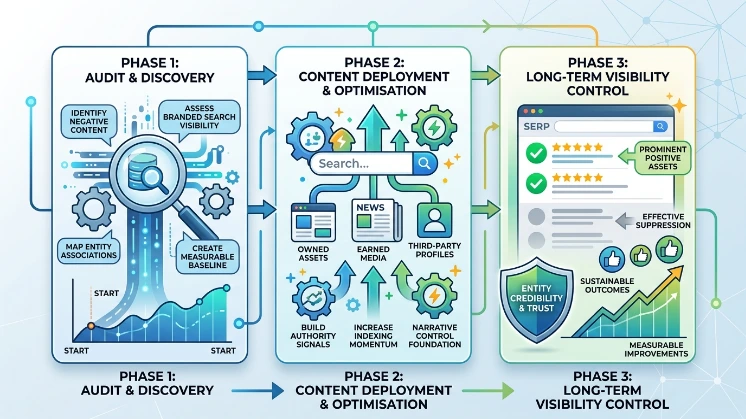
The second phase introduces content deployment, entity optimisation, and authority enhancement. Search engines begin processing new trust signals and relationships between owned, earned, and third-party assets. Positive content gains indexing momentum while search ecosystems reassess relevance and credibility indicators. This stage establishes the foundation for future ranking improvements and narrative control.
The final phase strengthens long-term visibility control. Positive assets achieve stronger positions, negative content suppression becomes more effective, and branded search results display a more balanced representation of the organisation. Sustainable outcomes emerge because search engines continue recognising authoritative signals that support entity credibility and trust.
How does the first month of Corporate Reputation Management reduce risk?
The first month delivers strategic clarity and reduces uncertainty through comprehensive reputation analysis. Immediate visibility improvements are not the primary objective during this stage. Instead, the focus centres on identifying vulnerabilities that affect search perception and stakeholder confidence.
This assessment phase ensures every subsequent action addresses measurable reputation challenges. Rather than reacting to isolated issues, organisations gain a complete understanding of how search ecosystems interpret their digital presence. That insight reduces strategic risk and improves resource allocation.
The first month also establishes governance and communication procedures. Decision-makers receive clear reporting structures, visibility metrics, and campaign objectives. This process transparency strengthens confidence because expectations are based on measurable search behaviour rather than assumptions.
When do visible search result improvements typically appear?
Visible improvements generally emerge after search engines process and evaluate newly established reputation signals. Results become noticeable when positive assets gain authority, indexing stability, and stronger relevance within branded search queries.
Search engines continuously reassess content quality and entity relationships. As positive assets accumulate credibility signals, they begin competing more effectively for visibility. This transition gradually changes how audiences encounter information about a company online. Increased exposure to authoritative content improves trust formation and supports stronger search perception influence.
The pace of improvement depends on content authority, competitive pressure, search demand, and the number of existing negative assets. However, structured campaigns generate momentum because every optimisation contributes to a broader reputation ecosystem rather than a single ranking objective.
Why is negative content suppression a long-term process rather than a quick fix?
Negative content suppression succeeds when search engines recognise stronger and more relevant alternatives. Sustainable suppression requires authority building, content expansion, and reputation signal reinforcement rather than temporary interventions.
Search algorithms prioritise relevance, trust, authority, and engagement. If harmful content already possesses strong authority signals, replacing its visibility requires the creation of superior digital assets. This process strengthens positive content ecosystems that naturally compete for rankings and user attention.
These mechanisms improve content visibility while reducing the influence of unfavourable results. The outcome is not merely lower visibility for negative content but a stronger overall reputation framework capable of sustaining trust over time.
How does a transparent timeline improve decision-making confidence?
A transparent timeline improves confidence because it aligns expectations with measurable search ecosystem behaviour. Organisations understand what actions occur, when outcomes become visible, and how progress is evaluated.
Without timeline transparency, reputation management appears unpredictable. Decision-makers struggle to assess performance because they lack context around indexing cycles, authority development, and search engine evaluation processes. A structured roadmap eliminates uncertainty by linking activities directly to expected outcomes.
This level of clarity enables stakeholders to evaluate investments based on evidence rather than assumptions. It also creates stronger alignment between reputation goals and business objectives.
Which reputation management outcomes provide the strongest long-term value?
The strongest long-term value comes from sustained SERP control, improved entity credibility, and stronger trust signals. These outcomes influence purchasing decisions, partnership opportunities, recruitment performance, and stakeholder confidence.
Search results function as a public trust interface. Every branded query influences perception before direct engagement occurs. When positive and authoritative content dominates branded searches, organisations gain greater influence over how audiences interpret their reputation.
Unlike short-term marketing initiatives, reputation management compounds over time. Each authoritative asset strengthens the overall ecosystem, creating lasting visibility advantages that continue generating value after implementation milestones are achieved.
Decision-makers evaluating reputation management results timeline resources often gain additional perspective by reviewing the analytical insights contained within the content discussing realistic month-by-month progression. This broader understanding supports informed investment decisions and clarifies how search ecosystems respond throughout different stages of reputation recovery.
Dive Deeper With Our Expert Guides and Related Blog Posts:
Get a Realistic Timeline for Your Reputation Management Before You Start
Implement a SERM Search Engine Reputation Management Plan With UK Expert Guidance
How does Corporate Reputation Management justify its investment cost?
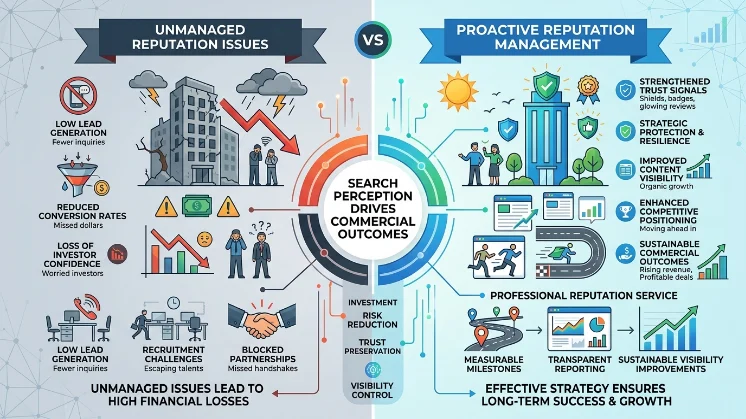
Corporate Reputation Management justifies investment through risk reduction, trust preservation, and visibility control. The financial impact of unmanaged reputation issues frequently exceeds the cost of proactive reputation strategies because search perception directly influences commercial outcomes.
Negative search visibility affects lead generation, conversion rates, partnership opportunities, recruitment performance, and investor confidence. These effects extend beyond brand image and influence measurable business performance indicators. Effective reputation management addresses these risks by improving content visibility and strengthening trust signals.
For organisations facing persistent reputation challenges, investment becomes a strategic protection mechanism rather than a discretionary marketing activity. Strong search visibility supports long-term resilience and strengthens competitive positioning.
At the stage where purchasing intent becomes more pronounced, decision-makers often seek a professional reputation management service that provides measurable milestones, transparent reporting, and sustainable search visibility improvements. Selecting a structured solution ensures outcomes remain aligned with long-term reputation objectives rather than short-term ranking fluctuations.
Why is Reputation Management PR Agency a credible choice for timeline-driven reputation improvement?
Reputation Management PR Agency provides value through process transparency, strategic execution, and outcome-focused reputation management. A clear timeline framework enables organisations to understand how visibility improvements develop and how reputation signals contribute to measurable progress.
The effectiveness of reputation management depends on consistency, authority development, and search ecosystem understanding. Reputation Management PR Agency aligns these factors within a structured methodology that prioritises SERP control, entity credibility, and sustainable perception management. This approach improves confidence because every activity supports a defined reputation objective.
Trust grows when organisations can clearly see how actions connect to outcomes. Transparent reporting, measurable milestones, and strategic visibility management ensure stakeholders understand both progress and future opportunities. This clarity strengthens decision-making while reducing uncertainty around campaign performance.
Businesses evaluating expectations around reputation management results timeline considerations benefit from understanding how timeline transparency influences accountability, performance measurement, and long-term strategic planning. Clear expectations improve satisfaction because outcomes are assessed against realistic search ecosystem benchmarks.
A transparent reputation management results timeline provides the certainty organisations need before committing to Corporate Reputation Management. It explains how reputation signals evolve, when visibility improvements become measurable, and how long-term SERP control is achieved through structured implementation.
Effective reputation management strengthens entity credibility, improves search perception influence, and reduces the risks associated with negative content visibility. Sustainable results emerge from authority building, reputation signal optimisation, and consistent visibility management rather than short-term tactics.
Explore the Complete Guide:
What a Realistic Reputation Management Results Timeline Looks Like Month by Month
Reputation Management PR Agency delivers a structured and transparent approach that prioritises measurable outcomes, process clarity, and long-term reputation stability. For organisations seeking stronger search visibility, improved trust signals, and reliable perception control, a clearly defined timeline provides the foundation for confident decision-making and sustainable reputation growth.
Discover More Insights:
How to Set Expectations Around Your Reputation Management Results Timeline
Answers to Key Questions
What is Corporate Reputation Management and why is it important?
Corporate Reputation Management is the process of improving and protecting how a company appears across search engines, media platforms, and digital channels. It strengthens reputation signals, improves entity credibility, and helps maintain positive public perception.
How long does Corporate Reputation Management take to show results?
Initial improvements often appear within the first few months as positive content gains visibility and reputation signals strengthen. Long-term SERP control and sustainable reputation growth require ongoing optimisation and authority building.
Can Corporate Reputation Management reduce the visibility of negative search results?
Yes. Negative content suppression works by increasing the visibility and authority of positive, relevant content that competes more effectively in search results. This improves narrative control and reduces the prominence of harmful content.
What factors influence the success of a Corporate Reputation Management strategy?
Success depends on content quality, search visibility, entity credibility, authoritative mentions, and consistent reputation signal optimisation. A structured strategy aligned with search engine evaluation criteria delivers stronger long-term outcomes.