

Reputation management is the systematic process of monitoring, influencing, and protecting an entity’s perceived credibility across digital systems. Online reputation refers to the aggregate of signals, content, and interactions that define an entity’s credibility within search ecosystems.
What happens in month 1 of a reputation management timeline?
Month 1 establishes the baseline: audit current reputation signals, index status, and immediate risk factors.
A baseline audit is a structured inventory that defines present reputation signals and their distribution across SERPs. The audit identifies indexed pages, review profiles, social mentions, press coverage, and metadata that contribute to an entity’s digital footprint.
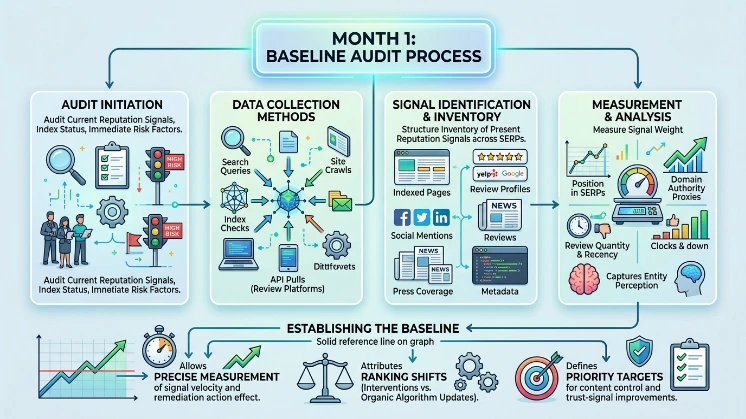
The audit uses search queries, site crawls, index checks, and API pulls from reviews platforms to map content indexing and entity mentions. Analysts measure signal weight by position in SERPs, domain authority proxies, and review quantity and recency. This phase captures entity perception as represented by current search visibility and content indexing.
Establishing a baseline allows precise measurement of signal velocity and the effect of remediation actions. Without a baseline, SERP evaluation cannot attribute ranking shifts to interventions versus organic algorithm updates. Baseline data defines priority targets for content control and trust-signal improvements.
What activities define months 2–3 in a reputation management timeline?
Months 2–3 implement remediation and content optimisation to alter immediate reputation signals and improve indexing rates.
Remediation refers to targeted adjustments that redefine weighting of reputation signals within search ecosystems. Content optimisation refers to structured changes to on-site and off-site content that improve relevance and authority markers.
Remediation executes technical SEO fixes (canonical tags, robots directives, structured data), metadata adjustments, and content rewrites to align relevance signals with entity intent. Off-site activities include structured content submissions to authoritative directories and legal or platform escalation for clearly defamatory content. Crawling frequency and indexation are monitored via search console tools and server logs to confirm content indexing and SERP propagation.
Technical and content changes accelerate correct content indexing and update reputation signals quickly, changing entity perception scores in SERP evaluation. Immediate gains appear in improved snippets, corrected knowledge graph associations, and updated review aggregates. These changes influence short-term trust signals and reduce exposure to high-visibility negative items.
How does month 4 change content strategy and reinforcement?
Month 4 focuses on amplification: publishing authoritative, optimised content and building trust signals to displace negative visibility.
Content production targets long-tail and entity-related queries, implements structured data for entity markup, and uses internal linking to consolidate topical authority. Distribution channels include recognised editorial sites, controlled domains, and content hubs engineered for consistent entity associations. Performance metrics include impressions, CTR shifts, and ranking changes for targeted keywords.
Amplified content increases positive share of voice and modifies entity perception by flooding SERPs with high-authority results. Authority signals backlinks, citation frequency, and cross-domain mentions—improve ranking dynamics, pushing low-authority negative items lower in SERPs and changing perceived credibility during SERP evaluation.
What are the key actions in months 5–6 for stabilising reputation signals?
Months 5–6 institutionalise governance: review management, authority consolidation, and monitoring system maturity.
Governance introduces review response protocols, verification of official profiles, and recurring content calendars. Authority consolidation secures backlinks from domain-relevant authoritative sites, standardises NAP (name, address, phone) data across directories, and creates canonical hubs for entity-related information. Monitoring systems scale with automated alerts and scheduled SERP evaluation reports.
Sustained governance and consolidated authority stabilise ranking improvements and reduce volatility in content indexing. Review signals become more resilient; sentiment aggregates reflect active management instead of isolated corrections. Search visibility becomes predictable, enabling precise evaluation of long-term reputation shifts.
How do months 7–9 refine signals for long-term ranking dynamics?
Months 7–9 refine semantic relevance and authority depth to influence algorithmic trust beyond short-term gains.
Refinement expands content clusters around entity attributes, uses entity-centric schema to link disparate assets, and acquires topical citations to reinforce contextual authority. Analysts run semantic gap analyses to identify missing subtopics and update content to cover those areas comprehensively. Backlink profiles are audited for topical relevance and clean link acquisition is prioritised.
Deeper semantic signals improve the entity’s standing in algorithmic trust models, which evaluate coherence and topical completeness. SERP evaluation increasingly recognises the entity as a primary node for related queries, resulting in durable ranking improvements and stronger snippet authority in knowledge panels and rich results.
What progress is expected in months 10–12 for reputation maturity?
Months 10–12 demonstrate reputation maturity: reduced negative visibility, stable authority metrics, and predictable SERP performance.
Maturity results from continuous content publication, structured data maintenance, ongoing review management, and periodic audits to counter algorithm updates. Analysts track citation velocity, backlink growth curves, and sentiment trend lines to confirm stability. Systems incorporate anomaly detection for sudden negative signal emergence.
Mature reputation ecosystems show limited SERP volatility and sustained high visibility for authoritative assets. Entity perception becomes resilient to isolated adverse events because the signal portfolio demonstrates depth, recency, and authority—factors weighted heavily in SERP evaluation and content ranking dynamics.
How should expectations be set around timelines and measurable outcomes?
Expectations must align with signal complexity: immediate technical fixes affect indexing quickly, content authority gains require months, and trust-based algorithmic shifts take 6–12 months to materialise.
Categorise actions into three classes technical (indexing, metadata), content (publication, semantic coverage), and trust (reviews, authority backlinks) and assign expected impact windows: technical 0–2 months, content 2–6 months, trust 6–12 months. Use KPI dashboards for impressions, ranking movements, sentiment aggregates, and authority proxies to demonstrate progress. Provide monthly reporting with baseline comparisons and variance analysis to isolate intervention effects from algorithm shifts.
Clear expectations reduce misattribution of performance. When stakeholders understand which signals respond within which windows, SERP evaluation focuses on signal-specific metrics rather than opaque overall ranking changes. This alignment improves decision-making and prioritisation of reputation tactics.
Which reputation signals influence SERP evaluation most strongly?
Search engines prioritise recency, authoritative citations, structured entity data, and review signals when evaluating reputation.
Recency is measured via content timestamps and update frequency; authoritative citations are measured by backlink provenance and topical relevance; structured entity data is measured through schema and knowledge graph links; review signals are measured by volume, recency, and sentiment distribution across verified platforms. Algorithms weight these inputs to estimate entity trust and ranking eligibility.
Signals with higher algorithmic weight rapidly change SERP outputs when improved. For example, authoritative citations elevate domain-level trust, structured data increases eligibility for rich results, and review signals alter snippet sentiment presentation. Effective reputation strategies map to these high-weight signals to optimise search visibility.
How do search algorithms interpret trust and credibility for entities?
Algorithms interpret trust as a composite score derived from citation quality, content coherence, user engagement, and verified entity attributes.
Algorithms evaluate citation quality using provenance and topical alignment; content coherence by semantic completeness and entity-focused coverage; user engagement by CTR, dwell time, and pogo-sticking metrics; and verified attributes through structured data and third-party confirmations. These factors are combined into entity perception models that inform ranking decisions.
Higher algorithmic trust increases ranking priority and eligibility for features such as knowledge panels and rich snippets. Trust amplification reduces the visibility of lower-quality or contradictory content in SERPs, thereby shaping public perception during search interactions.
Dive Deeper With Our Expert Guides and Related Blog Posts:
How Long Does Reputation Management Take and What Affects the Timeline
What SERM Search Engine Reputation Management Is and Why Brands Are Investing
What role do review signals and sentiment play in reputation timelines?
Review signals and sentiment directly influence short- to mid-term perception by affecting snippet sentiment, local pack rankings, and trust proxies.
Algorithms parse review metadata and apply sentiment analysis to extract polarity and topical relevance. Platforms surface review-derived information in SERP features and local packs. Review velocity and reviewer credibility act as multipliers to sentiment impact.
Enhance brand trust with professional Corporate Reputation Management that improves review signals, sentiment perception, and overall search visibility. By strengthening positive customer feedback and managing reputation indicators strategically, businesses can accelerate credibility growth and support stronger SERP performance over time.
How should progress be measured month by month?
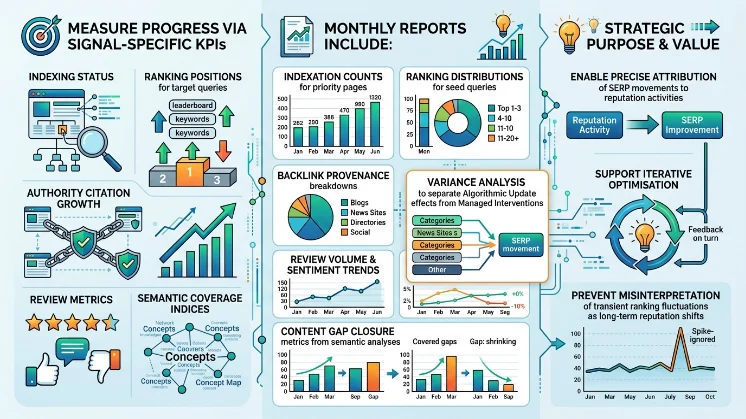
Measure progress via signal-specific KPIs: indexing status, ranking positions for target queries, authority citation growth, review metrics, and semantic coverage indices.
indexation counts for priority pages, ranking distributions for seed queries, backlink provenance breakdowns, review volume and sentiment trends, and content gap closure metrics from semantic analyses. Include variance analysis to separate algorithmic update effects from managed interventions.
Signal-specific KPIs enable precise attribution of SERP movements to reputation activities. Monthly measurement supports iterative optimisation and prevents misinterpretation of transient ranking fluctuations as long-term reputation shifts.
This timeline defines reputation management as a systems-level process that progresses from baseline audit to governance and maturity over a 10–12 month horizon. Reputation signals—indexing, structured entity data, authoritative citations, and review sentiment—drive how algorithms form entity trust and perform SERP evaluation. Measured, signal-specific interventions produce predictable changes: technical fixes show within months, content authority builds over months, and trust-based algorithmic improvements stabilise over 6–12 months.
Complete Details Available Here:
How to Set Expectations Around Your Reputation Management Results Timeline
Answers to Key Questions
What is corporate reputation management and why does it matter?
Corporate reputation management defines the processes used to monitor, influence, and protect an organisation’s credibility across search engines and digital channels. It affects search visibility, stakeholder trust, and SERP evaluation through signals like content indexing, reviews, and authoritative citations.
How long does corporate reputation management take to show results?
Timelines depend on signal type: technical fixes often show within 0–2 months, content authority improvements within 2–6 months, and trust-based algorithmic shifts typically require 6–12 months. Measuring indexation, ranking changes, backlink provenance, and review metrics provides evidence-based progress tracking.
Which reputation signals should businesses prioritise first?
Prioritise indexing and technical SEO, structured entity data, and review signals because algorithms weight these heavily for credibility and SERP features. Addressing canonical issues, schema markup, and review management yields faster improvements in search visibility.
How does Corporate Reputation Management handle negative reviews and mentions?
Effective management analyses review metadata and sentiment, responds through established governance protocols, and works to publish authoritative content that balances negative visibility. Tracking review velocity and reviewer credibility provides measurable changes in snippet sentiment and local pack rankings.