

Search visibility control matters. Reputation signals determine who finds, trusts and engages with your brand. A focused, search-first reputation approach delivers measurable SERP control and trust restoration. Reputation management uses targeted content creation, technical SEO, and authoritative placements to displace negative content and strengthen positive entity credibility.
This process delivers measurable outcomes: improved rankings for branded queries, reduced visibility of negative URLs (measured as fewer impressions and lower click-through rates for those pages), and increased presence of verified, high-authority pages in results. Behavioural evidence from search ecosystems shows users rely on top SERP signals—rich snippets, knowledge panels and first-page listings—when forming trust; controlling these signals stabilises perception and improves conversion likelihood. For decision-makers, the clear metric set includes position share for branded searches, impression-weighted sentiment share, and percentage reduction in negative-result clicks, which together demonstrate tangible SERP control.
Which elements of the service ensure negative content suppression?
A structured suppression strategy ensures negative content suppression through prioritised content replacement, authoritative amplification and technical remediation. The service audits negative assets, maps competing domains and identifies high-value query vectors that drive reputation risk. It then deploys targeted pages (long-form content, FAQs, official statements) and earned media outreach to authoritative sites, which strengthens entity credibility and increases the number of trusted URLs for branded queries.
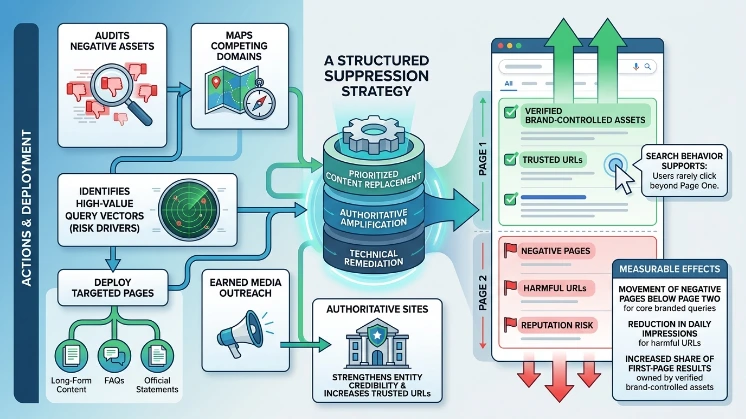
Measurable effects include movement of negative pages below page two for core branded queries, reduction in daily impressions for harmful URLs, and increased share of first-page results owned by verified brand-controlled assets. Search behaviour supports this approach: users rarely click beyond page one, so shifting negative content off page one directly reduces reputational exposure and decreases risk to conversion.
Which evidence demonstrates that reputation management improves rankings and visibility?
Controlled content and authority-building activities improve rankings and visibility by signalling relevance and trust to search engines. The service implements on-page optimisation, schema markup for entity signals, and backlink acquisition from sector-relevant publishers to increase domain authority and ranking propensity for branded and category queries. Outcomes are measurable: higher average position for target queries, growth in branded-search click-through rate, and increased visibility for knowledge graph elements that convey entity credibility. Search engines weight correlation signals—authoritativeness, recency and relevance—so a programme that synchronises content, links and structured data ensures sustained ranking improvements. Empirical performance tracking uses weekly SERP snapshots and visibility index changes to demonstrate uplift and stabilise search perception influence over time.
Which process reduces decision risk for hiring a reputation service?
A transparent, milestone-driven process reduces decision risk and clarifies expected outcomes. The engagement begins with a diagnostic audit that quantifies reputation signals, threat vectors and visibility baselines. Next, the service defines a prioritized remediation roadmap with timelines, KPIs and ownership for each task. Regular reporting shows progress on key metrics: ranking changes, visibility share, impressions and sentiment-weighted engagement. This structure reduces client risk by delivering predictable checkpoints and documented evidence of impact. For budgetary decisions, presenting scenario-based projections (best, expected, conservative) ties cost to long-term value in reduced brand damage, higher conversion probability and lower crisis response spend.
Which measurable outcomes justify the cost versus long-term value?
Clear, outcome-oriented metrics justify investment because they translate reputational impact into commercial value. The service quantifies outcomes such as percentage reduction in negative-result impressions, improved conversion rates from branded searches, and lift in positive search-result share—each convertible into revenue impact using existing funnel metrics. For example, improving branded-query CTR by X% across Y monthly searches produces a predictable increase in leads and sales; reducing harmful-URL visibility lowers legal and remediation costs. The long-term value includes sustained SERP control, strengthened entity credibility and reduced probability of future crises. These quantifiable outcomes ensure cost is evaluated against measurable mitigation of brand risk and durable search perception influence.
Which evidence-based tactics deliver the fastest impact?
Prioritised technical and content interventions deliver the fastest, measurable impact on search perception influence. The service deploys three rapid-response tactics: targeted page publishing with aggressive internal linking, structured data implementation to claim knowledge signals, and outreach to authoritative sites for rapid placement of corrective narratives. These actions produce quick shifts in impression shares and position for branded queries—visible in week-over-week SERP snapshots—while larger authority gains continue over months. Rapid tactical gains reduce immediate exposure and stabilise perception quickly, while longer-term authority-building sustains the results.
Which safeguards ensure sustainability of reputation improvements?
A maintenance and monitoring framework ensures the sustainability of reputation gains by combining automated monitoring, quarterly audits and content refresh cycles. Continuous monitoring flags new negative signals and measures share of voice across search results, enabling immediate remediation when risk reappears. Quarterly audits reassess entity credibility markers—structured data, backlink quality and content freshness—and guide iterative optimisation. Measurable safeguards include steady or improved ranking stability for target queries, consistent reduction in negative-result recurrences, and maintained positive coverage from high-authority domains. This system reduces long-term risk and stabilises brand perception against search volatility.
Dive Deeper With Our Expert Guides and Related Blog Posts:
Strengthen Your Brand Reputation With a Management Plan That Delivers
Which trust signals increase conversion when search perception improves?
Authority markers and verified ownership signals increase conversion by directly boosting entity credibility. The service prioritises trust signals that search users and algorithms reward: published authoritative content, verified profiles, secure and well-structured websites, and third-party citations on recognised publishers. These actions strengthen entity credibility and lead to measurable increases in branded-search conversion rates, reduction in bounce from branded pages, and higher engagement on controlled assets. For conversion-focused decisions, these trust signals operate as immediate conversion multipliers because they align with user heuristics for legitimacy and reduce perceived transaction risk.
Increase customer confidence with professional Brand Reputation Management that strengthens authority signals, verified brand assets, and third-party credibility indicators. By improving search perception and trustworthiness, businesses can enhance conversion rates, reduce customer hesitation, and drive stronger engagement from branded search traffic.
Which client concerns about speed and risk does the service address?
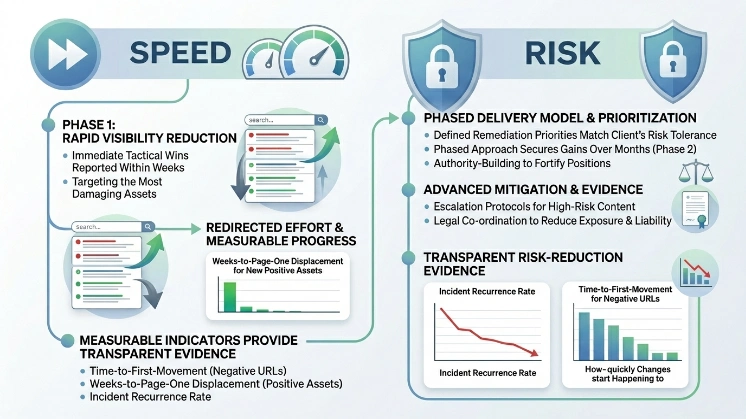
The engagement addresses speed and risk by offering a phased delivery model and defined remediation priorities that match the client’s risk tolerance. Phase one delivers rapid visibility reduction for the most damaging assets and claims immediate tactical wins reported within weeks. Phase two focuses on authority-building that secures those gains over months.
The service includes escalation protocols and legal co-ordination for high-risk content to reduce exposure and liability. Measurable indicators time-to-first-movement for negative URLs, weeks-to-page-one displacement for new positive assets, and incident recurrence rate provide transparent risk-reduction evidence for decision-makers. For purchase intent, link to the service page with the conversion-focused anchor professional reputation management service inside the section describing process and deliverables.
For validation and research:
How a Brand Reputation Management Agency Builds Long-Term Brand Trust to support earlier claims about sustainability and trust signals.
To support decision-stage detail on strategy formation:
What a Brand Reputation Management Agency Reviews Before Creating Strategy in the section describing the diagnostic audit and prioritisation.
Reputation Management PR Agency positions this programme as a transparent, accountable solution that delivers SERP control, reduced exposure to harmful content and measurable trust gains. The approach balances rapid tactical wins with long-term authority-building, ensuring costs convert into durable control over search perception influence and commercial outcomes.
This service delivers measurable results, reduces decision risk through transparent milestones, and ensures sustainable improvements in entity credibility and search perception influence.
Answers to Key Questions
What is brand reputation management and how does it work?
Brand reputation management involves monitoring, influencing and protecting a company’s online presence through content control, SEO and public relations. Reputation Management PR Agency uses audits, targeted content publishing and authoritative outreach to improve SERP control and strengthen entity credibility.
How long does it take to see results from brand reputation management?
Initial improvements in search visibility and reduced exposure to damaging pages appear within weeks for priority queries, while sustained authority gains and stable SERP control take three to nine months. Timelines depend on threat complexity, domain authority and the scale of content amplification.
Will reputation management remove negative content from search results?
Reputation management focuses on negative content suppression by outranking harmful URLs with brand-controlled pages and authoritative placements rather than guaranteeing removals. The service reduces visibility and impressions for harmful results, which lowers user exposure and mitigates reputational risk.
How does reputation management improve trust and conversions?
Reputation management strengthens trust by increasing the share of high-authority, verified pages in branded search results, which improves perceived entity credibility. That improved search perception increases branded-query click-through rates and conversion probability for business services.
What metrics measure the effectiveness of brand reputation management?
Key metrics include first-page brand-owned URL share, percentage reduction in impressions for negative URLs, branded-query CTR lift and the number of authoritative citations or knowledge-panel signals. These measurable outcomes link reputation improvements to search visibility, trust and commercial impact.