
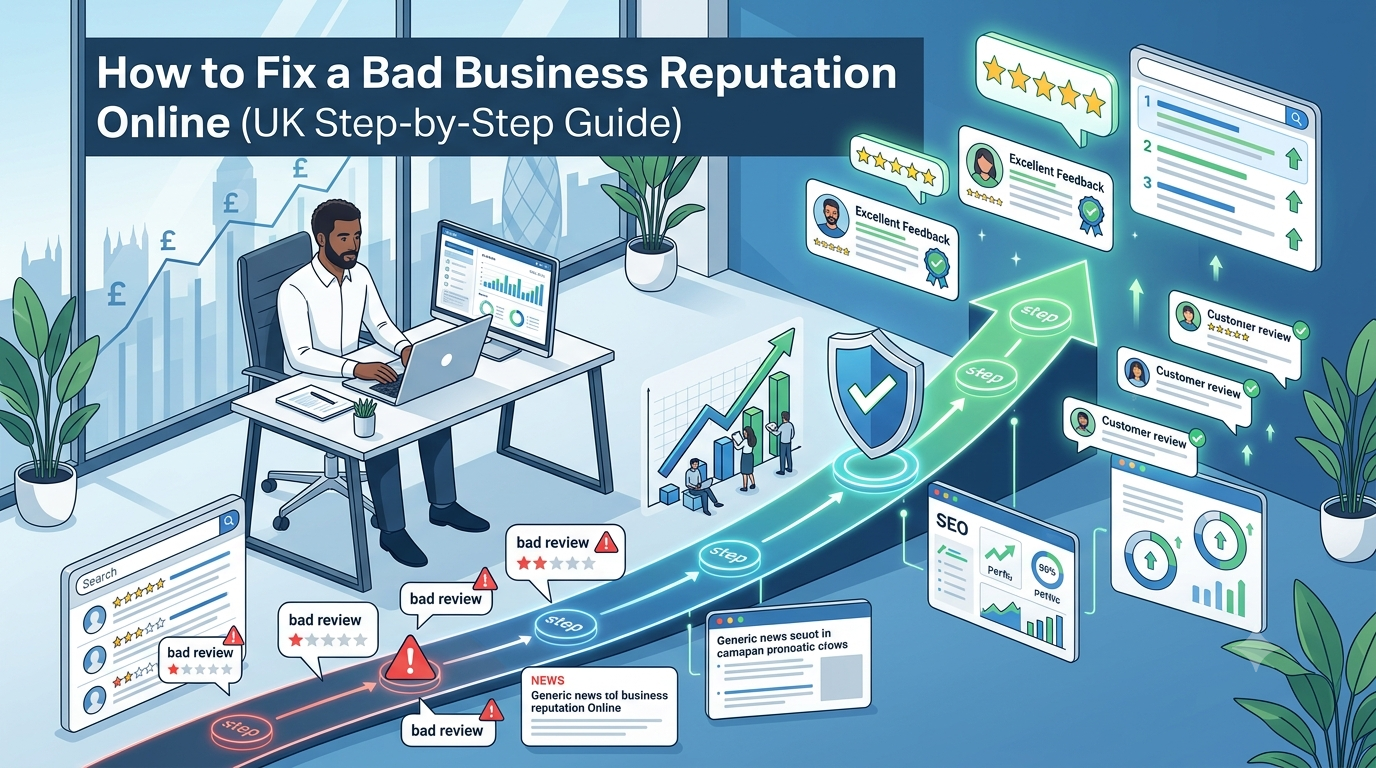
Fix A Bad Business Reputation Online
A damaged online reputation rarely fixes itself, but it is fixable. Whether you’re a business owner watching reviews pile up, a company director dealing with a wave of negative press, or an individual professional whose name has been unfairly tied to old, misleading content, the path back to a strong online presence follows the same core logic: contain the damage, fix what can be fixed at the source, and rebuild search visibility with genuine, authoritative content over time.
By the end of this guide, you’ll know:
- Exactly what counts as a damaged online reputation and why it happens
- A clear, step-by-step process to fix it, whether you’re managing this for a business or yourself personally
- The tools and realistic timelines that separate a genuine recovery from wasted effort
What Is a Bad Business Reputation Online?
A bad business reputation online is any combination of negative reviews, outdated or inaccurate content, damaging press coverage, or unresolved public complaints that rank prominently when your business name, or your own name as an individual or director, is searched. This isn’t limited to one bad review. It’s the cumulative picture a prospective customer, client, employer, or partner sees within the first page of Google.
For business owners, this often shows up as a cluster of negative reviews on Google or Trustpilot. For company owners and directors, it might be older press coverage tied to a resolved dispute, or Companies House records surfacing alongside unrelated negative content. For individuals managing personal reputation repair, it’s frequently a mix of outdated social media, an unfair review, or content connected to someone with a similar name.
Why Fixing a Bad Reputation Matters
Search results shape decisions before any direct conversation happens. A business with visible reputation damage sees slower sales cycles, weaker conversion from search traffic, and, for company owners specifically, more hesitant investors or partners during due diligence. For individuals, a damaged personal search presence can quietly affect job offers, client trust, and professional partnerships, often without anyone ever explaining why the opportunity didn’t move forward.
Left unaddressed, reputation damage compounds. Older negative content accumulates authority and backlinks over time, making brand reputation recovery progressively harder the longer it’s ignored.
Types of Reputation Damage
Reputation damage generally falls into a few distinct categories, and the fix differs depending on which one you’re dealing with:
- Review-based damage, from a cluster of negative or unfair reviews across platforms
- Content-based damage, from outdated news articles, blog posts, or forum threads that continue to rank
- Crisis-driven damage, from a viral complaint, PR incident, or coordinated negative campaign
- Identity-based damage, where content about someone with a similar name gets mistakenly attributed to you or your business
Correctly identifying which type you’re facing is the single biggest factor in choosing the right fix, since a review problem and a legal defamation problem require completely different approaches.
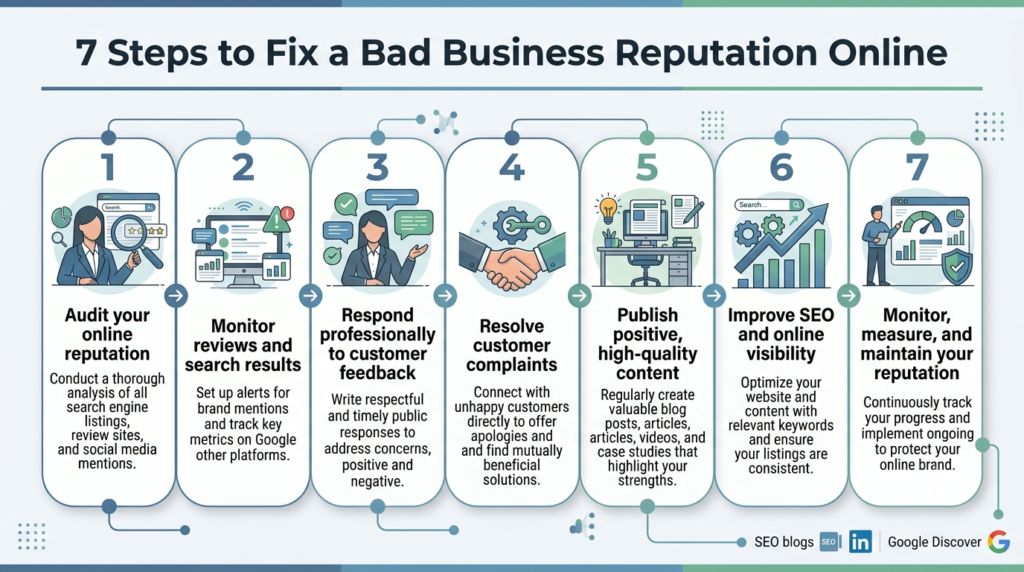
How to Fix a Bad Business Reputation Online
Step 1: Audit What’s Currently Ranking
Search your business name, and if relevant, your own name as an individual, across standard search and news-specific search. Document everything on the first two pages, sorting it into accurate-positive, accurate-unflattering, and inaccurate-outdated categories. This audit becomes the foundation for every step that follows.
Step 2: Fix the Fastest Wins First
Correct outdated business listings, inconsistent NAP (name, address, phone) details across directories, and any unclaimed profiles. These foundational fixes are often the quickest form of reputation damage control available and clear the ground before deeper work begins.
Step 3: Address Reviews Directly
Respond professionally to negative reviews, report any that breach platform guidelines, and encourage a genuine, steady stream of new feedback. Negative reviews removal UK platforms allow is limited to policy violations, so this step is about balance and response quality, not deletion alone.
Step 4: Contact Publishers for Outdated or Incorrect Content
If specific articles or pages are outdated, factually incorrect, or resolved, reach out to the publisher directly. Many will correct, update, or in some cases remove content once given clear, evidenced context.
Step 5: Pursue Legal Removal Where Appropriate
If content includes false statements of fact causing serious harm, this may meet the UK threshold for defamation. A solicitor can pursue formal removal through a letter before action. This route is separate from, and should run alongside rather than instead of, a broader reputation strategy.
Step 6: Build Positive, Authoritative Content
This is where real, sustainable business reputation recovery happens. Publish genuine case studies, expert commentary, press coverage, and updated professional profiles designed to rank for your name over time. Search result suppression of negative content is rarely about removal. It’s about building enough authoritative content that the negative result stops being the first thing people see.
Step 7: Monitor Continuously
Set up ongoing search alerts and review monitoring so new issues are caught early. Crisis reputation management works far better as prevention than as damage control, and consistent monitoring is what makes that possible.
Tips and Best Practices for Successful Reputation Repair
- Prioritise accuracy over speed. A rushed, defensive response usually causes more damage than the original issue
- Keep a paper trail of every removal request and publisher response, since legal escalation may require it later
- Treat company-level and personal-level reputation as connected but distinct problems requiring separate strategies
- Never pursue incentivised or fake reviews as a fix. This risks platform penalties and further reputational harm
- Set realistic timelines. Foundational fixes can move in days, but full recovery from entrenched negative content typically takes several months
Fix A Bad Business Reputation Online
Tools for Managing Online Reputation
- Google Alerts or a dedicated search monitoring tool, for tracking new mentions of your name or business
- Review management platforms, for centralising and responding to feedback across Google, Trustpilot, and industry-specific sites
- Google Search Console, for monitoring how your own site’s content is indexing and performing
- A reputation monitoring tools dashboard, if managing multiple locations, executives, or brand entities at once
Get Started With Reputation Repair Today
The businesses and individuals who recover fastest are the ones who start with a clear audit rather than reacting to the most visible problem first. If your situation involves a straightforward review cluster, much of this can be handled with consistent internal effort. If it involves legal risk, a viral incident, or entrenched negative content, working with a specialist in online reputation repair services UK-wide will typically move faster and more safely than handling it alone.
Frequently Asked Questions
How long does it take to fix a bad business reputation online?
Foundational fixes, like correcting listings, can show results within days. Rebuilding search visibility through content and reviews typically takes a few weeks to several months, depending on how entrenched the negative content already is.
Can negative content ever be fully removed from Google?
Only in specific cases, such as content violating platform policy, containing personal data, or meeting a legal threshold like defamation. In most cases, the realistic goal is outranking it rather than removing it entirely.
Is personal reputation repair different from business reputation recovery?
They overlap in method but differ in scope. Personal reputation work often involves more sensitive legal considerations, such as GDPR-based removal rights, while business reputation recovery focuses more heavily on reviews and customer-facing content.
Do I need a solicitor or a reputation management agency?
If the content involves false statements of fact causing serious harm, start with a solicitor. If it involves genuine but unflattering reviews or outdated content, a reputation management agency is the more appropriate first step.
What’s the biggest mistake businesses make when trying to fix their reputation?
Reacting only to the most visible problem instead of conducting a full audit first. This often means the underlying, larger issues keep resurfacing even after the initial complaint is addressed.