

Doctor Reputation Management UK
Doctor reputation management UK practices need today covers more ground than most people realise. It’s not just about one clinician’s search results, it’s about protecting an entire practice, its patient reviews, its CQC ratings, and every doctor working under its name, all at once. A single unresolved complaint or a run of unanswered reviews can affect patient trust in the whole practice, not just the individual involved.
What Does Doctor Reputation Management UK-Wide Actually Cover?
Doctor reputation management UK-wide typically spans three connected layers: individual doctor search results and GMC-related visibility, practice-level reviews across Google and NHS-linked platforms, and CQC ratings that reflect on the practice as a whole. Managing only one layer while ignoring the others leaves real gaps, since patients researching care often check all three before booking.
Why Practices Face a Different Challenge Than Individual Doctors
An individual doctor’s reputation centres on their own name, GMC registration, and personal conduct. A practice’s reputation is the sum of every doctor working there, plus the facility itself, its CQC rating, its front-of-house experience, and its collective review history. A practice can have several excellent doctors and still suffer reputational damage from a single unresolved administrative complaint or one doctor’s unmanaged online presence dragging down the group’s overall perception.
This is why practice-level doctor reputation management UK strategy needs to work at both levels simultaneously, individual and institutional, rather than treating either in isolation.
GMC Scrutiny: What It Means for the Practice, Not Just the Doctor
A GMC complaint against an individual doctor can still affect the practice’s reputation, particularly if the matter becomes public through a tribunal hearing or local press coverage. Confidentiality obligations mean the practice generally cannot discuss specifics publicly, even to defend itself, which makes proactive reputation management more important, not less, during these periods.
If a practice is currently facing an active GMC matter involving one of its doctors, our detailed guide to GMC complaints and patient reviews covers the individual doctor’s side of this in more depth, including exactly what can and cannot be said publicly during an active case.
CQC Ratings: The Practice-Level Layer Most Sites Ignore
Unlike GMC scrutiny, which applies to individual doctors, CQC ratings apply to the practice or facility itself, and they are publicly searchable alongside patient reviews. A practice with a strong CQC rating has a genuine trust asset to lean on during a difficult review period, while a weak or outdated CQC listing can undercut even excellent individual doctor reputations within that practice. Keeping CQC information current and, where a re-inspection has improved a rating, ensuring that update is reflected prominently is an often-overlooked part of doctor reputation management UK practices should be actively maintaining.
Managing Patient Reviews at the Practice Level
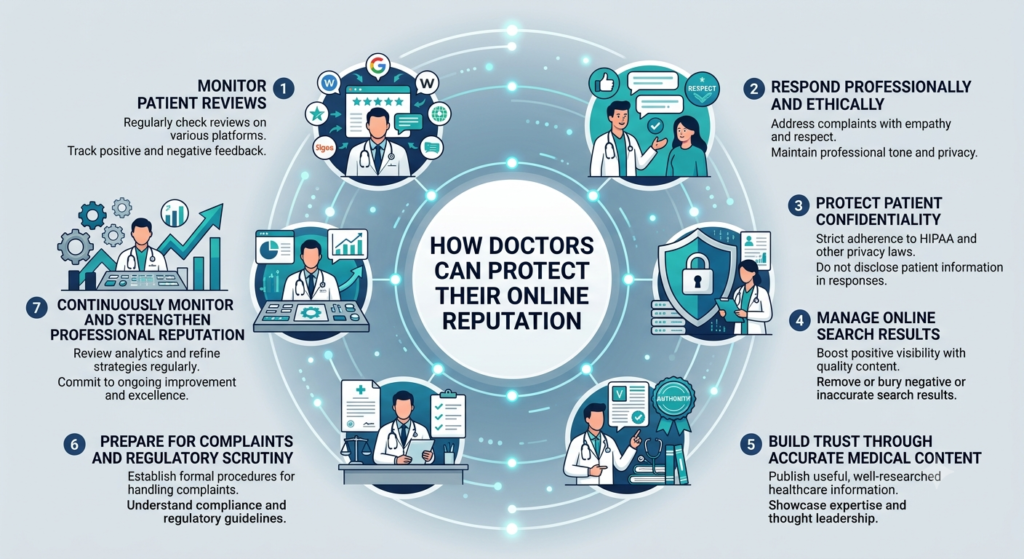
Patient reviews UK-wide carry particular weight for medical practices because healthcare decisions feel high-stakes to patients choosing where to register or seek treatment. A few principles matter most here: respond to reviews generally and professionally without confirming or discussing any specific patient details, encourage genuine feedback consistently rather than only after negative experiences, and ensure review responses come from a designated practice contact rather than individual clinicians commenting informally.
Our guide to the UK review platforms that matter most is a useful reference for understanding where patients are most likely to actually leave and read reviews about a practice.
Building a Resilient Practice Reputation Proactively
The strongest medical practice reputation UK-wide is built before a crisis, not during one. This includes maintaining accurate, consistent practice information across Google Business Profile, NHS.uk listings, and any relevant directories, ensuring every doctor at the practice has at least a basic, professional online presence rather than leaving gaps that outdated or unrelated content can fill, and establishing a clear internal process for who responds to reviews and complaints so responses stay consistent and appropriately worded.
Responding to a Practice-Level Crisis
If a serious incident affects the practice’s public reputation, whether a safety concern, a high-profile complaint, or negative media coverage, speed and consistency matter more than a perfect statement. Our guide to reputation damage control in the first 48 hours walks through the response framework this kind of fast-moving situation demands, adapted here to the specific sensitivities of a healthcare setting, including patient confidentiality throughout the response process.
When Content Crosses Into a Legal Matter
Most patient reviews reflect genuine experience, even when critical. Occasionally, content goes further, containing false statements of fact rather than opinion, and causing serious harm to the practice or an individual doctor’s reputation. In these cases, this moves beyond standard doctor reputation management UK practice into genuine legal territory. Our comparison of defamation solicitors versus reputation management agencies explains how to tell which situation applies before committing resources to the wrong approach.
Frequently Asked Questions
What’s the difference between GMC and CQC when it comes to reputation?
The GMC regulates individual doctors and their professional conduct, while the CQC rates and regulates practices and facilities as a whole. Both are publicly searchable and both affect how patients perceive a practice, but they operate at different levels.
Can a practice respond publicly to a negative patient review?
Yes, but the response must stay general and avoid confirming or discussing any specific patient details, due to confidentiality obligations that apply regardless of how the review itself is worded.
Does one doctor’s reputation issue affect the whole practice?
It can, particularly if the matter becomes public or if patients associate the issue with the practice generally rather than the individual doctor specifically, which is why practice-level monitoring matters alongside individual doctor reputation work.
How often should a practice check its CQC rating and online reviews?
Regularly, ideally as part of a routine monthly check, since CQC ratings can change after inspections and review patterns can shift more quickly than practices often expect.
Should every doctor at a practice have their own online presence, or is the practice profile enough?
Both matter. A practice-level profile handles general enquiries and reviews, but individual doctor profiles help patients research the specific clinician they’ll actually be seeing, and gaps here are often filled by outdated or irrelevant content instead.