
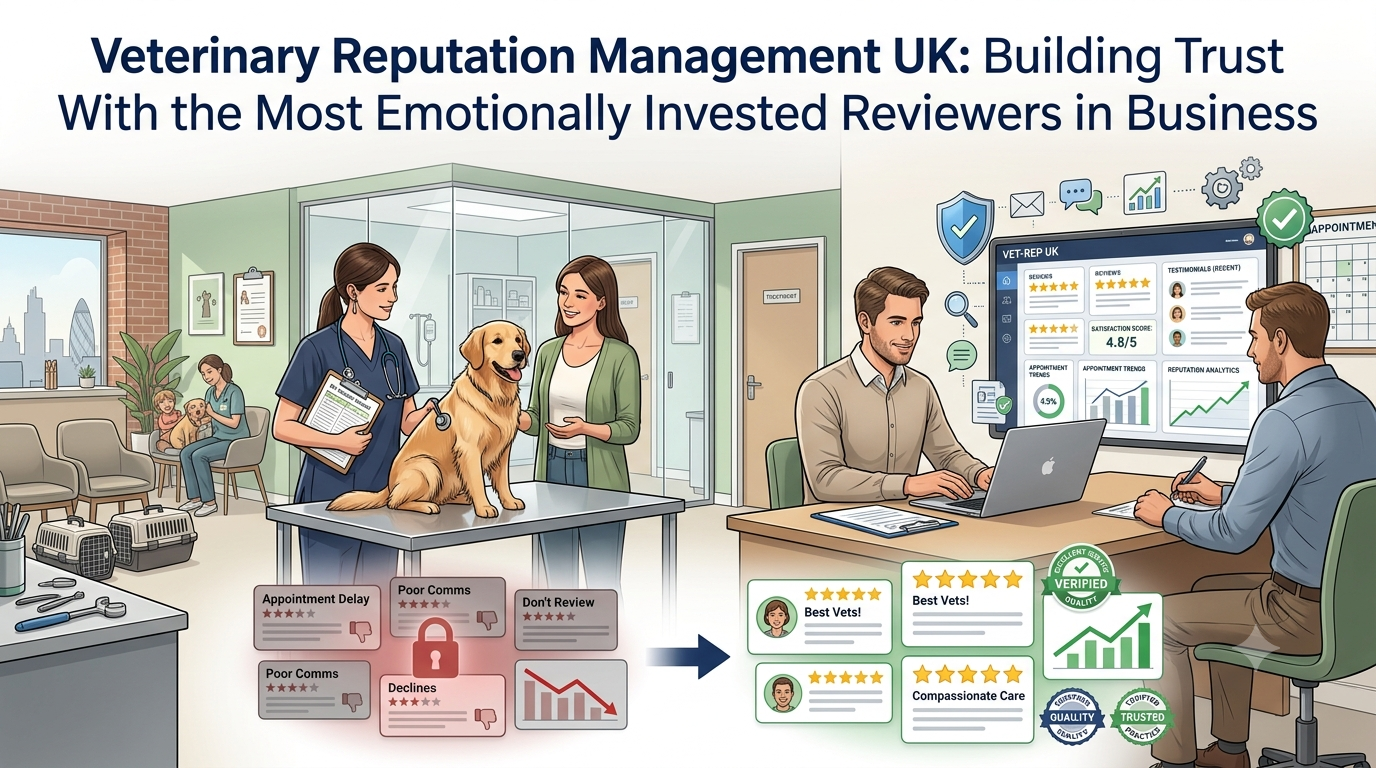
Veterinary Reputation Management
No one researches a service provider quite as anxiously as a pet owner choosing a vet. Their patient can’t describe symptoms, can’t consent to treatment, and can’t tell them afterward whether the experience was a good one, which means every decision rests entirely on trust built beforehand. Veterinary reputation management exists because that trust is unusually fragile, and unusually public, built through reviews, word of mouth, and a regulatory framework that’s currently under more scrutiny than it’s faced in years.
Why Vet Practices Face Uniquely High Emotional Stakes
Pet owners write some of the most detailed, emotionally charged reviews of any service industry, since a vet visit often involves genuine fear for a beloved animal’s wellbeing. Veterinary reputation management has to account for this intensity directly: a single difficult experience, a perceived rushed consultation, an unclear fee, a communication breakdown during an already stressful moment, can generate a review far more detailed and far more widely read than a typical service complaint in almost any other sector.
The CMA Investigation Changed What Pet Owners Now Expect
A recently concluded Competition and Markets Authority investigation into the veterinary sector has put fee transparency and pricing practices under sustained public attention, and pet owners are noticeably more informed and more likely to question costs than they were even a couple of years ago. Veterinary reputation management now has to treat clear, upfront pricing communication as a core reputational priority, not an operational detail, since practices that haven’t adapted to this heightened scrutiny are more likely to generate exactly the kind of cost-related complaints the CMA investigation specifically highlighted.
Understanding the RCVS Complaints Landscape
The Royal College of Veterinary Surgeons regulates individual veterinary surgeons and nurses through its concerns process, though it’s worth knowing that only around 20% of concerns raised actually progress to a full investigation, since many arise from misunderstandings that get resolved through direct conversation with the practice itself. For unresolved disputes that don’t meet the RCVS’s threshold for serious professional misconduct, the Veterinary Client Mediation Service offers free, voluntary mediation between the practice and the pet owner, a genuinely useful resolution route that many practices under-promote to anxious clients who assume a formal complaint is their only option. This dual layer structure, an individual professional regulator alongside a separate practice-level complaints route, closely mirrors the pattern covered in our dental practice reputation management guide, where the GDC and CQC play a similar dual role.
What Actually Drives Negative Veterinary Reviews
A few specific patterns show up consistently across vet practice reviews UK-wide:
- Perceived cost surprises during an already stressful visit. Given the current climate of fee scrutiny following the CMA investigation, unclear pricing communication is now one of the fastest routes to a detailed, specific negative review, since pet owners increasingly expect transparency as standard.
- Communication that feels rushed during emotionally difficult moments. End-of-life decisions, diagnosis conversations, and treatment options all require time and empathy, and reviews frequently cite feeling hurried through exactly these conversations as the source of lasting dissatisfaction.
- Perceived dismissiveness toward a pet owner’s concerns. Even when clinically correct, a response that comes across as dismissive of a worried owner’s questions tends to generate reviews describing feeling unheard, regardless of whether the underlying veterinary judgement was sound.
- Unclear next steps after treatment. Reviews frequently cite confusion about aftercare instructions or follow-up expectations, an easily preventable gap that nonetheless shapes lasting impressions of the entire practice.
How Effective Veterinary Reputation Management Actually Works
Strong veterinary reputation management starts with proactive fee transparency, clear, upfront cost communication before treatment begins, directly addressing the exact concern the CMA investigation brought into sharp public focus. Alongside this, practices benefit from actively promoting the Veterinary Client Mediation Service as a genuine, non-adversarial resolution option, since many pet owners escalate straight to a public review or formal complaint simply because they don’t know a calmer middle path exists.
Responding to negative reviews requires particular sensitivity given the emotional weight involved. A defensive or clinical-sounding response to a review about a pet’s care can look cold regardless of the actual facts, while a genuinely empathetic, specific response, acknowledging the difficulty of the situation without disclosing confidential treatment details, demonstrates exactly the compassion pet owners are looking for when researching a practice. For situations that escalate quickly, a viral complaint, a serious welfare allegation, our guide to reputation damage control in the first 48 hours covers the response framework that applies to fast-moving reputational incidents generally.
Building Long Term Trust With Pet Owners
The strongest veterinary practices treat reputation as continuous groundwork rather than crisis response: maintaining a steady, genuine flow of vet clinic Google reviews, communicating pricing clearly and consistently across every client interaction, and ensuring every team member, not just senior vets, understands how to handle a worried or upset pet owner with patience. Our guide to the UK review platforms that matter most is a useful reference for understanding where pet owner review activity tends to concentrate. This proactive approach to veterinary reputation management consistently outperforms reactive damage control once a difficult review has already been posted.
Why Multi Branch Veterinary Groups Face an Added Layer
Veterinary reputation management becomes more complex for practices operating multiple branches or belonging to a larger corporate group, a structure that has become increasingly common across the UK sector in recent years. Pet owners researching a specific branch often don’t distinguish clearly between an individual practice and the wider group it belongs to, meaning a reputation issue at one location can quietly influence perception of the entire brand, even among clients who have never actually visited that branch. This makes consistent standards around fee communication, client care, and review response particularly important for larger veterinary groups, since the CMA’s findings on transparency and pricing practices apply with equal weight regardless of practice size, and a single branch falling short can attract disproportionate attention precisely because of its association with a larger, more visible group.
Coordinated monitoring across every branch, alongside a shared, consistent approach to responding to reviews and client concerns, helps prevent this kind of reputational spillover. Independent single-site practices generally have more direct control over their own reputation, but even they benefit from treating this as an ongoing, structured practice rather than something addressed only when a difficult review appears.
Frequently Asked Questions
How has the CMA investigation actually changed what pet owners expect from vets?
Pet owners are now noticeably more attentive to pricing transparency and more likely to question costs upfront, meaning practices that haven’t adapted their fee communication are more exposed to cost-related complaints than before the investigation’s findings became public.
What percentage of RCVS concerns actually lead to formal disciplinary action?
Only around 20% of concerns raised with the RCVS progress to a full investigation, and many issues that do get raised are ultimately resolved through direct conversation with the practice rather than formal regulatory action.
What is the Veterinary Client Mediation Service, and should practices promote it?
It’s a free, voluntary mediation service that helps resolve disputes between pet owners and practices without a formal complaint. Practices that promote it proactively often prevent unresolved frustration from escalating into a public review instead.
How should a vet practice respond to a negative review about a pet’s care?
With genuine empathy and a general acknowledgement of the difficulty involved, without disclosing specific treatment details, since a response that reads as clinical or defensive tends to compound the original complaint rather than resolve it.
What’s the single most preventable cause of negative vet reviews right now?
Unclear fee communication, especially given the heightened public attention on veterinary pricing following the CMA investigation, making proactive, upfront cost transparency one of the highest-impact changes a practice can make.