
Business Reputation Score UK
Ask ten business owners what a “business reputation score” actually means, and you will likely get several different answers. Some assume it refers to how the company is perceived by customers and the public. Others assume it means a financial rating used by lenders. In reality, a business reputation score UK companies should be paying attention to actually covers two distinct things, and confusing them can lead to focusing effort in the wrong place entirely.
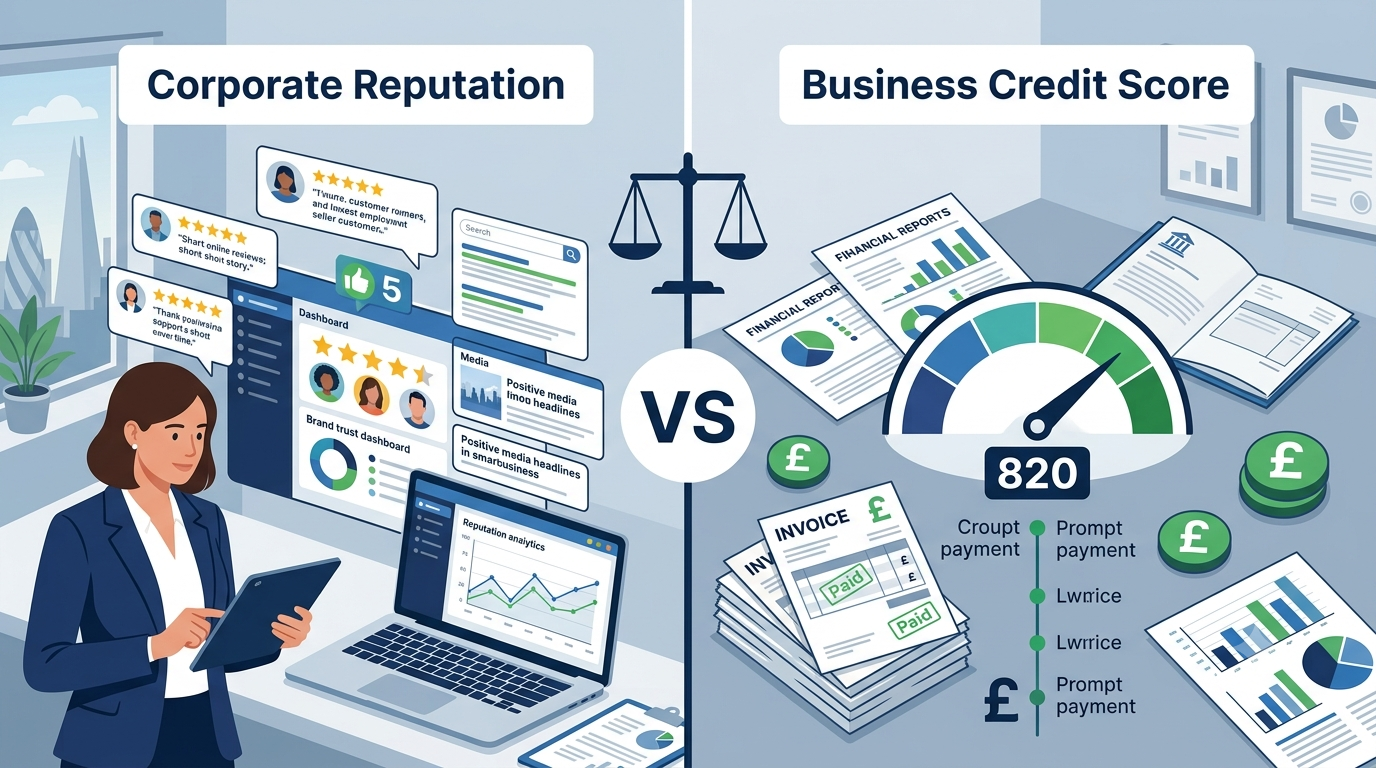
This guide separates the two clearly: corporate reputation, which reflects public and brand perception, and business credit score, which reflects financial reliability. Understanding both, and how they influence each other, gives a much clearer picture of where your business actually stands.
Corporate Reputation: Public and Brand Perception
Corporate reputation is the part most people mean when they talk about a business reputation score in everyday conversation. It reflects how customers, employees, partners, and the wider public perceive a company based on reviews, press coverage, search results, and general sentiment.
This side of reputation is shaped by things like:
- Customer reviews across Google, Trustpilot, and industry-specific platforms
- Employer reviews on sites like Glassdoor
- News coverage and press mentions
- Social media sentiment and engagement
- Search engine results for the company name
Corporate reputation management is the ongoing work of monitoring and shaping these signals, since none of them are static. A single viral complaint or a wave of negative reviews can shift public perception quickly, which is why active monitoring and response matter as much as the underlying quality of the business itself.
Business Credit Score: Financial Reliability
Separate from brand perception, your business credit score measures something entirely different: how financially reliable your company appears to lenders, suppliers, and other businesses considering credit terms. This score is calculated by credit reference agencies such as Experian, Equifax, Creditsafe, and Dun & Bradstreet, using data including payment history, company accounts filed at Companies House, outstanding debts, and any County Court Judgments.
A strong business credit score UK companies rely on can mean better loan terms, more favourable supplier credit terms, and greater trust from potential business partners conducting due diligence before signing a contract. Unlike corporate reputation, this score is driven almost entirely by financial behaviour rather than public sentiment.
Why These Two Scores Get Confused
The confusion between corporate reputation and business credit score usually comes down to the word “reputation” being used loosely to describe both. In practice, a business can have an excellent corporate reputation, glowing reviews, strong press coverage, high customer satisfaction, while still carrying a weak business credit score due to late payments or thin filed accounts. The reverse is also true: a financially strong business can still suffer from poor public perception if reviews and search visibility are neglected.
Treating these as the same thing means one can be managed while the other quietly deteriorates unnoticed.
How Corporate Reputation Is Actually Measured
There is no single official corporate reputation score in the way there is a standardised credit score. Instead, it is typically assessed through a combination of review platform ratings, sentiment analysis across search results and social media, and the overall balance of positive versus negative content appearing for the company name. Reputation management agencies often build an informal scoring model internally, tracking these signals over time to measure whether public perception is improving or declining.
How Your Business Credit Score Is Calculated
Business credit scores in the UK are typically calculated using a points-based or letter-grade system depending on the agency, factoring in payment history with suppliers, filed accounts and their timeliness, any County Court Judgments or insolvency history, and the length of time the business has been trading. You can check your own business credit report UK-wide directly through Experian, Equifax, or Creditsafe, and it is worth reviewing this periodically in the same way you would monitor your personal credit file.
Where to Check Each Score
For corporate reputation, start with a direct search of your business name across Google, plus a review of your listings on Trustpilot, Google Business Profile, and any relevant industry platforms. For your business credit score, request a report directly from a UK credit reference agency such as Experian or Equifax, several of which offer a free or low-cost initial check for company directors.
How They Influence Each Other
While distinct, these two scores are not entirely separate. A damaged corporate reputation, particularly one involving public disputes or unresolved complaints, can indirectly affect creditworthiness if it leads to lost contracts, reduced revenue, or payment difficulties. Similarly, a poor business credit score that becomes public, through a County Court Judgment or insolvency filing, can damage corporate reputation if it surfaces in press coverage or search results. Businesses that manage both proactively tend to be more resilient when either one comes under pressure.
Building a Strong Business Reputation Score
Improving corporate reputation involves consistent review management, active search monitoring, and genuine positive content over time, the kind of work covered in our 10-point UK checklist for signs your business needs reputation management. Improving your business credit score is a more mechanical process: paying suppliers on time, filing accounts promptly, and keeping company records at Companies House accurate and current.
Treating both as ongoing priorities, rather than one-off checks, is what protects a business from being caught off guard on either front.
Frequently Asked Questions
Is there one single business reputation score in the UK?
No. Corporate reputation is typically assessed through a combination of review, sentiment, and search signals rather than a single standardised number, unlike a business credit score, which does follow a more formal scoring model from credit reference agencies.
Can a good business credit score offset bad reviews?
Not directly. They influence different audiences, lenders and suppliers care primarily about credit reliability, while customers and the public respond to reviews and search visibility, so both need to be managed on their own terms.
How often should I check my business credit report UK-wide?
Checking every few months is a reasonable habit, particularly before seeking new credit terms, applying for a loan, or entering a significant new supplier relationship.
Does a poor corporate reputation affect my ability to get business credit?
Not directly through the credit scoring formula itself, but indirectly, since reputational damage that affects revenue or leads to payment difficulties can eventually show up in your credit history.
What is the fastest way to improve a damaged corporate reputation?
Start with an audit of what currently appears in search results, address any quick wins like outdated listings, then build a consistent strategy of genuine reviews and positive content over time, since sustainable improvement is rarely instant.