Crisis Management for Reputation
Every business thinks it won’t happen to them, right up until it does. A data breach, a viral complaint, a product failure, a leadership scandal, the trigger varies, but the pattern that follows almost never does. Crisis management for reputation isn’t really about the crisis itself. It’s about whether a business already has a framework in place before disaster strikes, or whether it’s improvising the basics while the story is already spreading.
This guide covers the complete picture, not just the frantic first hours, but the planning that should happen long before a crisis, and the recovery work that continues long after the headlines fade.
Why Most Businesses Get Crisis Management for Reputation Backwards
The instinct is to think of crisis management as something that starts when the crisis does. In practice, effective crisis management for reputation actually starts months or years earlier, with a documented plan, a trained team, and a clear understanding of what could realistically go wrong. Businesses that treat this as purely reactive consistently perform worse than those with even a modest plan in place, not because the crisis itself is different, but because every early decision gets made faster and with far less panic.
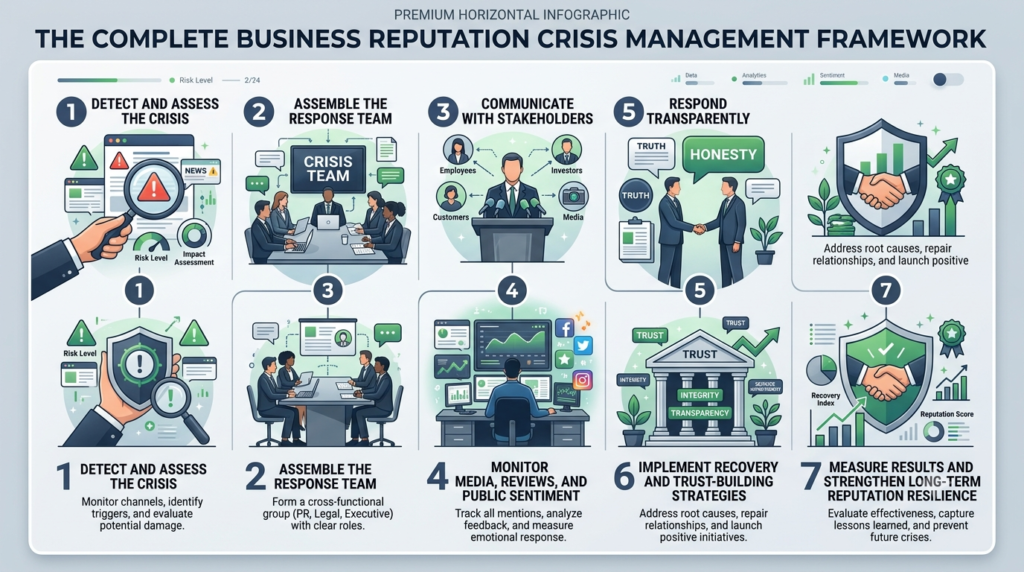
The Three Phases of a Complete Framework
A genuinely complete framework covers three connected phases, and most businesses only ever build the middle one.
| Phase | What It Involves | When It Happens |
|---|---|---|
| Prevention | Risk mapping, response planning, team training | Ongoing, before any crisis |
| Response | Immediate containment, communication, monitoring | The first hours and days |
| Recovery | Rebuilding trust, search visibility, long-term monitoring | Weeks to months afterward |
Phase One: Prevention and Planning
This is the phase almost every business skips, and it’s the one that determines how well the other two go. A genuine crisis prevention planning process includes mapping realistic risk scenarios specific to your industry, identifying who holds decision-making authority during a crisis before you actually need them to act, and drafting holding statement templates for your most likely scenarios so no one is writing from scratch under pressure.
This is also where a stakeholder communication crisis plan gets built, covering not just public messaging but how employees, investors, and partners are kept informed in parallel with any public response.
Phase Two: The Acute Response Window
This is the phase most crisis content focuses on exclusively, and for good reason, since the first hours and days genuinely do shape how a story develops. Reputation crisis response at this stage means confirming facts before speaking publicly, issuing a prompt holding statement, briefing employees before they learn about a situation externally, and monitoring sentiment closely enough to adjust the response as new information emerges.
We’ve covered this specific window in detail elsewhere: our guide to the first 24 hours of crisis PR walks through the immediate response sequence, and our guide to reputation damage control across the first 48 hours extends that into the full initial response period, hour by hour. Both are worth reading alongside this framework for the tactical detail this overview doesn’t repeat.
Phase Three: Recovery, the Phase Everyone Underestimates
Once the immediate story fades from headlines, most businesses assume the work is done. It isn’t. A genuine crisis recovery strategy continues well beyond the acute window, rebuilding search visibility so the incident doesn’t permanently dominate the business’s name in search results, restoring internal trust with employees who lived through the disruption, and monitoring closely for any resurgence as the story gets referenced in future coverage.
Our guide to building a positive content strategy covers exactly this longer-term rebuilding work, the genuine, authoritative content that gradually outweighs a crisis in search visibility rather than simply waiting for it to fade on its own.
Building a Business Crisis Framework That Actually Gets Used
A framework sitting unused in a drawer helps nobody. The businesses that handle a real crisis well are the ones that rehearse their plan periodically, even briefly, so the team executing it has done so before under low-stakes conditions. This includes running a short tabletop exercise using a realistic scenario, confirming the current decision-makers and contact details are actually up to date, and reviewing the plan after any real incident, however minor, to close gaps before a bigger one arrives.
Reputational Risk Management as an Ongoing Discipline
Crisis management for reputation works best when it’s treated as one part of a broader reputational risk management practice, not an isolated emergency procedure. This means regularly reassessing what could realistically go wrong as the business changes, since the risks facing a five-person startup look nothing like the risks facing the same company three years and fifty employees later. Our 10-point UK checklist for signs your business needs reputation management is a useful way to gauge whether your current risk exposure has outgrown your existing plan.
Why a Real Framework Beats Improvisation Every Time
The genuine difference between businesses that recover well and those that don’t rarely comes down to the severity of what happened. It comes down to whether a real plan was already a practiced discipline before the crisis, or whether the basics were being figured out live, in public, under pressure. A complete framework doesn’t prevent every bad thing from happening. It ensures that when something does, the response is fast, coordinated, and credible from the very first hour.
Frequently Asked Questions
Do small businesses really need a formal crisis management framework?
Yes, even a simple one. Small businesses often have less brand equity to absorb a poorly handled incident, meaning a modest, practiced plan provides disproportionate protection relative to its cost.
How often should a crisis management plan be reviewed?
At least annually, and after any real incident, however minor, since business risk, staff, and contact details all change over time and an outdated plan can be as unhelpful as no plan at all.
What’s the biggest gap in most companies’ crisis management for reputation?
The prevention phase. Most businesses have some idea of how they’d respond during a crisis but have never actually documented or rehearsed it, which costs valuable time in the first critical hours.
Is crisis management the same as reputation damage control?
Damage control refers specifically to the acute response during and immediately after an incident, while crisis management for reputation is the broader discipline covering prevention and long-term recovery as well.
How long does full reputation recovery typically take after a serious crisis?
Often several months to a year, depending on severity, since search visibility, stakeholder trust, and public sentiment each tend to recover at a different pace rather than simultaneously.