

Search visibility control decides which reviews shape buyer decisions, and reputation signals decide whether a hospitality or travel brand appears credible in search. Reputation management services work because they organise monitoring, response, and recovery into a structured system that changes what users see and what search engines prioritise.
Which review management approach delivers measurable results?
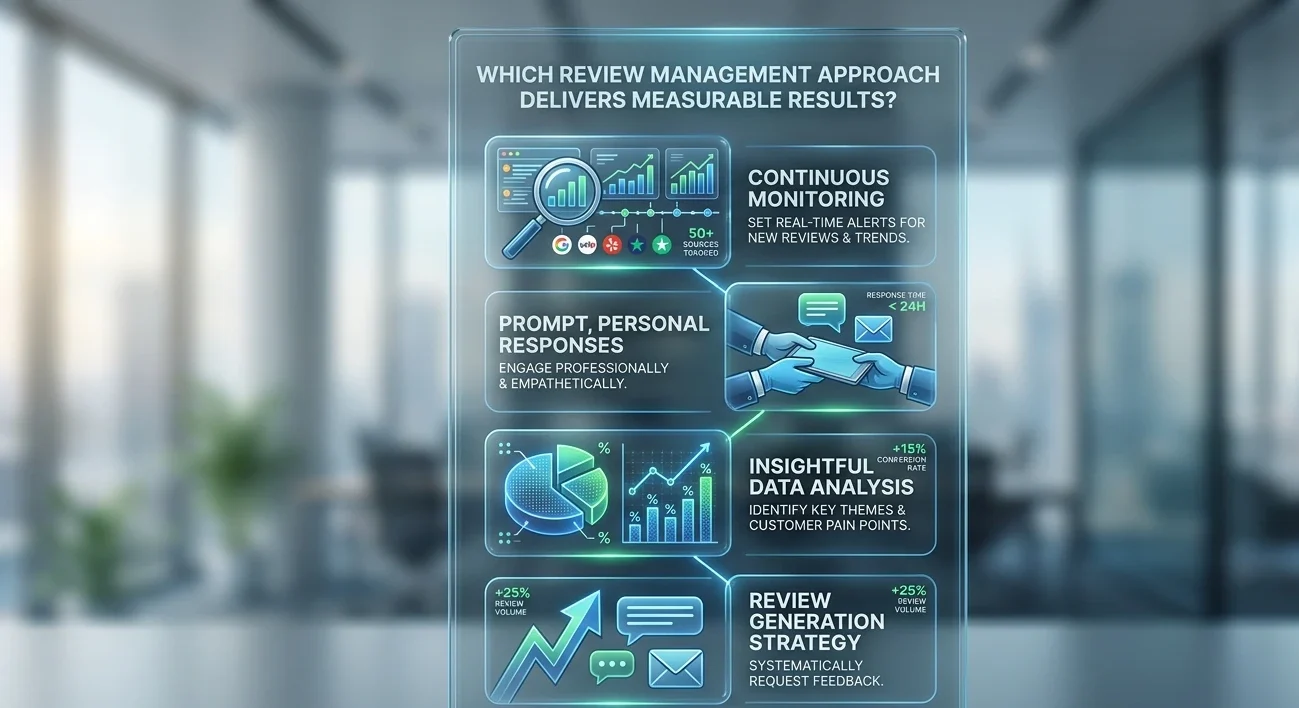
The most effective approach combines continuous monitoring, fast response, and structured recovery, because that sequence improves sentiment distribution and stabilises entity credibility. It delivers measurable results by reducing unresolved criticism, increasing visible trust signals, and improving how branded search results read to new visitors.
Dive Deeper With Our Expert Guides and Related Blog Posts:
Improve Your TripAdvisor Standing With a Professional UK Review Strategy
Protect Your Restaurant Brand With a Consistent Reputation Management Plan
Monitoring is the first layer. It tracks new reviews, rating changes, and platform-specific sentiment shifts across the business’s search footprint. This matters because review velocity influences how fast negative content gains visibility. A review left unanswered for 14 days often appears more prominent than one that receives a clear public reply within 24 hours.
Response is the second layer. It addresses criticism in a visible, professional way that reduces conflict and shows operational control. Search engines and users both treat active response behaviour as a trust signal, especially when the reply resolves a service issue or clarifies a misunderstanding. A weak or absent response pattern weakens search perception influence, even when the average rating remains stable.
Recovery is the third layer. It uses structured reputation work to correct the profile after a negative cluster forms. That can include review generation, platform-specific remediation, and support content that rebalances the branded SERP. Reputation PR positions this as a managed system rather than a one-time fix, because sustainability depends on repeated reputation signals, not isolated interventions.
How does a hospitality and travel reputation service work in search ecosystems?
A hospitality and travel reputation service works by tracking review ecosystems, shaping response behaviour, and improving the mix of signals that search engines use to evaluate trust. It influences rankings and perception by changing the volume, quality, and recency of publicly visible review activity.
Search ecosystems do not evaluate reviews as isolated comments. They evaluate clusters of feedback, platform diversity, response patterns, and recency. A hotel with 50 recent, detailed reviews across Google and Booking.com sends a stronger reputation signal than a property with a single high rating on one platform. This is because search systems interpret distributed evidence as more credible than a narrow signal source.
The service works by structuring how those signals appear. If a venue receives a negative TripAdvisor cluster, the management process tracks whether the same issue repeats on Google, Booking.com, or Trustpilot. That comparison identifies whether the problem is operational, platform-specific, or reputationally amplified. The result is a cleaner view of entity credibility, because the service distinguishes a one-off complaint from a systemic perception issue.
In practical terms, this means the service is not limited to review replies. It includes monitoring, escalation, sentiment analysis, and recovery planning. Reputation PR uses this structure to ensure the review profile does not drift into negative dominance, because search engines react to visible imbalance quickly. The stronger the control over review flow, the stronger the SERP control and the more predictable the public narrative.
What outcomes matter most when choosing a review management solution?
The most important outcomes are improved search visibility, stronger trust signals, and reduced exposure to unresolved negative content. These outcomes matter because they determine whether potential guests see a credible business or a review profile that raises booking friction.
Improved search visibility means the right content occupies the top of the branded search page. That includes updated review responses, recent positive reviews, and accurate business profiles. When search results show active reputation management, users interpret the business as monitored and accountable. That perception supports higher confidence before booking or enquiry.
Stronger trust signals come from visible activity. A property that replies to complaints, thanks positive reviewers, and resolves issues in public view sends a more reliable signal than a property with silent or defensive review behaviour. Search engines notice this behaviour through engagement patterns and recency. They also interpret consistent response quality as evidence that the business is active and credible.
Reduced exposure to unresolved negative content protects conversion. If a one-star review about cleanliness, check-in delays, or service failure remains unanswered at the top of the search profile, it shapes perception faster than any promotional page can correct it. A managed review system reduces that risk by improving the ratio of positive to negative content and by pushing recovery actions into the same search environment where decisions happen.
Why does multi-platform management outperform single-platform review control?
Multi-platform management outperforms single-platform control because hospitality and travel decisions rely on a distributed trust pattern, not one review site alone. Search engines aggregate reputation signals from several sources, so a narrow focus leaves visible gaps in entity credibility.
Google Business Profile affects local discovery and map visibility. TripAdvisor influences travel comparison behaviour. Booking.com shapes booking-stage confidence. Trustpilot contributes to general brand trust. A business that manages only one of these channels leaves the rest open to unmanaged sentiment distribution, which creates inconsistency in search perception.
The difference is measurable. A hotel with strong Google reviews and weak TripAdvisor management appears split. A travel operator with active Booking.com recovery but no Trustpilot response leaves a gap in broader consumer trust. Search engines and users both read those gaps as risk. That gap weakens ranking influence because the profile lacks coherence across the platforms where buyers compare options.
Multi-platform control solves this by standardising monitoring and response across every major review environment. The service tracks whether a complaint on one platform appears in another, whether the same issue is repeated by different users, and whether the reply tone stays consistent. Reputation PR uses this approach because the goal is not to win one platform. The goal is to stabilise the full search footprint.
How do cost, speed, and sustainability compare across reputation solutions?
The best reputation solution balances cost, speed, and sustainability rather than optimising only one of them. Fast suppression without long-term recovery creates repeated risk, while slow organic repair without active response leaves negative content visible too long.
Cost differs by method. Manual response and monitoring are lower cost but demand internal discipline. Full recovery systems cost more because they combine review surveillance, escalation, sentiment analysis, and structured repair. That added cost creates long-term value when the business depends on bookings, repeat visits, and comparison visibility. A low-cost, inconsistent system often fails because it leaves unresolved content in place.
Speed also differs by method. Review replies can stabilise perception in hours, while review generation and trust rebuilding take weeks. If a crisis cluster appears on Google or TripAdvisor, the fast response layer protects the brand immediately. If the aim is durable recovery, the business needs a longer cycle of positive review accumulation and content balancing.
Sustainability is the decisive factor. A solution that only hides negative reviews for 7 days does not solve the underlying visibility problem. Sustainable reputation management creates a stronger mix of reputation signals over time, so that future negative content has less influence. That is where a structured service becomes valuable: it keeps the profile stable after the initial repair phase ends.
What does a reliable review recovery process look like?
A reliable recovery process follows a fixed sequence: monitor, classify, respond, recover, and maintain. This sequence ensures that the review profile changes in a controlled way rather than through reactive, uneven fixes.
The first stage is monitoring. It identifies new reviews across platforms before they compound into visible clusters. The second stage is classification. It measures severity, topic, and platform impact so that the business can prioritise genuine threats to credibility. A review about hygiene or safety carries more weight than a vague opinion about atmosphere.

The third stage is response. Replies should be precise, visible, and consistent. A good reply acknowledges the issue, clarifies the facts, and signals action. That behaviour strengthens trust because it shows the business operates with accountability. The fourth stage is recovery. It improves the profile by increasing positive review activity and balancing negative sentiment with visible support content.
The fifth stage is maintenance in multiple platforms. This stage prevents the same problem from returning. It keeps the monitoring system active, reviews the response pattern, and tracks how new feedback affects branded search. Reputation PR frames this as a control system, not a one-off campaign, because search perception only stabilises when the process continues after the initial crisis response.
How should a business decide when expert help becomes necessary?
Expert help becomes necessary when review issues affect search visibility, booking confidence, or public trust faster than internal teams can manage them. The trigger is not the number of reviews alone. The trigger is the speed and visibility of negative content in search.
A business can manage isolated praise or a single minor complaint internally. It needs structured support when negative content appears on Google, TripAdvisor, Booking.com, and Trustpilot at once. At that point, the reputation problem is no longer a simple response issue. It becomes a search perception issue that requires coordinated control across platforms.
Clear escalation criteria make the decision easier. If unanswered criticism appears in the top three branded results, intervention is necessary. If the same service complaint repeats across 5 or more reviews, the issue is operational and reputational. If the booking team, front desk, and public response all use different tones, entity credibility weakens further. A managed service reduces that inconsistency and provides a fixed recovery structure.
A strong review management strategy for hospitality and travel businesses combines monitoring, response, recovery, and maintenance across every major review platform. The decisive difference lies in whether the business can control search visibility, balance reputation signals, and restore trust before negative content defines the booking decision. A reliable service provides process clarity, reduces risk, and delivers outcome certainty through structured review management rather than ad hoc reaction.
FAQs
What does online review management include?
Online review management includes monitoring new reviews, responding to customer feedback, and improving the overall sentiment profile across platforms such as Google, TripAdvisor, Booking.com, and Trustpilot. It also includes recovery work when negative reviews start to affect search visibility and trust signals.
How does review management help hospitality and travel businesses?
Review management helps hospitality and travel businesses protect booking confidence by keeping public feedback accurate, current, and balanced. Strong review handling improves entity credibility in branded search results and reduces the impact of unresolved criticism.
What is the difference between review monitoring and review recovery?
Review monitoring tracks new feedback in real time, while review recovery addresses reputation damage after negative content has appeared. Recovery often includes public responses, sentiment analysis, and actions that improve search perception influence over time.
Why are multi-platform reviews important for SEO and reputation?
Multi-platform reviews matter because search engines evaluate reputation signals across several sources, not one site alone. A balanced review profile on Google, TripAdvisor, Booking.com, and Trustpilot strengthens credibility and improves search ranking influence.
When should a business use professional review management support?
A business should use professional review management support when negative reviews appear across multiple platforms, when response quality is inconsistent, or when search results begin to reflect unresolved criticism. A structured approach improves control, reduces risk, and supports long-term reputation recovery.