
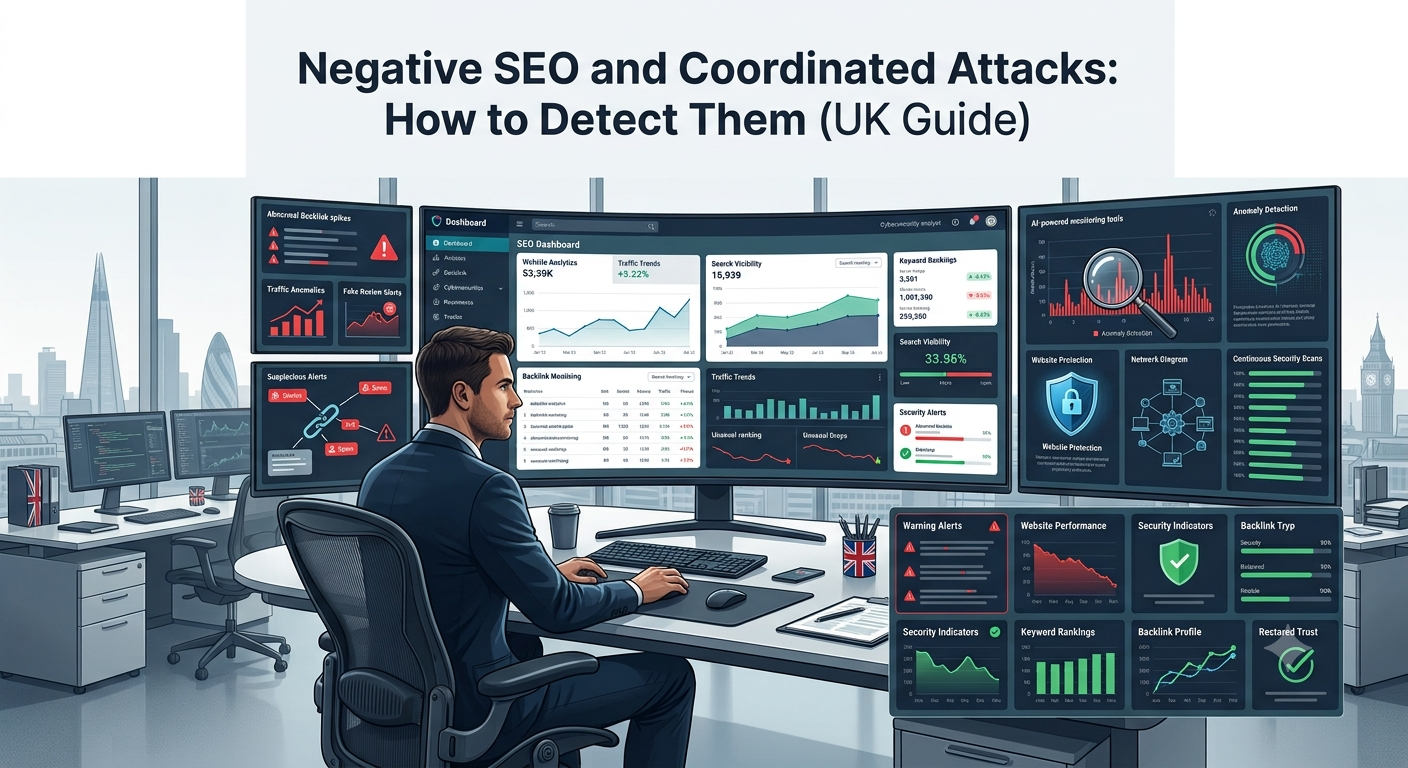
Negative SEO and Coordinated Attacks
A sudden wave of one star reviews. A mysterious spike in spammy backlinks pointing at your site. Your rankings dropping for no reason you can identify internally. It’s disorienting, and the first question most business owners ask is whether they’re imagining it or whether something deliberate is actually happening. We help UK businesses answer that question with evidence, not guesswork, identifying genuine negative SEO activity and building the right response before the damage compounds.
What This Actually Looks Like
Negative SEO refers to deliberate, malicious actions taken by a third party, often a competitor, a disgruntled former employee, or occasionally an organised bad actor, intended to damage a business’s search rankings or online reputation. Unlike organic reputation decline, which tends to build gradually from real operational issues, negative SEO attacks typically appear suddenly, cluster around specific triggers, and show patterns that don’t match your actual business activity or genuine customer behaviour.
Common Attack Types UK Businesses Actually Encounter
Several distinct tactics show up repeatedly, and recognising which one you’re dealing with shapes how you respond.
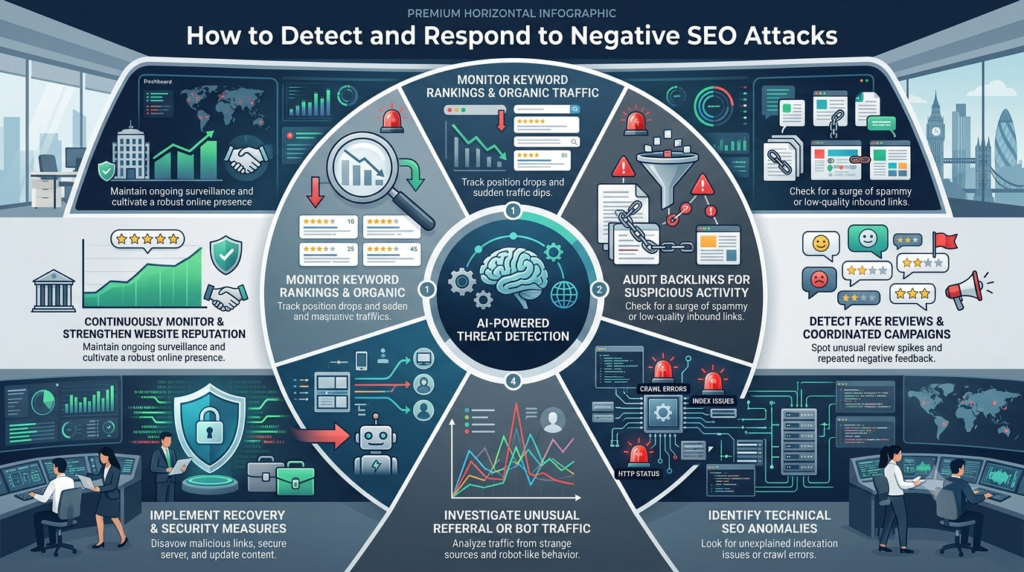
- Spam backlink attacks. A sudden, large volume of low-quality or irrelevant backlinks pointing at your site, often from spam directories, adult content sites, or gambling domains, designed to make your site look manipulative to search engines and trigger a ranking penalty.
- Coordinated review bombing. A cluster of negative reviews appearing within a short window, often from accounts with little or no other review history, sometimes referencing complaints that don’t match your actual products or services, or leaving suspiciously similar, templated-sounding language across multiple reviews.
- Content scraping and duplication. Your original website content copied and republished elsewhere, sometimes with your business details altered or removed entirely, which can confuse search engines about which version is the legitimate source and dilute your own page’s ranking authority.
- Fake business listings or altered information. Unauthorised changes to your Google Business Profile, incorrect hours, a fake closure notice, or a redirected phone number, designed to disrupt customers trying to reach you legitimately.
Signs You Should Actually Investigate Further
A few specific patterns are worth treating as genuine red flags rather than coincidence:
- A sharp, sudden spike in backlinks from clearly unrelated or low quality domains within a short time frame
- Multiple negative reviews posted within hours or days of each other, particularly from accounts with no other review activity
- Ranking drops for specific keywords that coincide precisely with one of the patterns above, rather than a broader, gradual decline
- Search Console security or manual action alerts appearing without any corresponding change on your own site
- Reviews or comments referencing details that don’t match your actual business, products, or service area
How We Investigate a Suspected Negative SEO Attack?
Confirming a suspicion requires looking at the data directly rather than relying on gut feeling alone. We start with a full backlink audit using Google Search Console’s links report and dedicated backlink analysis tools, identifying exactly which sites are linking to yours and flagging any sudden cluster of unfamiliar, low quality domains appearing at once. Alongside this, we review your review platforms for posting patterns, several reviews within a tight time window, similar phrasing, or accounts with no other review history, helping distinguish a coordinated review bombing incident from a genuine, if painful, run of real customer dissatisfaction.
Once we’ve established a baseline, we set up ongoing negative SEO detection tools and monitoring, including backlink alerts and search visibility tracking for your business name, so future patterns get caught early rather than discovered weeks later once damage has already accumulated.
What We Do Once an Attack Is Confirmed
If we’ve identified a genuine spam backlink attack, we build and submit a carefully reviewed Disavow Tool request, telling Google to ignore specific low-quality links pointing at your site so they stop counting against your ranking. This is handled carefully and applied only to genuinely suspicious links, since disavowing legitimate links can do more harm than good.
For coordinated review bombing, we report the suspicious reviews directly to the platform with documented evidence of the pattern, since most review sites have a specific policy against fake or coordinated reviews and investigate reports that include specific, credible evidence. Our guide to reputation damage control in the first 48 hours covers the broader response framework we apply once you’re dealing with a fast-moving reputational incident, regardless of whether it originated organically or through a coordinated attack.
For content scraping, we handle formal DMCA takedown requests to the hosting provider or search engine directly, addressing the unauthorised copy at the source rather than trying to compete with it in search rankings.
When This Crosses Into Legal Territory
If a competitor or individual is engaged in a sustained, identifiable campaign of coordinated sabotage, fake reviews with demonstrably false claims, deliberately defamatory content, or unauthorised alteration of your business listings, this may extend beyond a search engine issue into genuine legal territory. Our comparison of defamation solicitors versus reputation management agencies explains how to assess whether specific content meets that threshold before deciding how to proceed.
Why Ongoing Monitoring Is Part of Every Engagement
The businesses that recover fastest from this kind of coordinated attack are the ones that catch it early, while the pattern is still small and the evidence is still clear. Left unaddressed, a toxic backlink profile can compound over weeks into a genuine ranking penalty, and unanswered review bombing can settle into a business’s visible reputation long after the coordinated activity itself has stopped. This is why we build ongoing monitoring into every engagement rather than treating detection as a one-off audit, the same basic hygiene that protects against organic reputation decline, applied specifically to the possibility that some of what you’re seeing isn’t organic at all.
Frequently Asked Questions
How common is negative SEO against UK small businesses?
It’s less common than organic reputation decline, but it does happen, particularly in competitive local markets or industries with intense competitor rivalry. Most cases involve either spam backlinks or coordinated fake reviews rather than more sophisticated technical attacks.
Can Google tell the difference between organic negative reviews and coordinated review bombing?
Review platforms have detection systems for suspicious patterns, but they’re not perfect, which is why reporting specific, documented evidence of a coordinated pattern significantly improves the chances of a successful review removal.
Is it worth disavowing every suspicious backlink I find?
No. The Disavow Tool should be used selectively for genuinely low quality or spam links, since disavowing legitimate links can remove ranking value you actually want to keep.
How quickly does a spam backlink attack typically affect rankings?
It varies, but a large, sudden spike can start affecting rankings within weeks if left unaddressed, which is why early detection through regular backlink monitoring matters considerably.
Should I confront a suspected competitor directly if I think they’re behind an attack?
Generally not without solid evidence. Focus first on documenting the pattern and pursuing the correct reporting or legal channels, since a direct confrontation without proof rarely resolves the situation and can create further complications.