

Remove Personal Information from Internet UK
A surprising amount of your personal information is already online, and you almost certainly never agreed to put it there directly. Your address, phone number, date of birth, and even property ownership details are likely sitting on at least one UK people-search site right now, compiled automatically from public records you had no real say in publishing. We help individuals remove personal information from internet UK sources systematically, so you don’t have to track down and manage dozens of separate removal requests yourself.
This guide covers exactly where your information comes from, what we actually do to remove it, and what you can tackle yourself in the meantime.
Where Your Personal Information Actually Comes From
Before we can remove personal information from internet UK directories, it helps to understand the source. Most UK people-search sites don’t collect data directly, they aggregate it from a handful of public sources: the open electoral register, Companies House director filings, HM Land Registry property records, and phone directory listings. Once compiled, this data gets published on people-search directories and frequently surfaces directly in Google search results for your name.
The single largest source in the UK is 192.com, the country’s dominant people search directory, holding an estimated 700 million residential and business records built from exactly these public sources.
What Our Removal Process Covers
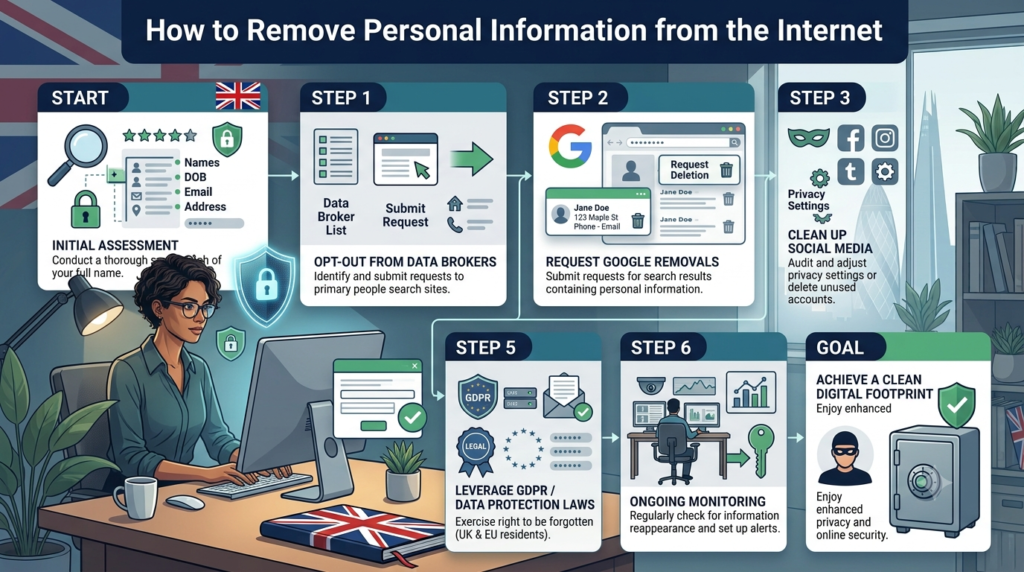
We handle personal information removal across every major exposure point, rather than leaving you to track sources individually:
- Open electoral register opt out. We confirm your registration status and help you formally opt out of the open (edited) register, separate from the full register used for voting and credit checks, which is the single biggest legal feed keeping UK residents searchable online.
- 192.com removal. Since 192.com pulls so heavily from public records, clearing your listing here addresses a large share of your overall exposure at once. Removals are typically processed within 24 to 48 hours of a successful request, clearing electoral roll, Companies House, and phone directory records simultaneously.
- Broader data broker removal. Beyond 192.com, dozens of smaller data broker and people-search sites may hold your information, often scraped or resold from the same underlying public sources. We work through these systematically, since there’s no single tool that clears every listing at once.
- Google search result removal. Even after a source site removes your information, the Google search result itself can persist until Google re crawls the page. We use Google’s results about you tool to request removal of specific categories of personal information, including your address and phone number, directly from search results. Our detailed guide to Google’s results about you tool covers what this tool can and cannot address on its own.
- Old account and profile cleanup. Old social media accounts, abandoned forum profiles, and forgotten online registrations frequently contain outdated personal information that continues surfacing in searches years later. We help identify these and either lock down or remove them entirely.
- GDPR right to erasure requests. UK GDPR gives individuals a right to request deletion of personal data in specific circumstances. This can be a genuine tool for compelling a reluctant data holder to act, particularly for organisations that aren’t primarily people-search sites but still hold your data unnecessarily.
Other Common UK Exposure Points People Overlook
Beyond the major people-search directories, several other public sources quietly keep personal information circulating, and most people never think to check them.
- Companies House director records. If you’re a company director, your name, month and year of birth, and service address are permanently public on the Companies House register. You can’t remove this while actively serving as a director, but you can use a service address instead of your home address to limit exposure, something our guide to preparing your reputation before becoming a company director covers in more detail.
- County Court Judgments and the Insolvency Register. Financial disputes and insolvency proceedings are recorded on public registers that data brokers frequently scrape and republish. Once resolved, a CCJ can be marked as satisfied, but the record itself typically remains publicly searchable for six years.
- WHOIS domain registration records. If you’ve ever registered a personal website or domain, your name and address may be publicly listed in WHOIS records unless you specifically enabled privacy protection through your registrar at the time of purchase.
- Old property listings and estate agent archives. Previous home sales or rental listings sometimes remain archived on property portals long after the transaction completed, occasionally still showing internal photos and address details.
- Genealogy and ancestry sites. Family history platforms often incorporate public record data, including your name alongside relatives, which can inadvertently expose family connections you’d rather keep private.
What Can Realistically Be Removed, and What Can’t
It’s worth setting honest expectations before starting this process. Some categories of information are genuinely straightforward to remove: your listing on commercial people-search sites, outdated contact details on old accounts, and search results containing your address or phone number through Google’s dedicated tool. Other categories are far more resistant to removal by design. Companies House director records, court judgments, and other statutory public registers exist specifically for public transparency and cannot be removed while the underlying legal reason for their publication still applies. Genuine news coverage, even when personally uncomfortable, is rarely removable either, since it serves a recognised public interest function that removal requests don’t override.
Understanding this distinction upfront saves considerable frustration. The realistic goal for statutory records isn’t removal, it’s minimising unnecessary exposure, using a service address instead of a home address, for example, rather than expecting the underlying record to disappear entirely.
A Typical Engagement in Practice
A common starting point looks like this: a client discovers their home address, phone number, and family details are visible across three or four people search sites after searching their own name for the first time in years. We begin with a full exposure audit, mapping every source, from 192.com through to smaller regional data brokers, then work through electoral register opt-out, direct removal requests, and Google’s results about you tool in parallel. Within the first week, the most visible listings are typically addressed. Over the following month, we monitor for any sites that refresh their databases and reintroduce the same information, closing that gap before it becomes visible again.
What You Can Handle Yourself Right Now
If you want to start working to remove personal information from internet UK sources before engaging any support, a few steps are quick to do directly:
- Tick the opt-out box next time you renew your electoral registration, or contact your local council’s electoral services team directly
- Submit a removal request through 192.com’s online form using your name and postcode
- Search your own name periodically to catch new listings as they appear
Ongoing Monitoring: Why This Isn’t a One Time Task
Data broker sites refresh their databases regularly, meaning information removed today can reappear months later when a site pulls fresh data from the electoral register or Companies House again. This is exactly why efforts to remove personal information from internet UK sources need ongoing monitoring built in rather than treating removal as a single, one-off task. Periodic re-checking is what actually keeps your exposure down over time, not a single sweep.
When Your Situation Needs a More Systematic Approach
For straightforward cases, the steps above cover most of what’s needed. For public figures, executives, or anyone facing an elevated privacy or security risk, our guide to UHNW privacy and reputation protection covers the more systematic, ongoing approach this kind of exposure typically requires, including coordinated removal across a much broader range of data broker sites and continuous monitoring for new listings, delivered as a managed service rather than something you track manually.
Frequently Asked Questions
How long does it take to remove personal information from 192.com specifically?
Removals are typically processed within 24 to 48 hours of a successful request, though it’s worth noting this clears the 192.com listing itself, not any existing Google search result linking to it.
Does opting out of the electoral register affect my ability to vote?
No. Opting out only affects the open (edited) register sold for marketing purposes. You remain on the full electoral register used for voting and elections regardless of this choice.
Will my information definitely stay removed once I’ve completed these steps?
Not permanently. Data broker sites refresh their records periodically, meaning removed information can reappear, which is why ongoing, periodic monitoring matters as much as the initial removal effort.
Can I remove personal information from internet UK sources for a family member, not just myself?
In some cases, yes, particularly for a household you share, since sites like 192.com allow you to request removal for multiple inhabitants of the same address in a single request.
Is a paid data removal service worth it compared to doing this myself?
It depends on your time and the scale of your exposure. A subscription service handles the tedious, ongoing work of multiple sites and re monitoring, while doing it yourself avoids sharing further personal data with an additional third party.
Can I ever fully remove my Companies House director information?
Not while you’re actively serving as a director, since this register exists for statutory transparency reasons. You can, however, use a registered service address instead of your home address to limit what’s publicly visible.
Do old County Court Judgments disappear from public records once paid off?
A satisfied CCJ can be marked as such on your credit file, but the underlying court record typically remains publicly searchable for six years regardless of whether the debt has been settled.