

Reputation management strategies differ based on platform structure, review velocity, and how search engines interpret reputation signals. Online reputation control methods are evaluated through sentiment distribution, entity credibility, and the extent to which review content influences SERP composition across Google, TripAdvisor, Booking.com, Trustpilot, and social profiles.
What does effective online review management mean across multiple platforms?
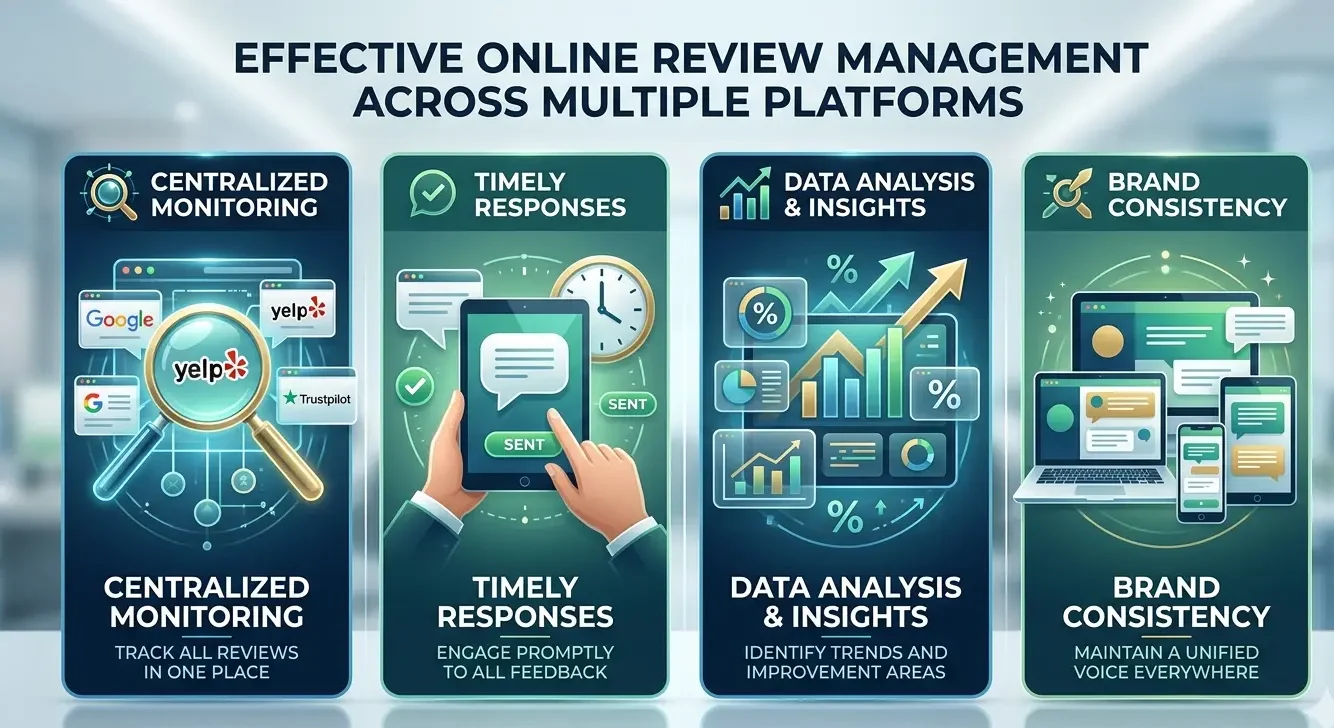
Effective online review management means monitoring, responding to, and analysing reviews in a way that stabilises sentiment distribution and strengthens entity credibility across every platform where the business appears. It operates by combining review monitoring, response policy, escalation logic, and content enhancement so that public feedback does not fragment the brand narrative.
Dive Deeper With Our Expert Guides and Related Blog Posts:
What TripAdvisor Review Management Involves Beyond Replying to Guest Feedback
How Restaurant Reputation Management Covers Reviews Social Media and Press
Across multiple platforms, review management is not a single action. It is a system that compares the volume of incoming reviews, the sentiment of those reviews, and the visibility of each review platform in branded search. A review on Google Business Profile affects local search ranking influence differently from a review on TripAdvisor or Trustpilot, because each platform feeds a different reputation signal into the broader search ecosystem.
The most effective systems treat reviews as structured data rather than isolated comments. A five-star review with a detailed narrative about service quality strengthens trust signals more than a short rating with no context. Negative reviews also matter because they shape sentiment distribution, and unaddressed criticism can accumulate into a search-visible pattern that reduces perceived reliability.
How does platform variation change review management effectiveness?
Platform variation changes review management effectiveness because each site applies different moderation rules, ranking logic, and user expectations. A review strategy that works on one platform often underperforms on another because the mechanisms for visibility, trust formation, and response display differ.
Google Business Profile prioritises recency, relevance, and local engagement. Reviews here affect local search visibility and map-based decision-making, so review management on this platform focuses on fast responses, accurate business information, and maintaining a consistent response policy. TripAdvisor and Booking.com place heavier emphasis on travel-specific trust cues, such as service consistency, room quality, cleanliness, and issue resolution. Trustpilot and similar consumer-review systems push reputation signals into generic brand search results, which means review volume and review quality have stronger influence over entity credibility.
This variation changes how managers allocate effort. A business with strong review activity on Google and weak activity on TripAdvisor presents an uneven reputation profile, even if the overall score appears acceptable. Search engines and users both detect these gaps. A fragmented profile reduces confidence because the entity appears credible in one environment and underdeveloped in another.
The strongest multi-platform systems therefore equalise visibility. They do not chase a perfect score on one site while ignoring another. They compare platform exposure, review frequency, and response quality so that no single platform dominates the search narrative with unresolved negative content.
Which works better: reactive review response or proactive review generation?
Proactive review generation works better for long-term reputation strength, while reactive review response works better for damage containment. The two methods serve different functions, and the strongest review management systems use both rather than relying on one alone.
Reactive review response operates by answering negative or neutral reviews quickly and professionally. This method limits escalation, shows public accountability, and can reduce the visible impact of criticism on decision-makers. It works best when the issue is factual, specific, and capable of resolution through explanation, correction, or compensation. The limitation is that response alone does not change the underlying review balance.
Proactive review generation operates by increasing the proportion of positive experiences that become visible reviews. This is the more scalable method because it shifts the review base over time, improving average sentiment and reducing the proportional weight of isolated negative entries. It also helps search engines interpret the entity as active, credible, and widely used. The limitation is that it depends on internal process quality, because weak service delivery produces weak review outcomes.
A mature review strategy treats proactive generation as the core mechanism and reactive response as the risk-management layer. When the balance is right, positive reviews create search-visible trust signals while responses prevent negative reviews from defining the narrative. This combination is especially important in hospitality and travel, where experience quality varies by location, booking channel, and time of year.
How do search engines interpret reviews in relation to reputation signals?
Search engines interpret reviews as behavioural and textual reputation signals that influence entity credibility, local ranking influence, and branded search composition. Reviews do not act alone, but they contribute to the broader trust model used to evaluate whether a business appears reliable, relevant, and active.
Search engines evaluate review language, review frequency, response behaviour, and platform diversity. A steady stream of detailed reviews gives stronger signals than a sudden burst of low-detail ratings, because consistent activity suggests ongoing demand and operational relevance. The presence of business responses also matters because it demonstrates active management and reduces the appearance of neglect.
Review text contributes to semantic evaluation. When reviewers repeatedly mention cleanliness, staff helpfulness, location accuracy, or booking reliability, those terms reinforce the entity’s topical profile in search. This helps search engines understand what the business is known for and where it deserves ranking influence. If the review corpus is dominated by unresolved complaints, the opposite occurs, and the entity begins to absorb negative sentiment distribution into its search footprint.
The most effective review management systems therefore track not only star ratings but also language patterns, frequency patterns, and response patterns. This is because search perception is shaped by more than averages. It is shaped by how the review ecosystem presents trust, consistency, and issue resolution to both algorithms and users.
How do content enhancement and content suppression compare in review management?
Content enhancement and content suppression are the two main strategic responses to review pressure, and they operate through different mechanisms. Content enhancement increases the volume and quality of positive signals, while content suppression reduces the visibility of harmful or low-value signals in search and platform environments.
Content enhancement is the more sustainable method. It works by publishing new positive content across profiles, business pages, and supporting assets while also generating fresh reviews that shift the balance of sentiment distribution. Over time, this changes what users see first in search results. The limitation is that it takes time, because search engines need repeated positive signals before they rebalance the entity’s profile.
Content suppression works by reducing the visibility of harmful content through platform reporting, removal requests, de-indexing, or the creation of stronger competing content. It is useful when a small number of damaging review pages, forum threads, or complaint posts dominate branded search. The advantage is speed of visibility reduction. The limitation is fragility, because suppressed content can return or remain accessible through alternative URLs and cached references.
In review management, suppression is defensive and enhancement is generative. The best outcomes come from combining them, but their roles are not interchangeable. Suppression buys time. Enhancement rebuilds credibility. Search engines reward the accumulation of positive reputation signals more reliably than they reward repeated attempts to hide unresolved criticism.
What evaluation framework identifies the strongest review management approach?
The strongest review management approach is identified by measuring visibility, sentiment balance, platform coverage, and response consistency rather than looking at star ratings alone. A useful framework compares how each method affects search ranking influence, entity credibility, and long-term sustainability.
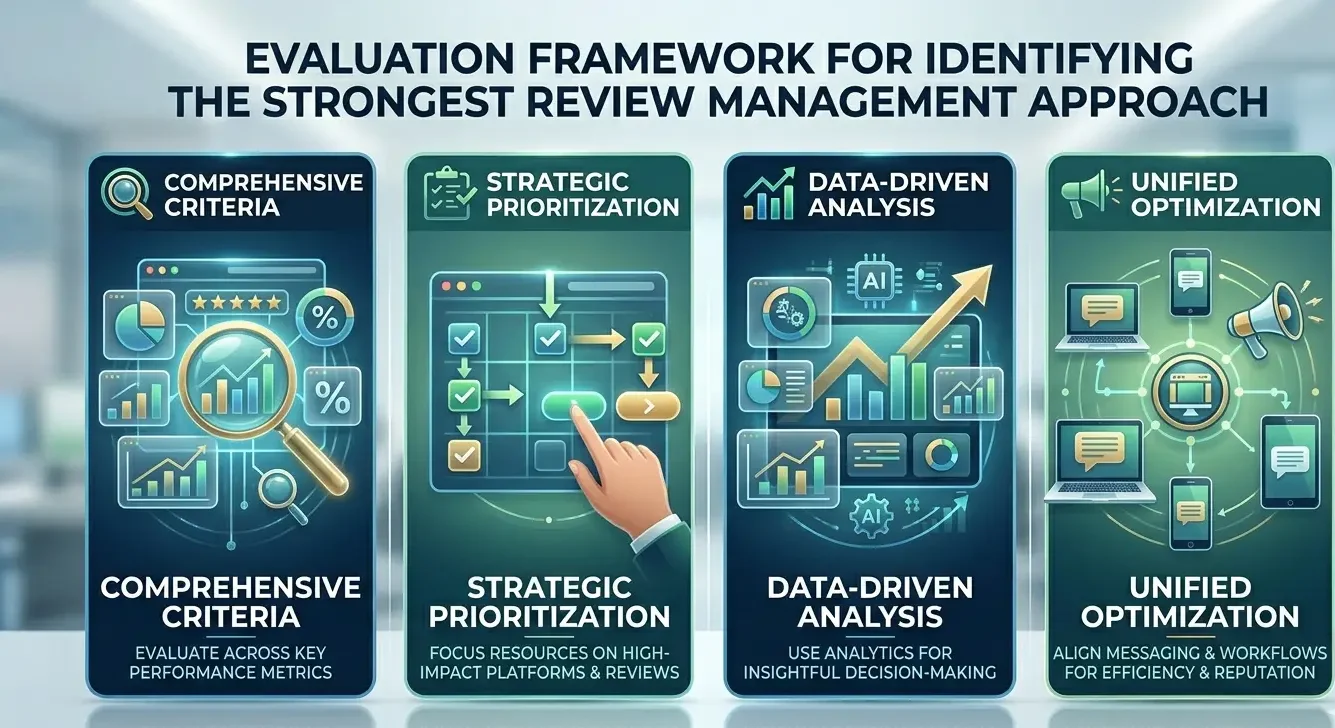
A practical evaluation framework uses three layers. First, measure platform coverage. If reviews appear only on one platform, the reputation picture remains incomplete. Second, measure sentiment distribution. A 4.6 average with scattered unresolved one-star reviews can still look fragile if the negative cluster dominates branded search. Third, measure response consistency. Businesses that answer every complaint with clear language and issue resolution generate stronger trust signals than businesses that respond only to severe criticism.
This framework also compares short-term and long-term impact. Reactive response and suppression improve immediate visibility, but proactive review generation and content enhancement deliver stronger durability. If a business needs fast stabilisation, suppression and response lead. If it needs sustained credibility, review generation and semantic content growth lead. In hospitality and travel, where search comparison is constant, the long-term approach usually carries more strategic weight.
Effective online review management across multiple platforms depends on how well a business balances proactive generation, reactive response, content enhancement, and selective suppression. The most reliable systems do not rely on one tactic. They compare platform-specific behaviour, measure sentiment distribution, and build a stable review footprint that search engines can interpret as credible.
For hospitality and travel businesses, the decision is not whether to manage reviews, but how to structure the system so that each platform reinforces the same trust narrative. The strongest approach combines fast response, consistent monitoring, and long-term content growth, because that mix influences both user perception and search visibility more effectively than isolated review activity.
FAQs
What does effective online review management mean across multiple platforms?
Effective online review management means monitoring, responding to, and improving customer feedback across platforms such as Google, TripAdvisor, Booking.com, and Trustpilot. It focuses on balancing sentiment distribution, strengthening reputation signals, and keeping branded search results credible and consistent.
How does review management on Google differ from other review platforms?
Google review management affects local search visibility and map rankings more directly, while platforms like TripAdvisor and Booking.com influence travel and hospitality decision-making. Each platform uses different moderation rules and ranking signals, so the review strategy must match the platform’s search and trust model.
Is it better to respond to negative reviews or generate more positive reviews?
Both are important, but they serve different purposes. Responding to negative reviews protects trust signals and shows accountability, while generating positive reviews improves overall sentiment distribution and long-term entity credibility.
Why do reviews matter for SEO and online reputation?
Reviews matter because search engines treat them as reputation signals that reflect customer satisfaction, business reliability, and engagement. Strong review profiles improve search ranking influence, while unresolved criticism can shape negative perception in branded search results.
How can businesses manage reviews across several platforms effectively?
Businesses manage reviews effectively by using a consistent response policy, monitoring review volume and sentiment, and aligning review generation with each platform’s user behaviour. A structured approach keeps the reputation profile balanced and reduces the risk of one platform dominating search perception.