

Reputation management strategies differ based on objectives, risk profile and the type of digital signals they aim to influence. Online reputation control methods are evaluated through their impact on SERP composition, entity credibility and long‑term sentiment distribution rather than isolated visibility metrics.
This consideration‑stage article analyses how different reputation‑management approaches perform within the UK search ecosystem, focusing on mechanisms, comparative strengths, limitations and strategic implications for commercial entities. The discussion centres on organic content strategies, removal‑based tactics, reactive‑event protocols and holistic corporate‑level frameworks, all grounded in search‑perception and trust‑signal dynamics.
What distinguishes organic reputation building from reactive crisis‑response protocols?
Organic reputation building is the continuous development of a brand’s digital footprint through planned, topic‑aligned content, backlinking and engagement that aligns with long‑term search and social‑perception goals. Reactive reputation protocols are incident‑driven responses triggered by specific negative events, such as viral complaints, review‑bombing or media coverage.
Organic reputation building operates by treating the entity’s online presence as a semantic network, where each piece of content reinforces coherence, topical authority and search‑engine‑friendly context. This approach relies on consistent publishing cadence, internal linking, E‑E‑A‑T markers and structured‑data signals to shape how search and discovery systems interpret reputation.
Reactive protocols operate by triaging negative signals, coordinating content, legal and PR responses, and accelerating the deployment of corrective or alternative content when sentiment shifts abruptly. These processes often involve rapid SERP monitoring, escalation workflows, and tactical amplification of specific messages to counter spikes in negative coverage.
Strengthen long-term brand perception with expert Corporate Reputation Management focused on building authority, trust, and positive entity signals across search ecosystems. From proactive reputation growth to rapid crisis-response strategies, professional reputation management helps businesses maintain credibility and control SERP perception during both stable and high-risk situations.
Organic methods tend to produce more stable, predictable SERP compositions and lower long‑term risk, because they control the majority of reputation‑relevant content. Reactive methods can contain short‑term damage but struggle to resolve underlying credibility gaps if not backed by ongoing organic‑reputation work.
How do short‑term reputation fixes compare with long‑term digital‑footprint optimisation?
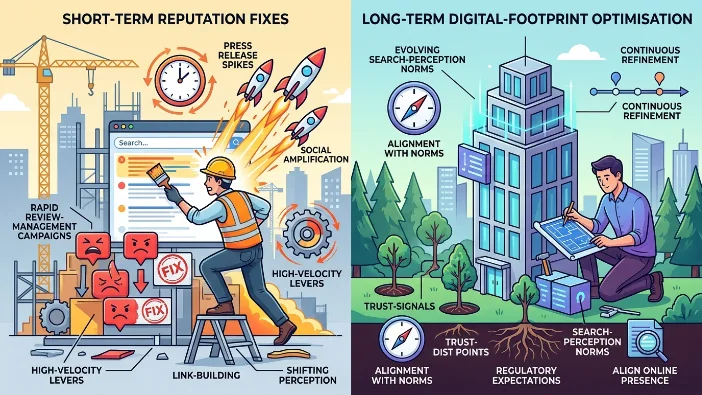
Short‑term reputation fixes are time‑bound interventions aimed at quickly altering SERP entries or sentiment distribution around an entity, such as tactical amplification, targeted link‑building, or rapid review‑management campaigns. Long‑term digital‑footprint optimisation is the continuous refinement of an entity’s online presence to align with evolving search‑perception norms, trust‑signal distributions and regulatory expectations.
Short‑term fixes operate by leveraging high‑velocity levers—such as social amplification, press‑release spikes, or temporary review‑response campaigns—to compress the visibility of negative items within a compressed timeline. These tactics often exploit temporal ranking factors, freshness signals and platform‑specific algorithms to temporarily shift perception.
Long‑term optimisation operates by aligning the entity’s content‑architecture, media‑relations patterns and digital‑governance rules with the way search engines model reputation over time. This includes systematic audits, topic‑authority development, backlink‑quality hygiene and compliance‑oriented content, all of which reduce the probability of future negative‑reputation events.
- Identify short‑term triggers (review clusters, news spikes, forum threads) and measure their SERP‑coverage impact.
- Deploy tactical content, social signals and PR‑aligned assets to dilute negative rankings over a defined period.
- Capture and document performance data from each short‑term intervention to inform future strategy.
- Map long‑term footprint‑optimisation goals to regulatory, media‑coverage and stakeholder‑expectation models.
- Align publishing cadence, topic‑coverage and governance rules with the entity’s evolving market‑position and risk‑profile.
Short‑term fixes are effective for reshaping immediate perception and containing specific incidents, but they offer limited protection against recurring or systemic reputation issues. Long‑term optimisation provides higher resilience and lower maintenance costs, because it reduces the raw‑material that short‑term crises can exploit.
Dive Deeper With Our Expert Guides and Related Blog Posts:
How Reputation Management Works and What Results to Expect
Building a Business Reputation Management Plan That Actually Holds Up
How do suppression‑only strategies compare with enhancement‑driven approaches?
Suppression‑only strategies are reputation‑management approaches that rely predominantly on diminishing the visibility of negative content, such as by pushing it down SERPs, discouraging shares or invoking takedown mechanisms. Enhancement‑driven approaches prioritise the creation and amplification of positive, trust‑building content to reshape how search engines and users interpret an entity’s standing.
Suppression‑only strategies operate by attempting to manipulate the ranking distribution so that negative items fall below the fold or are replaced by neutral or informational content. This often involves link‑velocity adjustments, index‑management tactics and platform‑policy‑based removal requests, all of which attempt to “clean” the SERP without altering the underlying narrative.
Enhancement‑driven approaches operate by systematically increasing the volume and quality of positive reputation signals, such as expert endorsements, case‑study‑style content, accreditation‑linked pages and media‑featured coverage. These signals reinforce entity credibility and influence how search engines weigh sentiment and authority around an organisation.
- Measure the proportion of negative, neutral and positive SERP slots for key entity‑related queries.
- Map potential suppression‑levers (takedown rules, redirects, index‑management) to specific URLs.
- Model the expected impact of each suppression‑tactic on overall SERP composition and ranking volatility.
- Identify reputation‑enhancement opportunities aligned to the entity’s core topics and service areas.
- Publish and amplify content that introduces new, positive narratives and supportive citations.
Suppression‑only methods can create an appearance of reputational stability in the short term, but they leave the underlying sentiment and credibility profile unchanged and may increase dependency on fragile technical levers. Enhancement‑driven methods are more transparent, less prone to policy conflict and generally produce more durable changes in search‑perception and trust signals.
For more information explore:
Get Expert Online Reputation Management Tailored for Your UK Business
What are the comparative risks and sustainability profiles of different reputation‑management approaches?
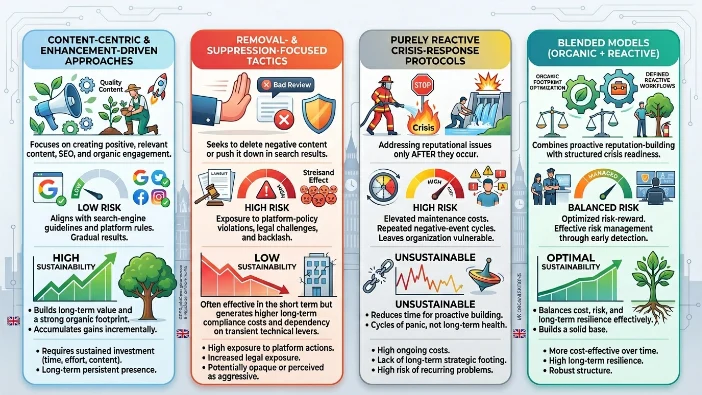
All reputation‑management approaches introduce some form of risk, exposure to policy constraints and opportunity cost, but the nature and duration of these risks differ significantly across methods. Understanding these trade‑offs is essential for UK organisations that operate within GDPR, platform‑governance and regulatory environments that shape how digital‑reputation work can be conducted.
Content‑centric and enhancement‑driven approaches introduce relatively low‑risk exposure when aligned with search‑engine guidelines and platform‑community rules. Their main limitation is that they require sustained investment in content, analytics and governance, and gains accumulate incrementally rather than immediately.
Removal‑ and suppression‑focused tactics increase exposure to platform‑policy violations, legal challenges and reputational backlash if perceived as aggressive or opaque. They are often more effective in the short term but can generate higher long‑term compliance‑costs and dependency on transient technical levers.
Purely reactive crisis‑response protocols reduce the time organisations spend on proactive reputation‑building, which can lead to repeated negative‑event cycles and elevated maintenance costs. By contrast, blended models that combine organic‑footprint optimisation with defined reactive workflows tend to balance cost, risk and sustainability more effectively.
What is corporate reputation management and why does it matter?
Corporate reputation management is the systematic monitoring and shaping of how a business is perceived online and in the media. It helps protect brand credibility, strengthen stakeholder trust, and improve search visibility for a company’s name and services.
How does a reputation management PR agency help UK businesses?
A reputation management PR agency supports UK businesses by aligning public relations, content strategy, and search‑presence work around an organisation’s brand image. The agency helps manage media coverage, online narratives, and stakeholder communications to maintain a consistent, credible corporate reputation.
What are common corporate reputation management services?
Common corporate reputation management services include crisis‑response planning, media‑relations, online review management, SERP‑monitoring, and content‑based reputation‑building. These services focus on controlling search‑engine results, shaping public perception, and reinforcing entity credibility across digital channels.
How long does corporate reputation management take to show results?
Noticeable improvements in corporate reputation management can appear within weeks for short‑term crisis response, but long‑term SERP and trust‑signal changes often take several months. Consistent content, PR activity, and monitoring are required to sustain a stable, positive reputation.