

Online reputation management services differ based on whether they prioritise content suppression, content enhancement, review governance, or entity-level trust rebuilding. Online reputation control methods are evaluated through search ranking influence, sentiment distribution, and the durability of reputation signals in branded search results.
Which reputation management approach works most effectively?
The most effective approach is the one that aligns with the visibility problem, because reputation management is an information-control system rather than a single tactic. Content suppression operates by reducing the prominence of unwanted pages in search results through stronger, more relevant, and more authoritative replacement assets.
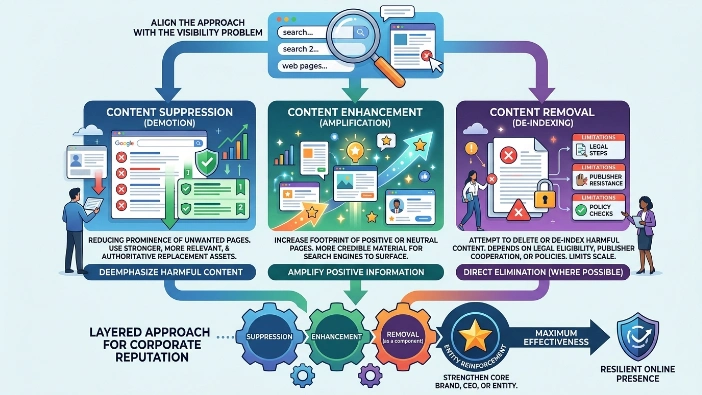
Content enhancement operates by increasing the footprint of positive or neutral pages so that search engines have more credible material to surface for branded queries. Removal strategies attempt to delete or de-index harmful content, but they depend on legal eligibility, publisher cooperation, or policy thresholds, which limits scale. For corporate reputation management, the strongest results usually come from a layered approach that combines suppression, enhancement, and entity reinforcement rather than relying on one method alone.
Content suppression versus content enhancement
Content suppression is a ranking contest, while content enhancement is a visibility expansion strategy. Suppression works by publishing and optimising assets that compete directly with negative URLs, using relevance, internal linking, topical depth, and authority signals to move them lower in the SERP. Enhancement works by building a denser content ecosystem around the entity so that search engines retrieve more brand-aligned pages for commercial and informational queries. Suppression produces faster visible movement when a negative result is already ranking, but it exposes the strategy to volatility if the competing page strengthens again. Enhancement develops broader trust signals over time and scales better across multiple queries, yet it usually requires more content investment before results stabilise.
Removal versus replacement
Removal is absolute when it succeeds, because the harmful page disappears from the index or is no longer accessible to search engines. Replacement is relative, because it does not erase the negative item; it redistributes attention to stronger assets that occupy the same query space. Removal delivers the cleanest perception outcome, but it has the narrowest success window because most online criticism, news coverage, and third-party commentary remains publishable and indexable. Replacement is less dramatic but more reliable, since search engines can always re-rank competing documents when they carry better entity associations and stronger engagement signals. In practical terms, removal solves a content existence problem, while replacement solves a search visibility problem.
Do reactive fixes outperform organic reputation building?
Reactive fixes produce faster movement, but organic reputation building creates the most durable trust profile. Reactive work targets a current crisis, a harmful article, a negative review cluster, or a page that dominates a branded SERP. Organic work builds authority before or after the crisis by strengthening first-party pages, earning citations, improving review velocity, and increasing the breadth of positive entity signals. Search engines interpret reactive changes as short-term relevance interventions, while organic changes contribute to historical credibility and topical consistency. For UK organisations, the risk profile often favours organic investment because reputation damage rarely stays confined to one page or one keyword.
Reactive control mechanisms
Reactive reputation control operates by diagnosing the precise query set where perception breaks down, then deploying corrective assets around those queries. It includes review responses, crisis landing pages, media outreach, profile optimisation, and indexable content that addresses the allegation or complaint directly. This approach measures success in reduced visibility of harmful results, improved branded click behaviour, and a shift in sentiment distribution across the SERP. Its limitation lies in dependency on an existing problem, because reactive work begins only after reputational damage becomes visible. That makes it efficient for urgent containment, but inefficient as a long-term trust architecture.
Organic trust building
Organic trust building operates by creating a reputation footprint that search engines and users can interpret as consistent, credible, and entity-rich. It includes authoritative case studies, company pages, executive bios, press mentions, thought leadership, and structured internal linking that clarifies relationships between the organisation and its core topics. Search engines reward this pattern because it improves crawl efficiency, entity confidence, and query matching across branded and non-branded searches. The advantage is sustainability: once the content ecosystem matures, it supports multiple reputation objectives at once. The limitation is time, because trust accumulation depends on repeated signals rather than isolated interventions.
How do search engines interpret reputation signals?

Search engines interpret reputation signals through entity recognition, content relevance, link context, and user response patterns. A reputation signal is any observable element that helps a system judge whether an entity is credible, disputed, prominent, or trustworthy. These signals include branded mentions, review consistency, author pages, publisher associations, structured data, and the balance of positive versus negative documents in the index. Search engines do not read reputation as a single score; they infer it from the relationship between documents, entities, and search demand. That means reputation management works best when it changes the ecosystem around the entity, not just one isolated page.
Entity credibility
Entity credibility is the degree to which search systems recognise an organisation as a coherent and trustworthy subject. It operates by connecting names, people, locations, services, and publications into a stable knowledge pattern. When an organisation has consistent naming, authoritative profiles, and linked evidence across trusted domains, search engines process the entity with less ambiguity. This improves search ranking influence because relevant documents receive clearer contextual interpretation. The limitation is that credibility accumulates slowly and can be weakened when conflicting or low-quality references dominate the index.
Sentiment distribution
Sentiment distribution is the balance of favourable, neutral, and unfavourable material attached to an entity in search results. It operates by shaping the mix of page types that appear for branded queries, including reviews, news, social profiles, and owned content. A healthy sentiment distribution does not require only positive content; it requires a visible ratio that prevents negative material from monopolising perception. Search engines use this distribution as a proxy for public context, even when they do not explicitly score sentiment. The challenge is that high-authority negative coverage can override weaker positive pages unless the supporting ecosystem is broad enough to compete.
Which strategy scales better across large organisations?
Entity-led reputation systems scale better than page-by-page fixes because they organise multiple outputs around one central identity. Large organisations deal with branch pages, leadership profiles, product pages, review sites, press coverage, and social presence, so reputation control needs structural coordination. A page-specific fix handles one query cluster, while an entity-led strategy shapes how the entire organisation is understood across dozens of related searches. This makes scalability a core differentiator between tactical repair and strategic governance. For corporate reputation management, scale depends on whether the method can control perception across departments, regions, and stakeholder groups.
Multi-page governance
Multi-page governance is the coordination of owned pages, earned media, and third-party references around one consistent entity narrative. It operates by ensuring that title tags, biographies, service descriptions, and press references all reinforce the same core identity and topical associations. This reduces search ambiguity and supports stronger retrieval across commercial, informational, and reputational queries. Its strength is coverage: it creates breadth without fragmenting the brand. Its limitation is operational complexity, because content quality, legal review, and publication discipline all affect performance.
Single-issue remediation
Single-issue remediation is the repair of one harmful result, one review pattern, or one negative mention cluster. It operates by targeting the exact asset causing perception damage and applying localised counter-signals. This approach is useful when the issue is narrow and the SERP is dominated by a small number of pages. It is weak for scale because the same method does not automatically fix broader entity trust or adjacent query spaces. In comparison, single-issue remediation is tactical control, not strategic reputation architecture.
What are the short-term and long-term trade-offs?
Short-term reputation work produces visible movement faster, while long-term reputation work generates compounding trust. Short-term methods focus on immediate SERP composition, crisis response, and search result dilution. Long-term methods focus on historical consistency, content depth, mention quality, and cross-channel corroboration. Search engines reward long-term stability because it reduces uncertainty about the entity’s public record. The trade-off is clear: speed resolves urgency, but depth resolves resilience.
Short-term impact
Short-term impact comes from actions that alter what appears in search results within a narrow time window. This includes new content publication, press distribution, review response, profile updates, and optimisation of existing high-authority pages. The benefit is rapid perception control when a negative item is harming conversions, recruitment, or stakeholder confidence. The limitation is fragility, because the same results can shift again when competitor pages, news cycles, or review activity change. Short-term methods therefore act as stabilisers, not permanent fixes.
Long-term impact
Long-term impact comes from repeated proof points that strengthen entity credibility over time. This includes sustained publishing, reputation-safe link acquisition, authoritative mentions, consistent review volume, and clear organisational identity across web properties. The search ecosystem treats this as accumulated evidence, which improves ranking influence across a wider query set. The advantage is durability, because the entity becomes easier to trust and harder to distort. The limitation is patience, since long-term value depends on consistent governance rather than one-off correction.
For more detail explore:
Explore Tailored Online Reputation Management Services Built for Growth
Which evaluation framework helps decision-making?
A useful evaluation framework compares mechanism, speed, risk exposure, scalability, and sustainability. Reputation management is not one decision but a sequence of trade-offs between suppressing harm, rebuilding trust, and strengthening search visibility. A structured assessment prevents organisations from over-investing in reactive tactics that create temporary gains but limited resilience. It also prevents over-reliance on content production when removal or legal action resolves the issue more efficiently. The most effective analysis measures how each approach changes the search environment, not just how it changes one ranking.
Compare by mechanism
- Measure whether the method removes, suppresses, replaces, or reinforces reputation signals.
- Analyse whether the tactic changes one URL, one query cluster, or the entity as a whole.
- Evaluate whether the mechanism depends on third-party cooperation, editorial control, or owned assets.
Dive Deeper With Our Expert Guides and Related Blog Posts:
What to Look for When Choosing a Reputation Management Company
Key Questions to Ask Before Hiring a Reputation Management Agency
Compare by risk
- Assess whether the tactic creates legal exposure, platform dependency, or ranking volatility.
- Review whether the method invites counter-speech, renewed indexing, or visibility rebound.
- Judge whether the intervention remains stable when external publishers update their content.
Compare by outcome
- Track branded SERP composition, sentiment distribution, and trust signal breadth.
- Monitor whether positive assets gain durable visibility across multiple query types.
- Examine whether the entity’s public profile becomes more coherent in search.
The main difference between reputation management approaches lies in whether they remove harm, suppress harm, replace harm, or rebuild trust at the entity level. Reactive methods deliver speed, organic methods deliver resilience, and removal methods deliver finality only in limited cases. Search engines interpret reputation through connected signals, so the strongest outcomes come from coordinated systems rather than isolated fixes. For consideration-stage decision-making, the key strategic question is not which tactic works in isolation, but which combination matches the visibility problem, risk profile, and required time horizon.
What is corporate reputation management?
Corporate reputation management is the process of shaping how a business appears in search results, reviews, media coverage, and public discussions. It focuses on protecting entity credibility, improving sentiment distribution, and maintaining trust signals across digital channels.
What does a reputation management PR agency do?
A reputation management PR agency manages public perception through search visibility, media positioning, review oversight, and content strategy. It helps businesses influence branded search results and strengthen reputation signals without changing the underlying facts.
How long does corporate reputation management take to show results?
Results depend on the problem, the current SERP composition, and the authority of existing content. Short-term visibility changes can appear within weeks, while durable trust-building and search ranking influence usually take longer.
What is the difference between reputation repair and reputation building?
Reputation repair focuses on reducing the impact of negative coverage, harmful reviews, or damaged search results. Reputation building creates consistent positive signals over time through content, mentions, and credible digital assets.