

Control of search visibility delivers decisive reputational advantage and stabilises public perception. Reputation signals determine buyer trust and investor confidence; an integrated corporate reputation management programme ensures SERP control, negative content suppression, and restored entity credibility.
A targeted, evidence-driven corporate reputation management programme delivers measurable outcomes in search visibility and trust. The service begins with a forensic audit of search results, brand mentions, and reputation signals (reviews, citations, authoritativeness, and social proof) to map current perception and prioritise suppression targets.
The agency then executes an integrated strategy combining high-authority content placement, technical SEO on owned assets, and coordinated PR outreach to push favourable content into primary SERP positions. Measurable outcomes include improved rankings for priority queries (tracked by share of SERP real estate), reduced visibility of negative URLs (measured as percentage decline in impressions and clicks), and increased positive entity signals (review scores and authoritative backlinks). Search behaviour justifies this approach because users overwhelmingly click top organic results and trust signals on page one; controlling those results directly influences conversion rates and reduces risk to corporate valuation.
Which tactics ensure rapid reduction of damaging content visibility?
A layered suppression strategy ensures rapid reduction of damaging content visibility while maintaining long-term control. The process deploys three concurrent tactics: publish high-quality owned content with aggressive SEO and schema to occupy SERP snippets, secure placements and citations on industry publications to elevate authoritative signals, and request remediation or legal takedowns where policy violations occur.
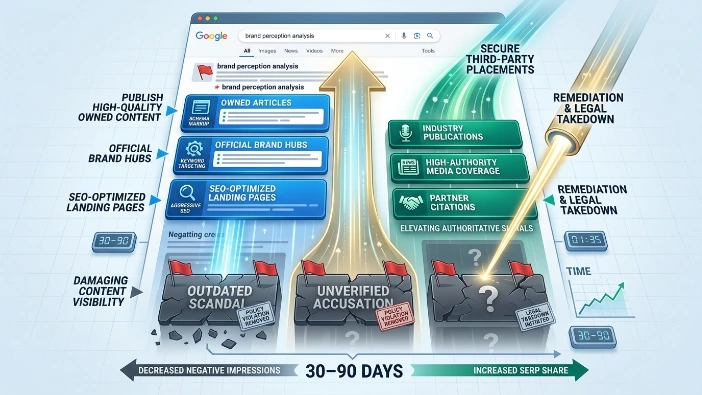
Expected metrics include a measurable decrease in negative-page impressions within 30–90 days and SERP share shifts showing favourable assets occupying top three positions for targeted terms. This approach aligns with search perception influence because algorithms prioritise relevance and authority; increasing authoritative instances of positive narratives strengthens entity credibility and replaces negative content in the user decision path.
Which evidence demonstrates ROI for corporate reputation management?
Clear evidence shows reputation management delivers a measurable return on investment through preserved revenue, reduced crisis costs, and improved conversion rates. Case metrics to evaluate ROI include uplift in conversion rate for branded search, reduction in abandoned deals linked to online reputation issues, and decreased spend on reactive crisis communications. The process quantifies outcomes by tracking organic traffic trends, conversion attribution for branded queries, and sentiment shifts across review platforms and social channels. Search-driven behaviours underpin ROI: decision-makers use search results as due diligence; better-controlled results shorten sales cycles and increase close rates. This justifies cost as investment in risk reduction and revenue protection rather than an expense.
Which reputation signals most strongly influence corporate trust?
Entity credibility, authoritative backlinks, verified reviews, and consistent NAP (name, address, phone) data deliver the strongest influence on corporate trust. The service identifies gaps in these reputation signals and implements corrective actions: build authoritative backlinks via targeted PR, standardise and syndicate NAP across citation networks, and drive verified review acquisition with compliance-safe programmes. Measurable improvements include higher domain authority proxies, increased count of positive verified reviews, and fewer discrepancies in citation data. These signals directly affect search algorithms and human evaluators: improved entity credibility raises the prominence of owned assets in search results and strengthens conversion likelihood when stakeholders evaluate the company.
Which risk controls reduce legal and regulatory exposure during reputation work?
Clear procedural controls reduce legal and regulatory exposure while executing reputation activities. The agency adopts documented approval workflows, legal review for takedown and suppression requests, compliant review solicitation practices, and transparent data protection measures for handling personal data. Outcomes include reduced incidence of escalated legal disputes, defensible takedown outcomes, and audit-ready documentation showing lawful remediation steps. This risk-managed approach maintains SERP control without creating new legal liabilities, ensuring long-term sustainability of search perception influence.
Which reporting and KPIs prove sustained SERP control?
Robust reporting delivers transparent proof of sustained SERP control and credibility improvement. The service provides weekly and monthly dashboards showing keyword ranking shifts, share of SERP real estate for branded queries, impressions and clicks for suppressed URLs, sentiment trendlines, backlink acquisition rates, and review-score movement. Measurable benchmarks include maintaining top-three placement for 70–90% of priority branded queries and achieving a 50% or greater reduction in negative-content impressions within six months. These KPIs translate directly into decision-stage proof points that validate the service’s effectiveness and stabilise stakeholder confidence.
Which investment balances speed of impact and long-term sustainability?
A phased investment model balances rapid suppression with sustainable credibility growth. Phase one delivers speed: targeted content pushes, paid amplification for reputation content, and immediate remediation steps to reduce negative visibility within 30–90 days. Phase two delivers sustainability: ongoing content governance, backlink and citation building, review management, and monitoring to prevent relapse. Expected fiscal outcomes include front-loaded cost for immediate impact and lower ongoing retainers focused on preservation and defence, producing lower total cost of ownership over time by reducing crisis-driven emergency spend. This structure reduces risk and ensures search perception influence persists beyond the initial remediation window.
Which process steps establish clear accountability and deliverables?
A documented, milestone-driven process ensures accountability and clear deliverables at every stage. Steps include:
- Conduct an audit to identify priority reputation signals and negative URLs, producing a ranked remediation plan.
- Deploy targeted content and PR placements to establish authoritative positive coverage and occupy SERP positions.
- Execute suppression tactics (SEO, backlinks, and where applicable, legal or platform remediation).
- Implement review and citation programmes to strengthen entity credibility.
- Provide ongoing monitoring, reporting, and governance to prevent recurrence.
Each step links to measurable effects: audit produces prioritised target list, content and PR increase domain-level signals and ranking share, suppression reduces negative impressions, and monitoring maintains KPI thresholds.
Which decision indicators show when to hire a reputation management PR agency?
Concrete indicators demand hiring a specialist agency: sustained negative-first-page results for branded queries, lost commercial opportunities traced to poor search perception, regulatory or investor inquiries triggered by online material, and rapid escalation of negative social attention that threatens business continuity.
These indicators show that in-house measures are insufficient and that specialised SERP control and negative content suppression are required. Engaging an agency at this point reduces risk of revenue loss and reputational erosion by deploying a coordinated PR-plus-digital strategy that delivers both immediate suppression and sustained entity credibility improvement.
Which outcomes prove the agency’s reliability and credibility?

Reliable outcomes combine quantitative metrics with validated trust signals. Expect improved search rankings for priority queries, reduced visibility of harmful content (measured by decline in impressions/clicks), higher counts of verified positive reviews, and demonstrable increases in authoritative backlinks and citation consistency. Independent validation through documented case studies, client references, and transparent KPIs confirms the agency’s deliverables.
When you select a partner, look for a process that documents baseline metrics, sets time-bound objectives, and commits to measurable targets for SERP control and trust restoration. This confirms the provider’s capacity to deliver and stabilise public perception.
Dive Deeper With Our Expert Guides and Related Blog Posts:
Work With a Proven ORM Agency That Delivers Measurable UK Results
Explore Tailored Online Reputation Management Services Built for Growth
How Reputation Management PR Agency integrates PR and digital strategy
The combined PR and digital strategy delivers superior search perception influence because it synchronises message placement with technical SEO and domain-authority building. PR placements create context and newsworthiness that search algorithms favour; digital optimisation ensures that those placements capture and retain SERP positions. This integration improves visibility of positive narratives, strengthens entity credibility via authoritative signals, and reduces the prominence of negative assets.
For an analytical overview of this integration, read:
How a Reputation Management PR Agency Combines PR and Digital Strategy.
What differentiates a specialist agency from standard PR
A specialist reputation management PR agency delivers focused SERP control tactics beyond traditional PR: negative content suppression, reputation signal remediation, continuous search monitoring, and legal/technical remediation workflows. Standard PR increases awareness; specialist agencies ensure the awareness aligns with decision-stage search results and entity credibility metrics that convert.
For deeper comparison, review:
What Makes a Reputation Management PR Agency Different From Standard PR.
When decision indicators align with your situation, engage a professional reputation management service to secure measurable SERP control and restore trust. Begin with a forensic audit that defines priorities, timelines, and measurable KPIs and proceeds to rapid remediation and sustained governance. For service details, see the dedicated corporate reputation management offering.
Choose a partner that delivers transparent processes, measurable outcomes, and defensible risk controls. A structured corporate reputation management programme stabilises perception, reduces legal and commercial risk, and ensures search perception influence that protects revenue and stakeholder confidence.
What is corporate reputation management and how does it protect my business?
Corporate reputation management is a coordinated programme that stabilises public perception by controlling SERP results, managing reviews, and strengthening entity credibility. It protects the business by reducing negative content visibility, improving branded search conversion, and providing monitoring that prevents reputational drift.
How long does it take for a reputation management PR agency to reduce negative search visibility?
Initial reduction in negative visibility typically appears within 30–90 days through targeted content pushes, authoritative placements, and suppression tactics. Ongoing improvements and sustained SERP control require continuous monitoring and maintenance to keep favourable assets in top positions.
What measurable KPIs should I expect from Corporate Reputation Management?
Expect clear KPIs such as percentage reduction in negative-content impressions, improved ranking share for priority branded queries, increase in verified positive reviews, and growth in authoritative backlinks. These metrics directly link to improved search perception influence and conversion outcomes.
How does a reputation management PR agency handle legal takedowns and platform disputes?
Agencies follow a documented remediation workflow that includes legal review, platform-specific takedown requests, and evidence-backed escalation where policies are breached. This process reduces regulatory and legal risk while focusing on search-friendly suppression and alternative visibility strategies.