

Reputation management is the set of practices that protect, monitor and shape an entity’s perceived credibility within digital information systems. Online reputation refers to the aggregate of indexed content, review signals, and contextual metadata that define an entity’s standing across search ecosystems.
The true cost of managing an online reputation equals the sum of resources required to monitor, analyse, and influence reputation signals across search ecosystems, weighted by the entity’s digital footprint complexity, the competitive intensity of relevant SERPs, and the persistence of negative signals.
Costs emerge from discrete activities—continuous monitoring, content production and optimisation, technical SEO for indexing control, review response systems, legal or platform escalation, and measurement of search visibility. Each activity consumes personnel, tools, and procedural overhead. Complexity scales with the number of owned domains, third-party references, languages, and jurisdictions that affect content indexing and discovery.
Investment level determines the speed and depth at which reputation signals change in SERPs. Increased monitoring and intervention accelerates content re-indexing and SERP evaluation in favour of updated entity perception. Conversely, underinvestment permits persistent negative signals to consolidate ranking authority, lowering perceived credibility during user search queries.
How is a digital footprint defined and why does it affect management cost?
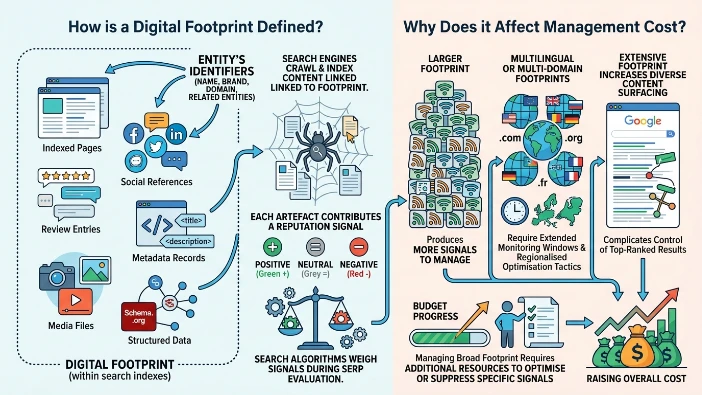
Digital footprint is the collection of indexed pages, social references, review entries, metadata records, media files, and structured data that associates with an entity’s identifiers (name, brand, domain, and related entities) within search indexes.
Search engines crawl and index content linked to an entity’s footprint. Each artefact contributes a reputation signal positive, neutral or negative—that search algorithms weigh during SERP evaluation. A larger footprint produces more signals to manage; multilingual or multi-domain footprints require extended monitoring windows and regionalised optimisation tactics.
Extensive footprints increase the probability of diverse content surfacing for a query, complicating control of the top-ranked results. Managing a broad footprint requires additional resources to optimise or suppress specific signals, raising the overall cost of achieving a desired entity perception within search visibility.
What are reputation signals and how do they influence content ranking?
Reputation signals refer to documented indicators such as authoritativeness of domains, backlink profiles, review ratings, content freshness, structured data presence, and user engagement metrics within search ecosystems.
Algorithms extract features from indexed content—source authority, topical relevance, user interaction rates, and review sentiment—and integrate those into ranking functions. Search systems construct an entity’s trust profile using aggregated signals; high-trust signals promote content visibility while low-trust signals suppress ranking potential.
Signal manipulation or remediation changes the weighting applied during SERP evaluation. For example, improving structured data and authoritative backlinks enhances indexing clarity and elevates ranking. Conversely, negative review signals and repeated negative mentions depress content authority and reduce visibility for reputation-critical queries.
How do review systems and sentiment analysis affect search reputation?
Review systems are platform-level mechanisms collecting user evaluations; sentiment analysis refers to automated assessment of textual tone that converts qualitative reviews into structured sentiment metrics for search ecosystems.
Search engines and platforms ingest review data through structured feeds, schema markup, and platform APIs. Sentiment analysis models parse textual reviews to derive polarity scores and theme extraction. These outputs contribute to reputation signals such as average rating, review velocity, and sentiment trend, which algorithms incorporate into entity credibility assessments.
High average ratings and positive sentiment trends increase the probability of favourable display features (rich snippets, review stars) and improve ranking in queries focused on reputation. Negative sentiment concentration generates adverse snippets and can trigger algorithmic demotion for reputation-related queries, increasing the resources necessary to restore favourable SERP evaluation.
How do search engines interpret trust and credibility for entities?
Search engines interpret trust and credibility through algorithmic models that evaluate provenance, authority, consistency, and corroboration across indexed sources.
Algorithms implement multi-dimensional trust models that combine source-level metrics (domain authority, historical accuracy), content-level features (factual consistency, topical depth), and network-level corroboration (external references, co-citation). Signals such as HTTPS, schema usage, verified profiles, and organisational metadata increase provenance scores. Corroboration occurs when independent authoritative sources reference the same facts, increasing entity perception reliability.
Entities with higher algorithmic trust receive preferential SERP placement for queries testing credibility. Conversely, inconsistent facts across sources, poor provenance signals, or lack of independent corroboration lower ranking probability and increase intervention costs to rebuild trust within indexing and ranking systems.
What role does content indexing and metadata play in reputation control?
Content indexing and metadata determine how search systems discover and classify reputation signals, and therefore dictate which assets require optimisation or remediation to control perception.
Indexing pipelines prioritise crawl budgets and classify content into topical clusters. Metadata signals communicate entity relationships, content intent and factual attributes to indexing algorithms. Proper schema markup connects disparate assets to a single entity identifier, enabling consolidated entity perception during SERP evaluation.
Accurate metadata and consistent structured data reduce ambiguity in content indexing and accelerate corrective changes in SERPs. Poor metadata or absent schema causes misattribution, fragmented entity perception and inefficient use of resources as search systems fail to index corrective content effectively.
Which authority and trust signals most affect reputation-related ranking?
Authority and trust signals that most affect reputation ranking are domain provenance, external corroboration, structured data presence, review quality metrics, and historical content stability.
Domain provenance evaluates registry age, reputation, and historical content accuracy. External corroboration measures cross-references from independently reputable sites. Structured data clarifies entity-type and relationships for algorithms. Review quality metrics account for rating distribution, reviewer authenticity signals, and temporal patterns. Historical stability quantifies content longevity and update integrity.
Strengthening these signals increases SERP evaluation scores related to credibility and reduces the relative ranking weight of isolated negative signals. Weaknesses in any of these elements increase the persistence of adverse content in search visibility and raise remediation costs.
How does competitive SERP intensity affect remediation timelines and cost?
Competitive SERP intensity, defined by the number and strength of authoritative pages competing for reputation-related queries, prolongs remediation timelines and increases cost proportionally to the authority gap.
When top SERP positions are occupied by high-authority, well-indexed sources, algorithms require substantial corroborative and authoritative signals to re-rank results. Remediation necessitates creation of high-quality, corroborated content, acquisition of authoritative references, and sustained engagement—each adding to time and financial expenditure.
Navigate competitive search landscapes with professional Corporate Reputation Management designed to strengthen authority signals, improve entity credibility, and accelerate reputation recovery. Strategic reputation management helps businesses overcome high-intensity SERPs by building authoritative content and increasing positive visibility across search results.
What metrics evaluate the effectiveness of reputation management efforts?
Effective evaluation uses quantitative metrics: changes in search visibility share for reputation queries, sentiment-weighted review scores, authority score deltas for owned assets, indexing velocity, and SERP feature incidence.
Search visibility share measures the proportion of top-10 results owned or influenced by the entity. Sentiment-weighted review scores convert review text into polarity-adjusted averages. Authority score deltas compare domain and page-level authority over time. Indexing velocity monitors the time between content publication and search engine inclusion. SERP feature incidence counts appearance of rich snippets, knowledge panels and review stars for target queries.
Positive metric trends indicate improved algorithmic trust and enhanced SERP evaluation. Persistently negative trends indicate either insufficient resource allocation or misaligned tactics, necessitating recalibration of interventions and budget.
Dive Deeper With Our Expert Guides and Related Blog Posts:
How Does Reputation Management Work Step by Step in Practice
How a Reputation Management PR Agency Combines PR and Digital Strategy
What operational activities drive the biggest portion of reputation management cost?
The largest cost drivers are continuous monitoring systems, high-quality content production for indexing and corroboration, technical SEO for metadata and schema alignment, and legal or escalation processes for content removal.
Monitoring requires tools and analyst time to capture signal changes across multiple platforms. Content production must meet editorial and factual standards acceptable to high-authority sources to influence corroboration. Technical SEO ensures correct indexing and entity consolidation via schema and canonicalisation. Escalation processes for takedown or de-indexing involve legal review, platform negotiations, and case management systems.
Investment in these operations shifts SERP evaluation by increasing the volume and quality of trust signals. Underfunding any activity leaves gaps that algorithms interpret as weaknesses in entity credibility, maintaining adverse rankings and perception.
How should organisations estimate budgets using UK-specific considerations?
Organisations estimate budgets by mapping footprint complexity, SERP intensity for UK-centric queries, regulatory and platform compliance in the UK, and the cost of localised monitoring and content localisation.

UK-specific queries often surface domestic review platforms, regulatory filings, and local media; these sources have distinct indexing behaviours and legal contexts (e.g., defamation frameworks, privacy rules). Estimation requires assessing the number of UK-targeted assets, the need for region-specific content, and the legal resource allocation to handle country-specific escalation channels.
Accurate UK-focused budgeting ensures interventions align with local SERP evaluation mechanics and jurisdictional expectations, optimising resource allocation to yield measurable improvements in search visibility for reputation queries.
Quantify the digital footprint, map reputation signals and SERP intensity, identify authority and trust gaps, and allocate resources to monitoring, content corroboration, technical indexing and review management. Each component defines a measurable contribution to overall cost and a pathway through which algorithms update entity perception. Organisations that parse these elements against UK-specific search behaviours can produce realistic budget forecasts aligned to desired search visibility outcomes.
Learn Everything About It Here:
Understanding UK Reputation Management Cost Ranges Before You Budget
Common questions about corporate reputation management
What is corporate reputation management and how does it affect search visibility?
Corporate reputation management is the practice of monitoring and shaping an organisation’s entity perception across search ecosystems. It affects search visibility by influencing reputation signals—review metrics, backlinks, and structured data—that search engines use during SERP evaluation.
How do review signals impact corporate reputation in search results?
Review signals, including average rating and review velocity, feed sentiment analysis and structured data that search systems index. Strong positive review signals increase the likelihood of rich snippets and higher placement in reputation-related queries.
Which metrics measure the effectiveness of corporate reputation management?
Key metrics include search visibility share for target queries, sentiment-weighted review scores, authority score deltas for owned assets, indexing velocity, and SERP feature incidence. These metrics quantify changes in algorithmic trust and entity perception over time.
How does content indexing and metadata improve corporate reputation?
Accurate metadata and structured schema ensure correct entity consolidation and faster indexing, reducing ambiguity in SERP evaluation. Proper indexing increases the visibility of authoritative, corrective content and lowers the prominence of adverse results.