
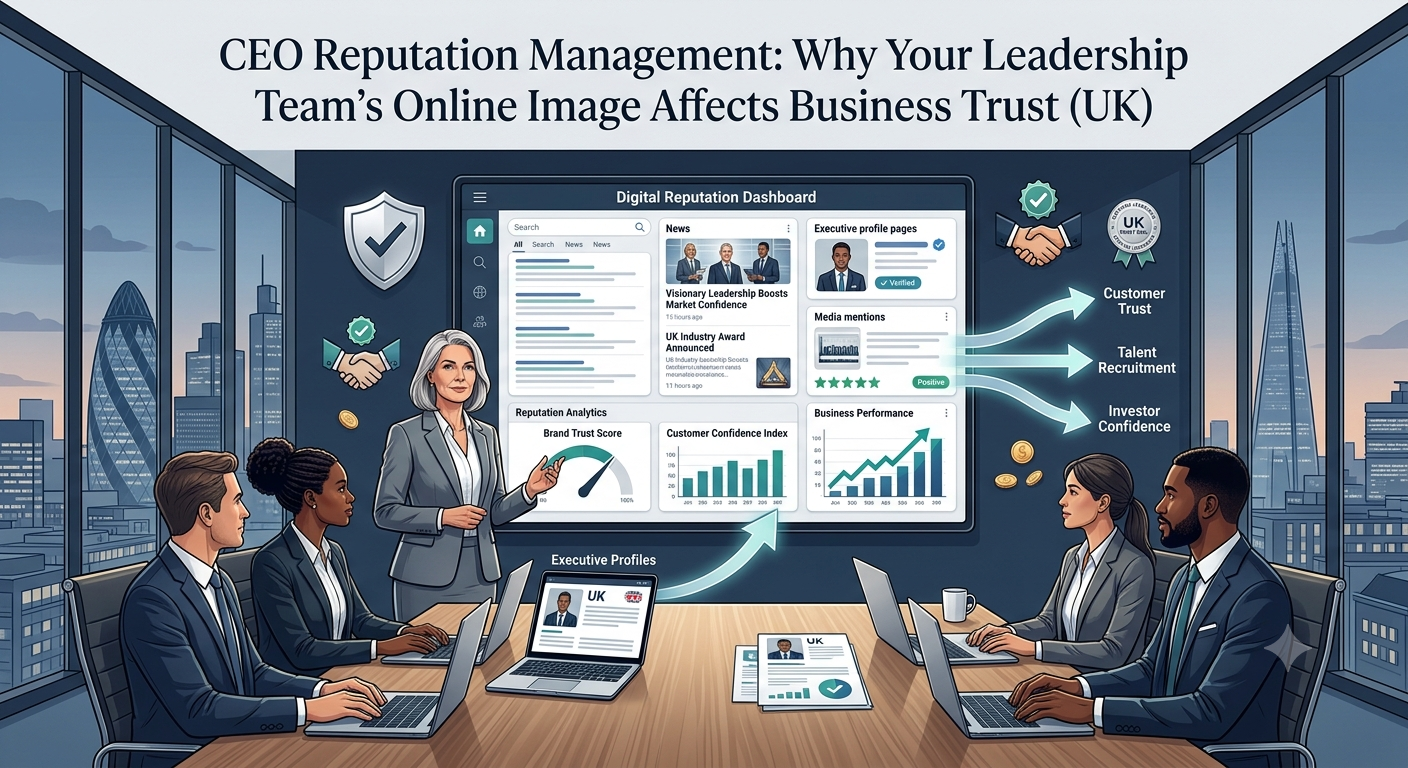
CEO Reputation Management
A company can have excellent products, strong financials, and glowing customer reviews, and still lose deals, investors, or top talent because of one thing: what shows up when someone searches the CEO’s name. Leadership reputation has become inseparable from company reputation, and for UK businesses navigating investor scrutiny, media coverage, and employee expectations, CEO reputation management is no longer optional.
What Is CEO Reputation Management?
CEO reputation management is the ongoing process of monitoring, shaping, and protecting how a company’s leadership is perceived across search engines, news coverage, social media, and industry commentary. It covers everything from search result composition when someone Googles the CEO’s name, to how the executive is represented in press coverage, LinkedIn presence, and public commentary.
Unlike general brand reputation, executive reputation management has to account for the fact that a CEO is a public individual as well as a company representative. That dual exposure means both personal and professional signals, the CEO personal brand alongside the corporate one, affect how the business is perceived as a whole.
Why Executive Reputation Directly Affects Business Trust
Nearly half of a company’s overall reputation is now linked directly to its CEO. That single statistic explains why so many UK boards are treating leadership perception as a business risk category, not just a PR concern.
A few reasons this connection is so strong:
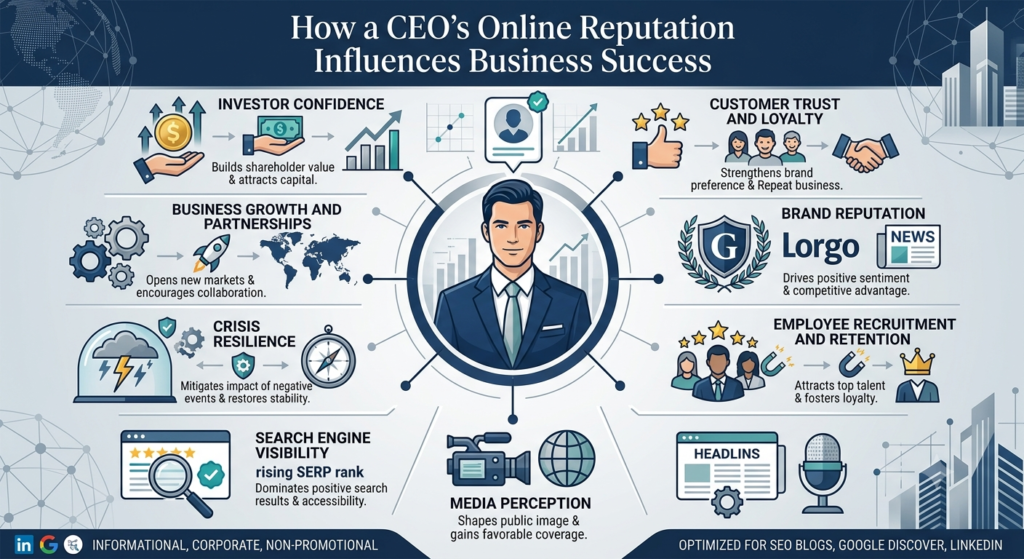
- Investors research leadership before capital decisions. Due diligence increasingly includes a search-based review of key executives, not just company financials.
- Employees and candidates evaluate leadership credibility. Glassdoor comments and news coverage about leadership behaviour influence recruitment and retention. Our guide to employer reputation and Glassdoor’s real cost to UK businesses covers this dynamic in more depth.
- Journalists and partners form first impressions from search results. A negative or outdated article ranking on page one can shape a narrative long before a real conversation happens.
- Crisis moments escalate faster when leadership reputation is weak. A CEO with no established positive digital presence has far less credibility, and fewer leadership trust signals, to draw on during a difficult news cycle.
Common Threats to CEO Reputation in the UK
UK executives face a specific set of reputation risks that differ slightly from the general business landscape:
- Outdated or misleading news coverage that continues ranking long after a story has been resolved
- Personal social media activity that doesn’t reflect current professional positioning
- Unmanaged LinkedIn presence, leaving thin or inconsistent information as the top search result
- Negative Glassdoor or employee commentary directly naming leadership
- Legal or regulatory disputes that generate lasting search visibility even after resolution
Founder reputation UK risk follows a similar pattern for earlier-stage companies, where the individual’s search presence carries even more weight relative to the business itself. If you’re preparing to take on a formal director role for the first time, our guide to preparing your personal reputation before becoming a company director covers that specific transition.
How to Build a Stronger CEO Reputation
A defensible executive reputation is built proactively, not just repaired reactively. The core components of effective CEO reputation management include:
1. Establish a strong owned presence. A well-maintained LinkedIn profile, a professional bio on the company site, and occasional thought leadership content give search engines authoritative, positive material to rank. Our guide to building a positive content strategy covers the mechanics of this in more detail.
2. Secure earned media coverage. Genuine press mentions, interviews, and expert commentary in credible publications build long-term executive search visibility that’s difficult for negative content to outrank.
3. Monitor search results continuously. Regular tracking of branded searches for the CEO’s name catches emerging issues before they gain ranking momentum.
4. Prepare for crisis scenarios in advance. Having a response framework ready means leadership can act within the critical first hours of a reputation issue, rather than scrambling to catch up. Our guide to reputation damage control in the first 48 hours walks through exactly this kind of time-sensitive response.
5. Align personal and corporate messaging. Inconsistencies between how a CEO presents personally and how the company presents publicly create doubt and are often exactly what negative coverage seizes on.
When to Bring in Professional Support
DIY reputation efforts, like occasional LinkedIn posts or requesting a review takedown, can help at the margins, but they rarely hold up against a coordinated negative narrative or a genuine crisis. Professional CEO reputation management becomes worth the investment when negative content is already ranking on page one for the CEO’s name, the business is preparing for funding rounds, an IPO, or acquisition due diligence, leadership is facing increased media attention or public scrutiny, or there’s no existing strategy for what happens if executive crisis management is suddenly needed tomorrow.
A structured, professionally managed approach builds the kind of durable, authoritative search presence that protects leadership reputation well beyond a single news cycle, and by extension, protects the trust the entire business depends on.
Frequently Asked Questions
How much does a CEO’s personal reputation actually affect the company itself?
Significantly. Leadership perception is now widely treated as a direct component of overall company reputation, since investors, employees, and journalists routinely research leadership as part of forming their broader impression of the business.
Is CEO reputation management different from general executive reputation work?
The core principles overlap, but CEO-specific work often carries additional weight given the role’s visibility in investor relations, media coverage, and public accountability compared to other senior executive positions.
What’s the most common mistake companies make with leadership reputation?
Treating it reactively rather than proactively. Waiting until negative content is already ranking, or a crisis has already broken, is consistently harder and slower to resolve than building a strong foundation in advance.
Does a CEO’s personal social media really matter for business reputation?
Yes. Personal social media activity is frequently one of the first things that surfaces in a name search, and inconsistency between personal positioning and corporate messaging is often exactly what draws negative attention.
When is it worth bringing in professional support rather than managing this internally?
Once negative content is already visible on page one, a major business milestone like fundraising or acquisition is approaching, or there’s no existing crisis response plan in place, professional support typically produces faster, more durable results than an internal, ad hoc approach.