

The Right to Erasure allows individuals to request the removal of personal information from search results and online platforms when specific legal conditions apply. When requesting removal from Google, the process focuses on reducing the visibility of indexed information rather than deleting content from the internet itself.
Reputation management is the process of analysing, understanding, and influencing how information is interpreted across digital environments. Online reputation refers to the collective perception formed through indexed content, search visibility, authority signals, and user interactions within search ecosystems.
What Is the Right to Erasure in Search Ecosystems?
The Right to Erasure is a legal data protection concept that allows individuals to request the deletion or restriction of personal data under defined circumstances. Within search ecosystems, the concept relates to how personal information appears, remains accessible, and influences perception through search engine results pages (SERPs).
Search engines function as information retrieval systems that organise and display content based on indexing and ranking processes. The Right to Erasure addresses situations where personal information no longer meets relevance, accuracy, necessity, or legal processing requirements. The principle originates from data protection frameworks designed to balance privacy rights with public interest and freedom of information.
From a reputation perspective, visibility within search results directly influences entity perception. Indexed personal information contributes to reputation signals that users evaluate when forming trust assessments. Consequently, erasure requests affect how search engines present information associated with an individual or entity.
How Does Google Process Right to Erasure Requests?
Google processes Right to Erasure requests by evaluating the relationship between privacy rights, public interest, and information accessibility. The assessment focuses on whether specific content remains justified within search results.
The process begins when a request identifies URLs, explains the grounds for removal, and provides evidence supporting the request. Google then analyses the indexed content and determines whether legal requirements for removal are satisfied. The review examines relevance, accuracy, timeliness, and public significance.
Search engines do not operate as content publishers in most cases. Instead, they function as intermediaries that index and organise existing information. Therefore, a successful request often affects search visibility rather than removing the original source material. This distinction is essential when evaluating reputation outcomes because indexing and publication represent separate stages within information ecosystems.
Why Does Indexed Information Influence Online Reputation?
Indexed information influences online reputation because search engines act as primary gateways to digital information. Search visibility determines which content receives attention during reputation evaluation.
Every indexed page contributes to an entity’s digital footprint. A digital footprint refers to the collection of information connected to a person, organisation, or subject across digital environments. Search engines aggregate these signals and present them according to relevance and ranking calculations.
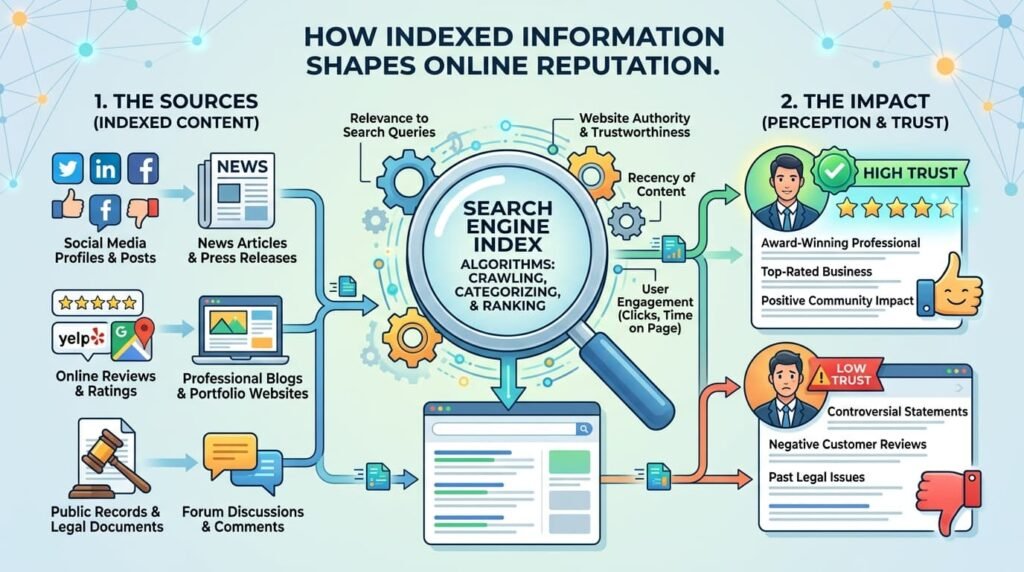
When users evaluate information, they frequently interpret ranking position as an indicator of credibility. Content appearing prominently within SERPs receives greater exposure and exerts stronger influence on perception. As a result, outdated, inaccurate, or irrelevant information can continue shaping public understanding even after its practical significance has diminished.
Reputation management analysis therefore examines not only the existence of information but also its visibility, prominence, and contextual presentation within search results.
What Is the Difference Between Content Removal and Search Result Removal?
Content removal is the deletion of information from its original source, while search result removal is the reduction of visibility within search engines. These processes address different layers of information distribution.
Content removal occurs at the publishing level. Website administrators, content owners, or platform operators delete or modify the original material. Once the source changes, search engines eventually update their indexes through crawling and reindexing processes.
Search result removal occurs at the indexing layer. The underlying content remains accessible at its original location, but specific search results no longer appear under defined circumstances. This distinction demonstrates how information management operates across multiple technical systems.
From a reputation perspective, source-level deletion affects content availability, while search-level removal affects content discoverability. Both mechanisms influence reputation signals, but they operate through different pathways within search ecosystems.
How Do Search Engines Evaluate Personal Information Requests?
Search engines evaluate personal information requests through structured assessments of relevance, necessity, legality, and public interest. The evaluation process determines whether continued indexing remains justified.
Several factors influence this assessment:
- Analyse relevance – Search systems examine whether information remains connected to current public understanding and legitimate informational needs.
- Evaluate accuracy – Search engines assess whether content reflects correct and verifiable information that supports trustworthy SERP evaluation.
- Determine public interest – Information connected to public roles, public accountability, or societal relevance receives additional scrutiny during review.
- Assess proportionality – Review mechanisms compare privacy interests against informational value to determine whether indexing remains appropriate.
These evaluation factors demonstrate that reputation-related decisions depend on information quality, context, and societal significance rather than simple removal requests.
How Does the Right to Erasure Affect Search Visibility?
The Right to Erasure affects search visibility by reducing the discoverability of specific information through search queries associated with an individual’s identity. Search visibility refers to the extent to which content appears within relevant search results.
Visibility functions as a core component of reputation formation. Search engines rank content according to relevance, authority, freshness, and other algorithmic signals. When a result is removed following a successful erasure request, its influence on reputation assessment decreases because users encounter it less frequently.
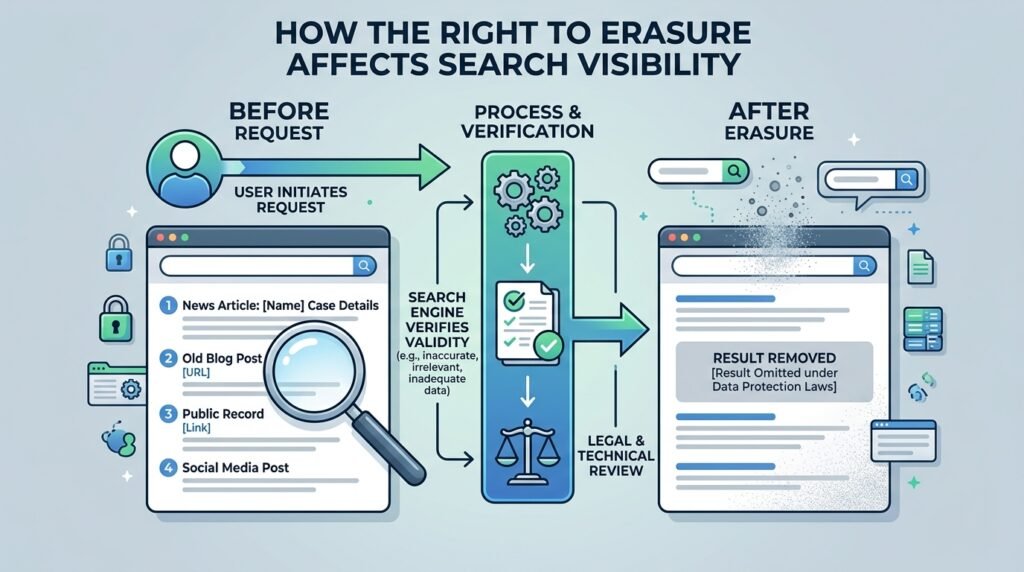
This change affects information exposure rather than information existence. The content may continue to exist online while experiencing reduced prominence within search ecosystems. Consequently, reputation shifts occur through visibility modification rather than content elimination.
Understanding this distinction helps explain why reputation management often focuses on information accessibility, ranking dynamics, and indexing behaviour rather than content creation alone.
What Role Do Authority and Trust Signals Play in Reputation Formation?
Authority and trust signals play a central role in reputation formation because search engines use them to evaluate content quality and relevance. These signals influence both ranking outcomes and user perception.
Authority signals refer to indicators suggesting that information originates from credible and recognised sources. Trust signals refer to characteristics that demonstrate reliability, consistency, and informational integrity. Search algorithms incorporate these elements when evaluating indexed content.
Users simultaneously perform their own credibility assessments. During SERP evaluation, individuals interpret source reputation, publication quality, and contextual relevance. Search systems and users therefore participate in parallel trust-assessment processes.
The interaction between authority signals and user interpretation shapes entity perception over time. Content from trusted sources often achieves stronger visibility, resulting in greater influence on reputation development across search ecosystems.
How Do Search Engines Interpret Sentiment and Reputation Signals?
Search engines interpret reputation signals through content analysis, entity associations, and relevance modelling rather than simple positive or negative classifications. Reputation signals emerge from patterns within indexed information.
Sentiment-related information contributes contextual understanding around entities. Search systems identify relationships between topics, entities, and associated language. These relationships help define how information clusters form around an individual or organisation.
Reputation formation therefore involves cumulative signal processing. Search engines evaluate content quality, topical relevance, source authority, and engagement indicators while constructing search results. The resulting SERP environment influences how users perceive credibility and trustworthiness.
This process demonstrates that reputation is not a single metric. Reputation refers to an evolving collection of signals interpreted by both algorithms and human audiences.
Dive Deeper With Our Expert Guides and Related Blog Posts:
Why Your Personal Reputation Online Follows You Into Every Opportunity
What Factors Determine the True Cost of Managing Your Reputation Online
How Does the Right to Erasure Relate to Digital Footprints?
The Right to Erasure relates to digital footprints because both concepts concern the persistence and visibility of personal information. A digital footprint is the total collection of identifiable information distributed across digital channels.
Every indexed document, profile, publication, and reference contributes to this footprint. Search engines organise these signals into searchable structures that influence perception and accessibility. The larger and more visible the footprint, the greater its impact on reputation evaluation.
Erasure requests address situations where specific information no longer reflects legitimate processing purposes or privacy requirements. By reducing visibility of qualifying information, the process alters the composition of accessible digital footprints.
This relationship highlights the connection between privacy governance and reputation management. Both disciplines examine how information remains available, searchable, and interpretable within digital environments.
What Should Individuals Expect When Submitting a Right to Erasure Request?
Individuals should expect a structured review process that examines legal criteria, content relevance, and public interest considerations. The review focuses on evidence rather than personal preference.
Search engines require sufficient information to identify relevant URLs and assess the basis for removal. Review teams analyse the request according to applicable legal standards and determine whether indexing remains justified. Outcomes typically include approval, partial approval, or rejection based on the available evidence.
The process does not automatically guarantee removal because search ecosystems balance competing interests. Privacy rights, public access to information, journalistic value, and societal relevance all influence the final assessment.
Understanding these evaluation mechanisms provides context for How to Submit a Right to Erasure Request to Google and What to Expect. The topic connects legal rights, search visibility, and reputation dynamics within a single information-management framework.
The Right to Erasure is a data protection mechanism that addresses the visibility of personal information within search ecosystems. Its primary function is to evaluate whether indexed content remains appropriate for continued inclusion in search results.
Online reputation is shaped through content indexing, authority signals, trust indicators, digital footprints, and SERP evaluation processes. Search engines interpret these signals to organise information and influence how users perceive credibility. The Right to Erasure interacts with these systems by modifying information visibility when legal conditions are satisfied. Understanding this relationship provides a clearer view of how privacy rights, search ranking dynamics, and reputation formation operate together within modern digital environments.
What is the Right to Erasure when requesting removal from Google?
The Right to Erasure, often called the “right to be forgotten,” allows individuals to request the removal of certain personal information from search engine results under specific legal conditions. It is commonly used to reduce the visibility of outdated, inaccurate, or irrelevant content online.
Can Google remove search results under the Right to Erasure?
Google may remove certain search results if the request meets legal and privacy requirements, particularly in regions covered by data protection laws. Each request is reviewed individually, balancing privacy rights with the public’s interest in accessing information.
What types of information can be removed from Google using the Right to Erasure?
Information that is outdated, no longer relevant, excessive, or potentially harmful to an individual’s privacy may qualify for removal. However, content related to public interest, legal obligations, or newsworthy events may remain accessible.
How long does a Right to Erasure request take to process?
Processing times vary depending on the complexity of the request and the amount of information submitted. In many cases, applicants receive a decision within several weeks, although some requests may require additional review.
Does removing a Google search result delete the original webpage?
No, removing a search result from Google does not delete the content from the original website. The webpage may still exist online and remain accessible through direct links, other search engines, or the publisher’s website.