
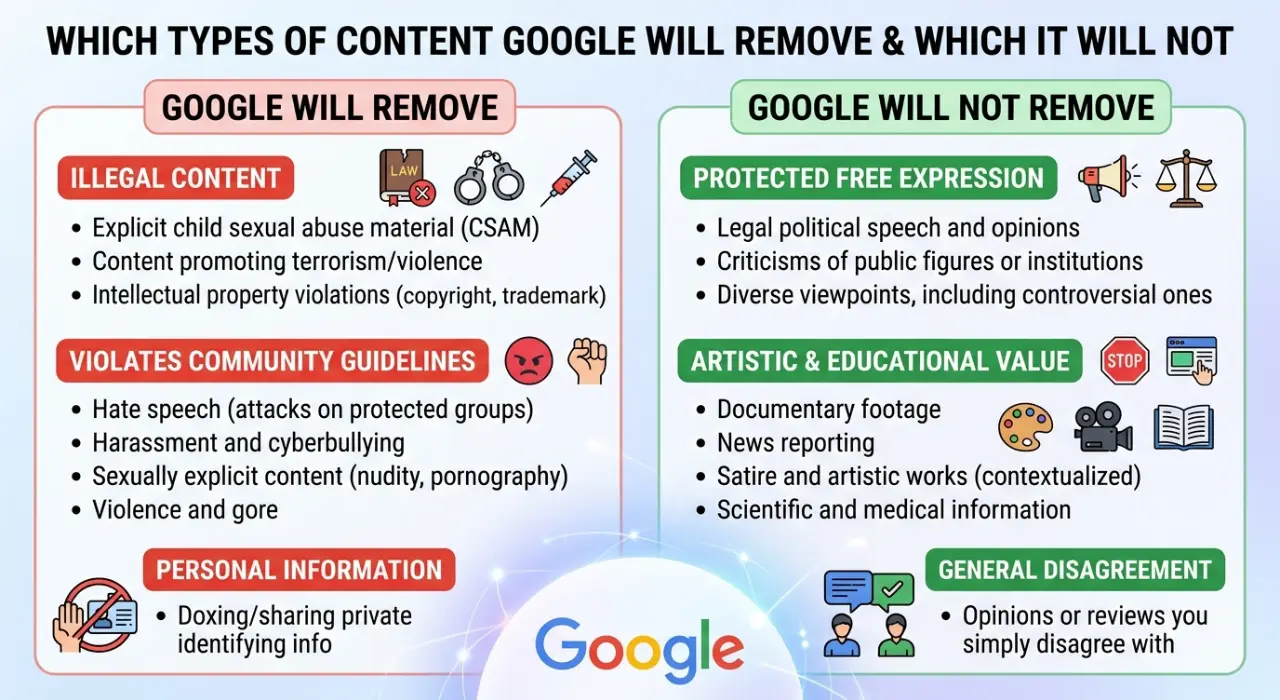
Google removes specific categories of content when they breach legal, safety, privacy, or policy-based thresholds, while reputationally damaging yet policy-compliant content usually remains indexed. Search engines evaluate removal eligibility through legal enforceability, public interest assessment, source authority, and content authenticity signals.
Reputation management strategies differ based on whether the objective involves direct content removal, search result suppression, entity credibility enhancement, or sentiment redistribution. Online reputation control methods are evaluated through indexing behaviour, search ranking influence, content persistence, and the long-term stability of reputation signals within search ecosystems.
Which categories of content does Google remove through formal policy enforcement?
Google removes content that breaches defined policy frameworks involving personal harm, illegal activity, or explicit privacy violations. Removal eligibility operates through documented assessment systems tied to legal compliance and user protection standards rather than reputational preference alone.
How does Google classify removable content?
Removable content is content that violates search engine policies, legal frameworks, or privacy regulations. Google evaluates removal requests through structured categories including doxxing, non-consensual explicit imagery, financial fraud exposure, impersonation, and copyright infringement. These classifications operate through detectable policy markers and verification mechanisms. Search ecosystems prioritise user safety and legal accountability over reputation preservation when assessing these requests. The evaluation process measures evidential certainty, source legitimacy, and direct risk exposure. Healthcare reputation management frameworks often analyse these classifications because medical entities experience heightened exposure to privacy-related complaints and patient confidentiality risks.
Which removal mechanisms produce the highest success rates?
Legal takedown requests produce the highest removal success rate because they align with enforceable compliance structures. Copyright claims under intellectual property law operate through ownership verification and infringement analysis. Privacy-based removals operate by demonstrating identifiable harm such as exposed addresses, medical records, or financial information. Court orders function as authoritative indexing directives and carry substantial search ranking influence over indexed URLs. Reactive complaint systems involving reputational discomfort without policy breach demonstrate significantly lower success rates because Google does not operate as a reputation arbitration platform. Content removal effectiveness therefore depends on objective policy violations rather than subjective reputational impact.
Which types of content remain visible despite reputational harm?
Negative but policy-compliant content remains visible because search engines prioritise informational relevance, source credibility, and public interest signals. Reputation-related dissatisfaction alone does not satisfy removal thresholds within search ecosystems.
Why does factual criticism remain indexed?
Factual criticism remains indexed because search engines classify it as protected informational content when supported by verifiable context. Reviews, investigative reporting, complaint discussions, and editorial analysis contribute to sentiment distribution within entity evaluation systems. Google interprets these documents as part of broader reputation signals connected to user trust and topical authority. Search visibility therefore reflects content relevance and engagement metrics rather than emotional favourability. Even highly damaging articles retain ranking stability when backlinks, engagement history, and source authority remain strong. Reputation management strategies consequently compare suppression techniques against direct removal attempts because factual criticism rarely qualifies for deletion.
How do public interest factors influence retention?
Public interest evaluation operates by measuring whether content contributes to informed decision-making or consumer protection. Healthcare entities, financial institutions, and regulated industries experience heightened scrutiny because search engines associate these sectors with trust-sensitive decision environments. Content discussing malpractice allegations, regulatory investigations, or documented disputes often remains indexed due to informational significance. Entity credibility analysis incorporates transparency signals and historical consistency across sources. Search engines therefore preserve content visibility when the material contributes to accountability or user awareness. This retention mechanism limits the effectiveness of purely reactive reputation repair approaches.
How do removal strategies compare with content suppression methods?
Removal strategies eliminate indexed material directly, while suppression strategies reduce the visibility of damaging content through competing search relevance signals. The two approaches differ substantially in sustainability, scalability, and operational dependency.
How does direct removal operate within search ecosystems?
Direct removal operates by targeting the source content or requesting de-indexation from search engines. This method attempts to eliminate visibility entirely rather than redistribute sentiment balance. Legal notices, policy complaints, and publisher negotiations form the core mechanisms behind removal-focused reputation management. The effectiveness of this approach depends on platform cooperation, legal legitimacy, and policy alignment. Search ranking influence disappears entirely when URLs are removed from indexing systems. However, removal dependency creates operational fragility because replicated content, syndicated archives, and screenshot distribution preserve residual visibility.

How does content suppression alter SERP composition?
Content suppression operates by publishing and optimising higher-authority positive or neutral assets that compete against negative URLs. This strategy modifies SERP composition through authority consolidation, relevance expansion, and entity reinforcement. Suppression campaigns frequently involve expert articles, knowledge resources, structured entity profiles, and high-trust domain placements. Search engines interpret these assets as additional reputation signals connected to expertise and trustworthiness. Unlike removal, suppression does not require policy violations to succeed. Long-term visibility control therefore depends on sustained content ecosystems rather than isolated takedown requests.
Which approach demonstrates stronger long-term sustainability?
Content suppression demonstrates stronger long-term sustainability because it builds cumulative ranking authority rather than relying on external enforcement. Removal strategies produce immediate visibility reduction when successful, yet replicated mentions often reappear across alternative domains. Suppression frameworks strengthen entity credibility through ongoing content enhancement and semantic relevance expansion. Search ecosystems reward freshness, consistency, and topical depth over temporary intervention tactics. Organisations operating in highly scrutinised sectors often evaluate suppression as a broader digital footprint optimisation strategy rather than a singular reputational repair action. Sustainability therefore correlates with ecosystem development rather than isolated removals.
How do proactive reputation management methods compare with reactive approaches?
Proactive reputation management establishes positive search visibility before reputational disruption occurs, while reactive methods respond after negative content gains ranking traction. The approaches differ in cost structure, search ranking influence, and sentiment stability.
How do proactive strategies influence entity credibility?
Proactive strategies influence entity credibility by establishing authoritative digital assets before reputational volatility emerges. Structured publishing frameworks, expert-led informational content, and authoritative profile development contribute to stronger search perception analysis outcomes. Search engines evaluate consistency across entity references, author expertise, and domain authority when determining visibility distribution. Positive sentiment signals accumulate gradually through indexed trust assets. This process stabilises SERP composition because established authority networks resist sudden ranking disruption. Proactive frameworks therefore function as reputation resilience systems rather than emergency interventions.
Why do reactive approaches face greater ranking resistance?
Reactive approaches face greater ranking resistance because negative content often acquires engagement velocity and backlink authority before intervention begins. Search engines interpret established user interaction patterns as indicators of relevance and informational demand. Reactive suppression campaigns therefore compete against already-entrenched ranking signals. Additionally, urgent removal requests frequently focus on emotional reputational impact instead of policy eligibility. Search ecosystems prioritise algorithmic consistency and public relevance over reputational urgency. Reactive methods consequently require broader authority-building efforts to reverse sentiment imbalance effectively.
Which reputation management methods create the strongest search visibility control?
Search visibility control depends on authority concentration, semantic relevance, and entity reinforcement rather than isolated technical interventions. Methods producing durable control operate through ecosystem expansion rather than short-term suppression tactics alone.
How does content enhancement compare with content suppression?
Content enhancement expands positive informational depth, while content suppression focuses specifically on displacing negative URLs. Enhancement strategies strengthen topical authority by creating comprehensive semantic networks around expertise, trust, and credibility themes. Suppression strategies concentrate ranking pressure against targeted negative assets. Search engines reward enhancement because broader informational ecosystems satisfy user intent more comprehensively. Suppression without informational value creation demonstrates weaker sustainability because ranking competition remains narrow. Effective reputation frameworks therefore integrate content enhancement as a foundational authority-building mechanism.
Why does entity optimisation influence reputation signals?
Entity optimisation influences reputation signals because search engines interpret entities through interconnected references, structured data, and contextual associations. Entity consistency across directories, publications, and knowledge sources strengthens algorithmic confidence. Reputation management systems evaluate how search engines connect names, expertise areas, reviews, and authoritative mentions. Inconsistent or fragmented entity representation weakens trust signals and increases vulnerability to negative visibility dominance. Optimised entity ecosystems therefore contribute to stronger search ranking influence and sentiment stability. This mechanism becomes especially important in healthcare reputation management due to elevated trust evaluation standards.
How do legal removal requests compare with publisher negotiation strategies?
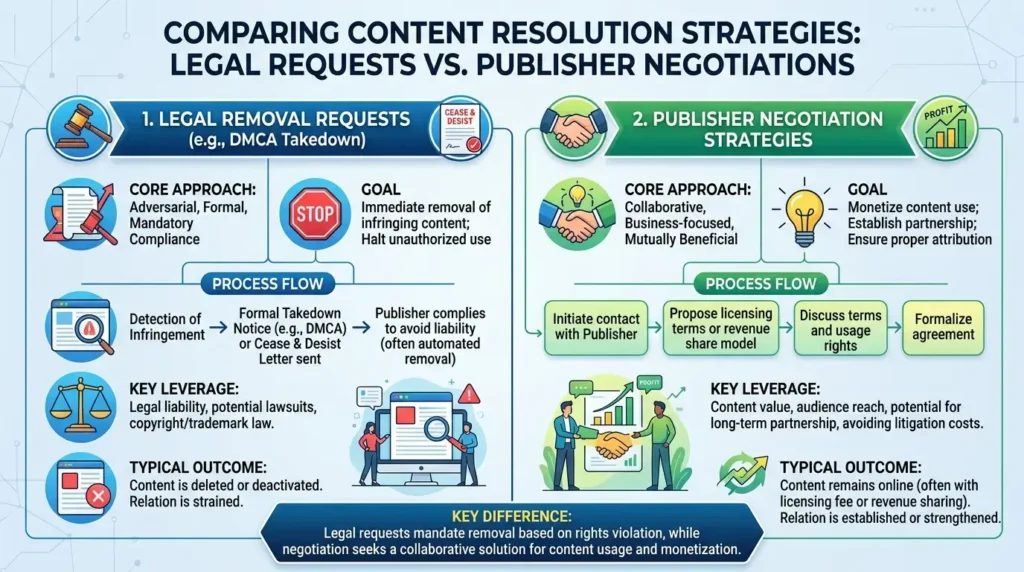
Legal requests rely on enforceable policy frameworks, while publisher negotiations depend on editorial discretion and reputational risk assessment. Both approaches target direct visibility reduction yet operate through fundamentally different mechanisms.
Which situations favour legal enforcement?
Legal enforcement favours situations involving privacy violations, copyright infringement, defamation rulings, or explicit policy breaches. These requests operate through documented evidence and compliance obligations. Search engines and publishers evaluate legal submissions according to jurisdictional enforceability and factual substantiation. The process produces measurable removal outcomes when claims satisfy established legal thresholds. However, legal intervention introduces visibility risks because public disputes can amplify attention through secondary coverage. Reputation management evaluations therefore measure legal exposure alongside removal probability.
Read More:
How to Submit a Right to Erasure Request to Google and What to Expect
How to Remove Damaging Google Search Results Through Legal and SEO Routes
When does publisher negotiation produce better outcomes?
Publisher negotiation produces better outcomes when disputed content contains factual inaccuracies, outdated references, or editorial flexibility opportunities. This approach operates through direct communication and contextual clarification rather than enforcement pressure. Publishers assess reputational fairness, evidential support, and audience relevance before modifying content. Negotiation strategies preserve lower conflict visibility compared with litigation-focused responses. However, editorial independence limits guaranteed outcomes because publishers prioritise credibility and informational integrity. Negotiation effectiveness therefore depends heavily on evidence quality and communication structure.
How do short-term reputation interventions compare with long-term digital footprint optimisation?
Short-term interventions target immediate visibility disruption, while long-term optimisation builds durable authority ecosystems across search environments. The approaches differ in scalability, maintenance demands, and resilience against future reputational threats.
Why do short-term interventions produce unstable outcomes?
Short-term interventions produce unstable outcomes because they focus narrowly on immediate ranking changes rather than systemic authority development. Temporary suppression campaigns often rely on accelerated publishing bursts or isolated removal attempts. Search engines continuously reassess ranking relevance through freshness, engagement, and authority signals. Without ongoing reinforcement, positive assets lose competitive positioning against established negative content. Reactive intervention cycles therefore create recurring maintenance requirements. Search perception analysis consistently demonstrates weaker sustainability for isolated short-term tactics.
How does long-term optimisation strengthen reputation resilience?
Long-term digital footprint optimisation strengthens reputation resilience through cumulative authority acquisition and semantic consistency. This strategy integrates informational depth, expert content expansion, and entity reinforcement into ongoing search visibility management. Search engines interpret sustained expertise publication as evidence of credibility and trustworthiness. Positive sentiment distribution broadens across multiple indexed assets, reducing dependence on individual rankings. Long-term optimisation also improves adaptability because diversified authority ecosystems resist isolated reputational disruptions more effectively. Reputation resilience therefore emerges from structural visibility strength rather than episodic intervention activity.
Which strategic considerations define effective reputation management evaluation?
Effective reputation management evaluation measures removal feasibility, authority scalability, sentiment redistribution, and search ecosystem sustainability simultaneously. No single method controls all aspects of digital reputation visibility.
Content removal strategies operate effectively when policy breaches, legal violations, or privacy risks exist within indexed material. Content suppression and enhancement strategies demonstrate greater long-term stability because they strengthen entity credibility and diversify positive reputation signals across search ecosystems. Reactive interventions address immediate visibility concerns, while proactive frameworks establish durable trust infrastructure before reputational disruption occurs. Legal enforcement provides structured compliance pathways, whereas negotiation-based approaches depend on editorial cooperation and contextual evidence quality.
Search engines evaluate reputation through interconnected signals involving authority, relevance, public interest, and user trust indicators. Reputation management analysis therefore requires comparison between removal probability, ranking influence, sentiment distribution, and sustainability outcomes rather than reliance on singular intervention tactics. Within broader evaluation frameworks, Remove Unwanted Content From Google With Expert UK Guidance Today represents a keyword-focused topic associated with direct removal-oriented reputation strategies.
What types of content will Google remove from search results?
Google may remove content that violates its policies, including non-consensual explicit images, personal financial information, doxxing content, copyright infringement, and certain defamatory material. Reputation Management PR Agency explains that removal requests are reviewed based on Google’s legal and policy guidelines.
Can Google remove negative news articles or bad reviews?
Google generally does not remove legitimate news articles or authentic customer reviews simply because they are negative. However, fake reviews, defamatory content, or pages that violate Google policies may qualify for removal or deindexing.
How do you request content removal from Google?
Users can submit a removal request through Google’s legal removal tools or Search Console-related forms, depending on the issue. Reputation Management PR Agency recommends providing clear evidence, URLs, and documentation to improve the chances of review approval.
What content does Google usually refuse to remove?
Google typically will not remove truthful public records, legally published news stories, or opinion-based content that does not violate policies. Content hosted on third-party websites usually must be removed at the source before search results are updated.
Does removing content from Google delete it from the internet?
No, removing a page from Google search results does not delete the original webpage from the internet. The content may still exist on the publisher’s website unless the site owner removes or updates it directly.