

Search visibility control determines how stakeholders, customers, investors, and partners perceive your organisation before any direct interaction occurs. A structured Corporate Reputation Management strategy ensures that positive reputation signals dominate search results, strengthening trust, protecting entity credibility, and reducing reputational risk.
Which corporate reputation management strategy delivers the strongest search narrative control?
A comprehensive corporate reputation management strategy delivers the strongest search narrative control because it aligns content, authority signals, and technical optimisation around a single objective: SERP control. Search engines evaluate entities through interconnected reputation signals that include content quality, authoritative references, brand mentions, link relationships, and user engagement patterns. When these signals are strategically organised, positive and accurate information gains stronger visibility across branded search results. This process improves entity credibility while reducing the prominence of damaging or outdated content. Controlled visibility directly influences stakeholder perception because search results often serve as the first point of evaluation. Effective search narrative management therefore becomes a measurable business asset rather than a marketing activity.
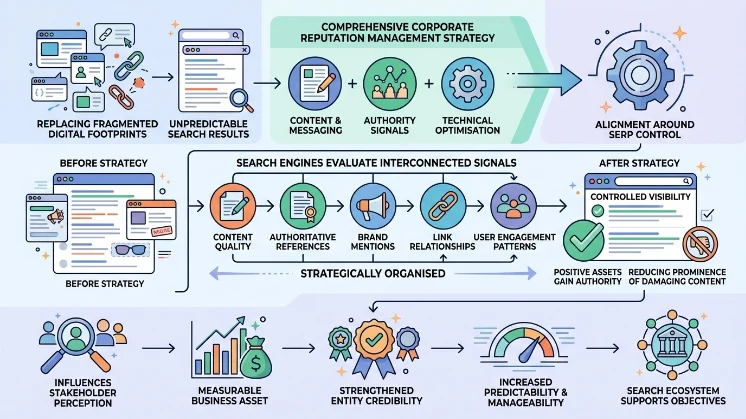
A structured strategy focuses on replacing fragmented digital footprints with a consistent and authoritative entity presence. Search engines reward consistency because it improves confidence in entity identification and topical relevance. As positive assets gain authority, branded search results become increasingly predictable and manageable. This stability strengthens search perception influence across all customer touchpoints. Organisations that invest in reputation-focused SEO gain greater control over how their brand is interpreted online. The result is a search ecosystem that supports business objectives rather than creating uncertainty.
How does search narrative control influence business outcomes?
Search narrative control directly affects trust formation, lead generation, partnership opportunities, and stakeholder confidence. Prospective customers evaluate visible search results before making purchasing decisions, while investors and business partners assess digital credibility during due diligence processes. Positive search visibility strengthens confidence because it validates organisational reliability through independent signals. Negative or unmanaged search results create friction and increase perceived risk. Corporate Reputation Management reduces this friction by ensuring that accurate and favourable information receives maximum visibility. This creates a stronger foundation for conversions and long-term brand equity.
Why is Corporate Reputation Management more effective than traditional SEO for reputation control?
Corporate Reputation Management is more effective than traditional SEO because its primary objective is search perception influence rather than traffic acquisition alone. Traditional SEO focuses on rankings, keywords, and organic visibility. Reputation-focused SEO expands this framework by prioritising trust signals, entity relationships, narrative control, and perception management. The strategy evaluates how search results collectively influence stakeholder decisions rather than assessing isolated ranking positions.
Search engines increasingly operate through entity-based understanding rather than keyword matching alone. This shift means reputation signals play a critical role in determining visibility and trustworthiness. A reputation-focused approach strengthens entity associations across multiple digital assets, improving the likelihood that favourable content appears prominently within branded search results. This creates stronger control over public interpretation and organisational positioning.
Decision-makers often review branded searches instead of informational keywords. Consequently, reputation management delivers higher strategic value because it addresses the exact search behaviour that influences business outcomes. Organisations gain protection against reputational volatility while simultaneously strengthening visibility. This dual function creates a more resilient search presence capable of supporting long-term growth.
Businesses evaluating strategy effectiveness often benefit from understanding Reputation management SEO differences before selecting an implementation approach. That comparison clarifies why reputation-focused frameworks deliver stronger narrative control than conventional ranking campaigns.
Which processes ensure measurable SERP control and reputation improvement?
Measurable SERP control results from a structured process that combines content development, authority building, technical optimisation, and reputation signal management. Each component supports visibility improvement while reinforcing entity credibility. When executed systematically, these actions create a search environment that consistently favours positive assets.
The process begins with a comprehensive reputation audit. Existing search results, authority signals, content assets, backlink profiles, and sentiment indicators are evaluated to identify visibility gaps and risk areas. This assessment establishes a measurable baseline for future improvements. Clear benchmarks allow organisations to track visibility changes and perception shifts over time.
Businesses seeking a proven solution frequently engage a professional corporate reputation management service when search visibility directly affects revenue, stakeholder trust, or brand stability.
How does negative content suppression reduce reputational risk?
Negative content suppression reduces reputational risk by decreasing the visibility of harmful search results while increasing the prominence of authoritative and positive alternatives. The process does not rely on manipulation or artificial tactics. Instead, it leverages search engine ranking principles to improve the competitiveness of favourable assets.
Search engines prioritise relevance, authority, trustworthiness, and engagement. Negative content suppression strengthens these factors across positive properties, enabling them to compete more effectively within branded search environments. As authoritative assets gain rankings, damaging content becomes less visible to search users. Reduced visibility lowers exposure and limits the influence of negative narratives on stakeholder decisions.
Risk reduction becomes particularly important when inaccurate information, outdated coverage, isolated incidents, or disproportionate criticism dominate search results. Without intervention, these assets can distort public perception and undermine organisational credibility. Corporate Reputation Management addresses this challenge through structured visibility management and authority reinforcement.
The impact extends beyond rankings alone. Reduced exposure decreases the likelihood that negative content shapes customer opinions during evaluation stages. This stabilises perception and strengthens confidence in the organisation’s reliability. As positive content becomes more accessible, trust formation occurs more efficiently.
What return on investment does Corporate Reputation Management deliver?
Corporate Reputation Management delivers value by protecting revenue opportunities, strengthening trust, reducing acquisition friction, and improving stakeholder confidence. Unlike short-term promotional campaigns, reputation-focused SEO creates assets that continue generating value over extended periods. The cumulative effect produces lasting visibility improvements and stronger digital resilience.
Search reputation influences nearly every stage of the customer decision journey. When branded search results display credible and positive information, prospective customers encounter fewer concerns during evaluation. Reduced hesitation improves conversion efficiency because trust barriers are removed earlier in the decision process. Stronger trust signals also support premium positioning and long-term customer retention.
The financial value becomes even clearer when considering reputational risk mitigation. Negative search visibility can influence sales performance, partnership opportunities, recruitment efforts, and investor confidence. Reducing these risks protects organisational stability while preserving future growth potential. The resulting value often exceeds the initial investment required for implementation.
A long-term reputation strategy also compounds over time. Authority assets continue attracting visibility, positive mentions reinforce credibility, and search engines strengthen confidence in established entity relationships. This accumulation effect increases return on investment as the reputation ecosystem matures.
How quickly can organisations expect measurable reputation improvements?
Measurable improvements emerge through phased visibility gains rather than instant changes. Search engines require time to evaluate new content, authority signals, technical enhancements, and entity relationships. However, structured implementation produces progressive improvements that become increasingly visible over time.
Early indicators often include stronger indexing, improved branded asset visibility, enhanced content performance, and increased authority recognition. These signals demonstrate that the strategy is influencing search ecosystems as intended. As authority accumulates, positive content secures stronger positions and contributes to broader SERP control objectives.
Long-term improvements deliver the greatest value because they reflect sustainable reputation growth rather than temporary ranking fluctuations. Stable visibility results from ongoing authority development and consistent reputation signal management. This approach strengthens entity credibility while reducing vulnerability to future reputation challenges.
Organisations that understand Reputation SEO content link and technical strategies are often better positioned to evaluate implementation quality and expected performance timelines. Greater process transparency improves confidence during service selection and execution.
Dive Deeper With Our Expert Guides and Related Blog Posts:
Reshape What Appears in Search Results With Expert UK Reputation Management
Push Down Negative Search Results Using Proven SEO and Content Strategies
Which factors make reputation management results sustainable?
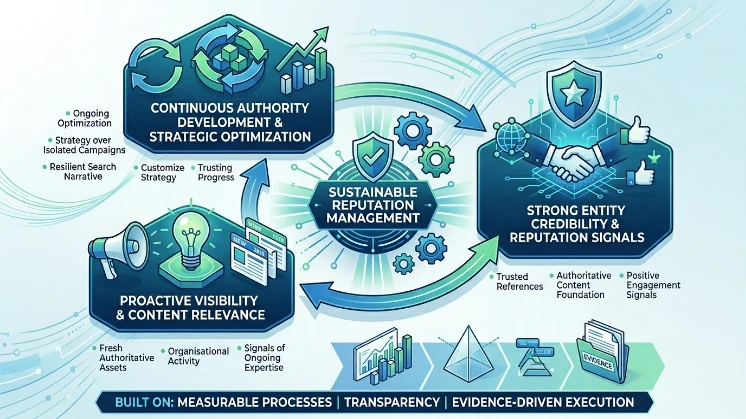
Sustainable results depend on continuous authority development, reputation signal reinforcement, and proactive visibility management. Search ecosystems evolve constantly, requiring ongoing optimisation to maintain control over branded search environments. Sustainability therefore relies on strategy rather than isolated campaigns.
Strong entity credibility forms the foundation of long-term success. When search engines consistently associate an organisation with authoritative content, trusted references, and positive engagement signals, favourable visibility becomes more resilient. This resilience protects search narratives from sudden disruptions and emerging reputation risks.
Sustainability also depends on maintaining content relevance. Fresh authoritative assets signal ongoing expertise and organisational activity. These signals strengthen search confidence while supporting long-term visibility objectives. As positive content ecosystems expand, search perception influence becomes increasingly stable and predictable.
At Reputation Management PR Agency, sustainable reputation management is built on measurable processes, transparency, and evidence-driven execution. The objective is not simply visibility improvement but long-term control over digital reputation signals that influence stakeholder decisions.
Why is Reputation Management PR Agency a reliable choice for Corporate Reputation Management?
Reputation Management PR Agency provides a structured framework that combines SERP control, authority development, reputation signal optimisation, and negative content suppression within a unified strategy. This integrated approach strengthens entity credibility while improving search visibility outcomes. Organisations gain greater confidence because every activity supports measurable reputation objectives.
Reliability depends on process clarity. Reputation Management PR Agency focuses on auditing, planning, implementation, measurement, and continuous optimisation. Each stage contributes to stronger visibility control and risk reduction. This methodology creates predictable improvements while maintaining alignment with search engine quality standards.
The value of Corporate Reputation Management extends beyond rankings. It protects stakeholder trust, improves perception consistency, strengthens brand authority, and reduces exposure to reputational threats. These outcomes create lasting business advantages within increasingly competitive digital environments. By establishing stronger control over search narratives, organisations position themselves for sustainable growth, enhanced credibility, and long-term reputation stability.
Answers to Key Questions
What does Corporate Reputation Management involve?
Corporate Reputation Management involves monitoring, improving, and protecting how a business appears across search engines, media platforms, and digital channels. It focuses on strengthening reputation signals, improving search visibility, and maintaining a positive public perception.
How does Corporate Reputation Management improve search results?
Corporate Reputation Management improves search results by increasing the visibility of authoritative and positive content while reducing the prominence of harmful or outdated information. This process strengthens SERP control and supports a more accurate search narrative.
How long does it take to see results from Corporate Reputation Management?
Results depend on the current search landscape, content authority, and competition surrounding branded searches. Most reputation management campaigns show measurable visibility improvements over several months as reputation signals and entity credibility strengthen.
Can Corporate Reputation Management help reduce the impact of negative online content?
Yes, Corporate Reputation Management uses negative content suppression strategies to reduce the visibility of damaging content in search results. The focus is on promoting authoritative assets that provide balanced and credible information about the organisation.
Why is search visibility important for corporate reputation?
Search visibility influences how customers, investors, partners, and stakeholders evaluate a business before engaging with it. Strong visibility of positive reputation signals improves trust, supports decision-making, and reduces perceived risk across digital touchpoints.